|
|
25 May 2004 @ 13:14, by bri_outten. Environment, Ecology
The celebrated environmentalist and visionairy James Lovelock wrote in an article in the 'Independant' newspaper on Monday 24th May that,
Unless civilisation takes the view that we must use the next most economical and politically acceptable form of power, ie nuclear, then society will face the greatest challenge yet seen to the survival of not just themselves, but of the natural world as well!
The future, he states, cannot wait as the evidence is now worse than predicted with the current evidence of the rate of icecap melting!
Personally I feel that this is a pramatic yet imperfect solution, with the potential of the possibilities of renewable power evident,and of ever increasing relevance, how can we be just giving it lip service??! More >
|
|
|
|
27 Apr 2004 @ 15:45, by raypows. Environment, Ecology
Global Population Decerease?
There is indeed a population shortfall trend developing in Western Europe, Russia and Japan. In Ireland, for instance, families have an average of 1.8 children today, slightly below the "replacement level" of two children per couple. Couples in Italy, Germany and Spain have just 1.2 to 1.3 children each. The average fertility rate in Europe is 1.45. Both Russia and Japan are at 1.3.
But it's simply not true that world population is shrinking, because these trends are overcompensated for by the very rapid population increases taking place in the world's poor and least-developed countries. According to the United Nations, population growth in less-developed countries is growing at an annual rate of 1.46 percent, nearly six times faster that the .25 percent growth taking place in the most heavily industrialized regions of the world.
We are currently adding 77 million people to the globe annually, with 21 percent of that increase coming from India, 12 percent from China and five percent from Pakistan. Three countries, Bangladesh, Nigeria and the United States each contribute four percent of the world's annual growth. In the U.S., where the average fertility rate was 2.05 in 2002, population growth is due largely to immigration.
From 6.3 billion people on the planet today, the United Nations projects we will grow to 8.9 billion by the year 2050. Half of that projected increase will occur in just eight countries, seven of them in Africa and Asia. It is interesting to consider that it took all of human history until 1800 for world population to reach its first billion; from there the second billion took only until 1930. Now, just 75 years later, we've passed the six billion mark.
Many environmentalists feel that human population growth is the most important environmental issue of all. The sheer number of people added to the planet each year easily erodes the "per capita" gains made by conservation measures. Globally, the population growth-induced accelerated loss of forestland results in a reduced ability for ecosystems to absorb the also-increasing carbon dioxide emissions that exacerbate global warming. Further, the expansion of human activity and associated loss of habitat are the leading causes of the unprecedented extinctions of plant and animal species worldwide.
In the United States, we lose two acres of farmland every minute, according to the American Farmland Trust, and a serious water shortage is developing nationwide, with aquifers once considered inexhaustible now drying up. In poor countries, population growth exacts its toll in the form of abject poverty and chronic food and water scarcity. More >
|
|
|
|
  11 Mar 2004 @ 21:13, by magical_melody. Environment, Ecology 11 Mar 2004 @ 21:13, by magical_melody. Environment, Ecology
See What You Can Do!!!
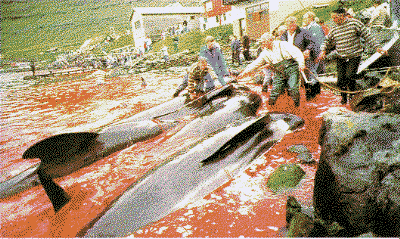
Stop Whaling in Japan, Iceland, and Faroe Islands.
Read the couple of reports here and see the actions you can take to stop this insanity! More >
|
|
|
|
2 Mar 2004 @ 21:39, by bushman. Environment, Ecology
When will we learn, to at least do it right, without destroying everything. How can they be stopped, if the people we gave the power to protect our resources and wildland habitats, are working for the companys that are doing the damage? Flippin insane abomination of the American way. Read about it here and weep.
[link] More >
|
|
|
|
 14 Feb 2004 @ 11:13, by jazzolog. Environment, Ecology 14 Feb 2004 @ 11:13, by jazzolog. Environment, Ecology
I have never waited for anything the way I've waited for today, when nothing will happen.
---Marguerite Duras
And the end of all our exploring will be to arrive where we started and know the place for the first time.
---T.S. Eliot
Approach it and there is no beginning; follow it and there is no end. You can't know it, but you can be it, at ease in your own life.
---Lao-Tzu
In the Woods, c.1900-04
Watercolor over pencil on paper
Paul Cezanne 1829 - 1906
A break in the weather and, while it's still cold outside (around 20 degrees Fahrenheit) here's a chance to restore and replenish. Southeast Ohio has been so wet this fall and winter, relieving a few years of drought conditions, that the ground is completely saturated. Any more rain or thaw after snowfall means flooding at once, so time at home has been used fortifying against the elements. Today is calm and rather bright so I was inspired, as the Valentine ladies laze about a bit this morning (plus Ilona's friend Tara who spent the night after the big Middle School dance) to get after a few chores. More >
|
|
|
|
 26 Dec 2003 @ 18:59, by magical_melody. Environment, Ecology 26 Dec 2003 @ 18:59, by magical_melody. Environment, Ecology
Photo taken of scene in Algeria. On the evening of the 21st of May in 2003, Algeria was stuck by its worst earthquake in 23 years. More than 2,000 people were killed and more than 9,000 injured. Many homes were destroyed in the initial quake and thousands more were damaged and made uninhabitable.
***********
--->>> Our Thursday (Christmas) evening in NZ (we are a day ahead) we were informed directly by Source within one of the most powerful channelings of my life, that a significant earth event was in process. Then a couple mornings later we were informed (our Saturday morning) there was a quake in Iran.
There have been a series of quakes - even one here on the North Island of NZ recently. There was the one in California just a few days ago, and now this one in Iran causing significant damage.
The earth is now moving into more of a profound process of release and these activities as we have been told, will be continuing throughout the world on a consistent basis now!! Please listen to your guidance daily so that you are attuned to where you need to be during these intense times of profound activity and change!!
Blessings to you, and to you a safe and abundant holiday season!
********************
Noteworthy Earthquakes of 2003: [link]
Earthquake Site - Listing of earthquakes around the world: [link] More >
|
|
|
|
26 Dec 2003 @ 12:45, by sharie. Environment, Ecology
Toxic Factory = A Healthy Economy ... Really?
When the Equation is clearly crazy, the formula needs to be altered, the factors... re-considered.
A Toxic Factory CANNOT result in a Healthy Economy.
The consequence of a Toxic Factory is a toxic environment and a poisoned population.
A poisoned population means the people are unable to contribute to the well-being of one another... this... results in an unhealthy economy, an impoverished way of life.
An exception to this is when Industrialists and their chemists poison a community, leaving the people dependent on more chemists and their chemicals (pharmaceutical companies) in order to survive. In which case, pharmaceutical company executives, their chemists, sales executives, and the doctors will get rich while the poor poisoned people die.
(Just thought I'd mention it.)
Joy to the World.
|
|
|
|
 9 Mar 2003 @ 19:02, by ming. Environment, Ecology 9 Mar 2003 @ 19:02, by ming. Environment, Ecology
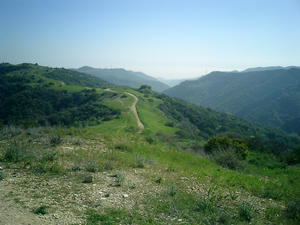
One of my favorite places to go for a walk is along Mulholland Drive. Mulholland runs along the ridge of the Santa Monica Mountains separating the Los Angeles basin from the San Fernando Valley, where I live. So, you're in the middle of the metropolis, but can still be in what is pretty much a wilderness. And most people stay down there in the smog, so you can even sometimes walk for a little bit without meeting anybody else. These pictures are some I took today. This one is pointed South, towards L.A. More >
|
|
|
|
 27 Dec 2002 @ 23:59, by ming. Environment, Ecology 27 Dec 2002 @ 23:59, by ming. Environment, Ecology
Evolution on this planet has gone through many steps towards developing gradually more complex creatures. There seems to be a fractal nature to evolution, where for example stages that microbes pass through in a small scale are later repeated at higher levels of complexity. Young life forms will often irresponsibly try to use up all available resources, and will act aggressively against their neighbors, but later on in the cycle, as they become more mature, the various players will negotiate mutually beneficial arrangements amongst each other. The microbes are in many ways ahead of us complex humans in terms of figuring out how different kinds of beings can live together in peace, to everybody's mutual benefit.
Even the most small and simple single celled organisms, bacteria, classified as monera, specialized themselves in amazing ways and organized themselves into complex social structures where they were supporting each other's existence. They specialized in breaking down different kinds of chemicals, and other bacteria would start using the chemicals the first produced, etc., forming a complete ecosystem. That was 1.7-3.7 billion years ago. These organisms then moved on to a higher level of cooperation. Multiple different kinds of creatures together formed a cell. These cells, which formed another kingdom called protista, were around a thousand times bigger than the monera. They were still single-celled, but we could say that they are multi-creatured, because they combine many previously separate creatures into one unit.
The protists, large multi-creatured cells, further evolved. At first they were prokariotes (before nucleus) and then they developed into eukariotes (cells with a nucleus). Eukariotes are now around a thousand times bigger than the prokariotes. Essentially they are very complex bacterial cooperatives, in many ways as complex as human cities, containing millions of specialized parts that would have been independent life forms in previous evolutionary steps. The nucleus of the cell is the information center, containing a DNA blueprint of how things are arranged.
Next step is that multiple nucleated cells combine into multi-celled creatures. And on and on to more and more complex multi-celled creatures, with more and more different specialized parts. Along the way death is invented, to make it easier to improve on the designs along the way, while recycling the old models.
Now, billions of years later, we humans have developed reflective intelligence, so we have the luxury of being able to sit and think about these things. But we are also rather ignorant about the complex social order that adds up to our existence. And we tend to be rather arrogant about it, even thinking that all these tiny creatures are nothing but a nuissance to us. Not realizing that our own bodies are amazingly complex cooperative organizations of billions of cells that each are complex organizations of millions of smaller specialized creatures. And all of it is pretty much working in perfect unison. And we humans tend to be so naive that we think that our conscious awareness is somehow in control of all of this, despite that we hardly understand it, and we mostly are totally unconscious of it.
Anyway, a question is what comes next, beyond us humans maturing into figuring out how we all can co-exist on the same planet. One quite logical thought would be that we all will arrange ourselves as components of a bigger organism of a higher order. That we'll be cells in the global brain, so to speak, and that humanity maybe will become conscious as a whole. Or, maybe other, more unexpected things will happen. Maybe parts of each of us will start cooperating with each other, and new kinds of life forms will emerge.
I'm no biologist. Better places to study some of this would be, for example the book Earth Dance - Living Systems in Evolution by Elisabet Sahtouris. More >
|
|
|
|
 18 Nov 2002 @ 22:24, by ming. Environment, Ecology 18 Nov 2002 @ 22:24, by ming. Environment, Ecology
"'Living Machines' are whole systems approaches to treating wastewater. They are solar-powered, accelerated versions of the water treatment facilities found in mature natural systems. Incorporating helpful microbes, plants, snails and fish into diverse, self-organizing and responsive communities, Living Machines are site-specific, biological solutions that re-route waste streams into resources." That is from this introduction. See companies like Ocean Arks or Living Machines that create ecologically sound ways of dealing with waste water, often better than any purely technological solution could accomplish. A lot of good stuff seems to be going on in the State of Vermont, with companies such as Ben & Jerry's leading the way. More >
|
|
<< Newer entries Page: 1 ... 9 10 11 12 13 Older entries >> |
|