New Civilization News - Category: Economics, Financing, Banking    
 Did God invent natural money?1 comment
7 Jan 2009 @ 15:36, by niphtrique. Economics, Financing, Banking
The answer may be yes! As the current financial system is in collapse, the threat of famine, war and complete chaos in the world becomes a real possibility. Mankind is in a difficult position because war can mean a near complete annihilation of mankind. Also nature is destroyed on a massive scale as rainforests are burned down, sees are overfished and chemicals are spread. It probably is not a coincidence that the end of times is predicted to be on december 21, 2012. The good news is that the end of times can also be a new beginning for earth and mankind.  More >

 Borrowing money to a beggar5 comments
picture11 Dec 2008 @ 14:29, by jhs. Economics, Financing, Banking
There is POSITIVE proof that the current economical philosophy is fundamentally flawed.

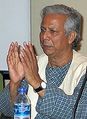
Its called Grameen Bank and its founder was Muhammad Yunus, Nobel Prize winner 2006 in Peace (NOT in Economy, someone please tell me why!).

I call this kind of proof POSITIVE because Yunus philosophy of borrowing to the poor without any collateral or guarantees at ultra-low rates is considered crazy by common adherents of today's economical structures and yet he achieved a stunning, irrefutable success, and thus a proof of concept beyond the complicated theories of the 'leaders' of today's system.

Recently he started to borrow money to beggars (the title of this little article is no joke!), and with this he is shifting even more the entire cultural concept of an entire country, Bangladesh, considered one of the poorest of the world,

But Bangladesh is a special country. 1999 it was ranked number one in the 'World Happiness Survey' [link] . Even though it is dubious how 'happiness' can really be measured with a survey, it still gives a strong hint.

Helo and I tried to talk to Muhammad Yunus at the recent ExpoManagement 2008 in São Paulo, but, surprise, surprise, we were not the only one, and I guess our connections are not good enough (yet) to skip a line like that in front of us.

Still, at an event at which even I if jumped into a business suit and decorating myself with a Delaveine cravate, no kidding, Muhammad Yunus just walked around smiling in some Bengalese clothes. Sometimes he appeared scared for a short moment when some sudden sharp noises were being heard, a bit as if he lived in fear of an assassination, but for the rest he was...  More >

 10,000 "uninsured" depositors of Indymac Bank0 comments
2 Dec 2008 @ 07:03, by gsmla. Economics, Financing, Banking
THE GOVERNMENT TRULY DOES NOT BELONG TO THE PEOPLE !!!!!!

I am a victim of the Indymac Bank Takeover.and I am now at a loss for a significant amount of my retirement savings.

As individuals we are being ignored by our government and the media.

How can the Federal government expect to restore consumer confidence if individual depositors are being robbed of their savings????....... No wonder that personal savings are at a historic low point.

The Federal government should take responsibility for not acting sooner to protect Indymac bank depositors.

The Treasury has a MORAL obligation to bail out the "uninsured" depositors of Indymac Bank. They should have acted sooner to protect the depositors.The majority were badly advised by Indymac bank and never notified that their funds were in jeopardy.

We are not people who made speculative investments - we are individuals who accepted lower returns on our money so we could feel protected by the federal government ....Now we are betrayed by the system.

Fat cats are getting billions 'bailout' funds while we ar left holding the bag.

WE ARE BEING SWEPT UNDER THE RUG !!!

LIVES HAVE BEEN RUINED,....and this terrible loss has been devastating to all involved.....We are living a nightmare.

I have found many internet postings from other depositors who were also deceived by Indymac bank..... all tragedies - College funds lost, retirements postponed, retirement nest eggs decimated, family homes in escrow now up in smoke..........broken dreams we have saved all our lives for.

I have literally spent nights on end looking for help, or even only recognition.

Major newspaper editors and reporters have cold heartedly ignored that we exist. We have no way of communicating with each other - we need a voice.

I would deeply appreciate all feedback !!!


----------------------------------------------------------------------------- Life

 Important Notice Of Change In Terms22 comments
picture1 Dec 2008 @ 11:01, by jazzolog. Economics, Financing, Banking
In mountain light, all sounds
return to silence.
All that remains, the temple
bell.

---Ch'ang Chien

Unexpectedly you find it, welling upwards in the empty tree.

---Rainer Maria Rilke

The meadows were a-drinking at their leisure; the frogs sat meditating, all Sabbath thoughts, summing up their week, with one eye out on the golden sun, and one toe upon a reed, eyeing the wondrous universe in which they act their part; the fishes swam more staid and soberly, as maidens go to church,

---Henry David Thoreau

The Eye of the Artist, c. 1898
Victor Dubreuil, born in New York to French emigre parents
The administration of President Grant, who's on the 5 dollar bill along with the mysterious pyramid we stuck on our money, is remembered for its financial corruption.

There is only one rule of economics for me, and that is I pay my bills on time. I prefer to pay for anything at the moment I buy it, but that isn't always possible so I get bills. My wife and I argue about some things, but we seem to agree about politics and money. We don't borrow. There's a car payment and we have a second mortgage for environmental improvements to the house---which already are saving us money on energy costs. Ilona probably is going to college shortly, so we may need someone to make us a loan then. Otherwise we have lived within our means for 27 years---despite rocky times.

I've been broke and down and out in my day. I've had everything I own in my car, with nowhere to go. I've sat on a curb in New York City, without a job, and wept. I've been grateful for government programs. I support them gladly through taxes, now that I have some money. I celebrate economic simplicity in my life, which principles I probably learned through some hardship and a sound upbringing. I learned only the basics of how a capitalist market is supposed to work in theory, in the single required course on the matter in college. Quite frankly, I haven't been able to see that the market---take gasoline for instance---actually works that way. But then maybe, for the last 10 years, the market hasn't really been working at all.  More >

 HEALING GLOBAL ECONOMY VIA NEW FINANCIAL ARCHITECTURE2 comments
30 Nov 2008 @ 05:10, by erlefrayne. Economics, Financing, Banking
At this juncture, this economist, who is also a healer (pranic healer, soul healer, psychosocial counselor), will begin to articulate economic problems from a wellness vantage point. I will be calling the paradigm ‘healing economics’ as a fusion of wellness principles and economic analysis.

If we observe the ‘treatment’ applied by public policy experts on national economies today, we would see that the solutions to the problems are largely short-term ones that only mitigate economic collapse for a while. We can call them ‘band aid’ solutions to problems that are more of ‘cancerous’ in nature, and by common sense we know that band aid cannot cure cancer.

The economies of our nations have already been integrated over the last three (3) decades or so. This integration constituted the ‘global economy’ which is distinct from national economies and which manifest its own laws. National economies have become interstices or tissues of the global economy, and trying to cure ailing national economies without taking into consideration the wellness of the whole global economy will fail.  More >

 Wood to Ash4 comments
picture23 Nov 2008 @ 05:48, by koravya. Economics, Financing, Banking
Last day of the quarter, final class for Contemporary World Cultures, which is what is culture all about anyway, and how many cultures do you belong to?  More >

 J.A.I.L. or Bailout?15 comments
13 Nov 2008 @ 17:01, by vaxen. Economics, Financing, Banking
About the Bailout
A look at the numbers tells the story. With thanks to www.reason.com ("Bailout Balance Sheet", November 7, 2008 by Katherine Mangu-Ward and Anthony Randazzo) the awful total so far looks like this:
$29 billion for Bear Stearns

$143.8 billion for AIG (thus far; it keeps growing)

$100 billion for Fannie Mae

$100 billion for Freddie Mac

$700 billion for Wall Street, including Bank of America (Merrill Lynch), Citigroug, JP Morgan (WaMu), Wells Fargo (Wachovia), Morgan Stanley, Goldman Sachs, and a lot more

$25 billion for the Big Three in Detroit

$8 billion for Indy Mac

$150 billion for stimulus package (from January)

$50 billion for money market funds

$138 billion for Lehman Bros. (post bankruptcy, through JP Morgan)

$620 billion for general currency swaps from the Fed

Rough total: $2,063,800,000,000—Two trillion and growing!
Not included in the above: hundreds of billions from the Fed to buy up commercial paper and lend out to other commercial firms.

What on earth is going on here? Simple, actually. Our Treasury and Federal Reserve are loading debt on future generations and transferring the debt money to Wall Street criminals and commercial bankers—the very people who massively breached their fiduciary duties by creating this catastrophe in the first place. BreaktheBailout indeed.

The first post-bailout outrage came from the massive insurance giant AIG. After receiving an $84 billion taxpayer bailout, AIG turned right around and held a grand party for their executives at a cost in excess of $440,000. There was outrage on Capitol Hill, including threats to "get the money back." Rep. Elijah E. Cummings (D. MD) thundered: "They were getting their manicures, their pedicures, massages, their facials, while the American people were paying their bills." But instead of any action, our Federal Reserve gave AIG another $38 billion after the party.

We heard lots of comments from presidential candidates and congressional leaders about not letting CEOs profit from the bailout, but the Wall Street Journal reported that, after the bill was signed into law, bailout czar Neil Kashkari (ex-Goldman Sachs) told a group of Wall Street executives that any restrictions on executive compensation in the bailout bill didn't really mean anything. As Dean Baker, co-director of the Center for Economic and Policy Research wrote: "Of course, anyone who bothered to look at the bill already knew that the compensation restrictions were meaningless before the bill passed. So why do we only see this reported in the media after the fact?"

Goldman Sachs has been scheduled to receive an estimated $10 billion in bailout money from the government. This firm responded by anointing 92 new members into its exalted status of partnership, and announcing bonuses of $210,000 per employee for 2008 -- a total bonus pool in excess of $6.8 billion. Similarly at Morgan Stanley, another giant bailout recipient, bonuses of $138,700 per employee were announced, with a total bonus pool in excess of $6.4 billion. Goldman and Morgan are prime offenders, but these firms were not alone-- this grotesque story repeats itself all across the Wall Street community. What we are seeing is crystal clear: our taxpayer bailout dollars flow into these Wall Street firms on one day, and out to their executives and employees as "bonuses" on the next.
The "bailout to bonus" issue is not unique to Wall Street. A floundering Royal Bank of Scotland received a massive bailout injection from British taxpayers in the amount of 20 billion pounds to stave off corporate bankruptcy. The reaction of Royal Bank of Scotland? They immediately announced bonuses for thousands of staff members (mostly in the investment banking division), totaling nearly two billion pounds. In the words of one frustrated British politician, as reported in the Guardian UK: "The banks are making complete monkeys of us."

And monkeys we are. The financial suffering of ordinary American (and worldwide). taxpayers, not to mention future generations loaded with bailout debt obligations, seems not to have registered in the slightest with our banksters and their purchased political patrons. Behind closed doors they surely must be laughing at the foolishness of the people they purport to serve. Already the bankers are announcing that they have no intention of lending out any of the bailout money. Their strategy is clear: rebuild their balance sheets, and wait for better times to acquire new assets on the cheap. Moral hazard? No one in government knows or cares.
The time has come for fundamental change. During the bailout debate, 50,000 letters were sent to Congress and the media through The Campaign for Fresh Air & Clean Politics, and we were just one among many. But this letter campaign was only the beginning of our effort, and more and more of the American people are coming to realize every day that bailout legislation is not going to solve the economic crisis our country is facing. Even on the day the original bailout legislation passed, members of Congress were expressing concern it would not be enough, and already there is talk in Washington DC about Congress coming back to pass an economic stimulus package. Meanwhile, our country has lost trillions of dollars in wealth on stock exchanges in recent weeks, and we are seeing the biggest unemployment increases and reductions in payrolls in many years. The disastrous economic news at home goes on and on, while at the same time the US fights two long (and unwinnable) wars in Iraq and Afghanistan at a price reaching trillions of dollars. Meanwhile, the Congress just approved an additional $700 billion in defense spending for the next year.
Here's What We're Asking You To Do

CFACP has retained Breakthematrix to serve as our moneybomb organizer and service provider for a massive donations collection effort. Remember the famous moneybombs that raised millions for the Ron Paul presidential campaign? Well Trevor Lyman was the man behind those efforts, and he and his Breakthematrix colleagues are the leading experts in the world in online moneybomb fundraising. Here's how it works:

You enter your pledge today – RIGHT NOW-- by clicking the "Pledge" button on the side of this web site screen. This pledge becomes your commitment to make a tax deductible contribution to the BreaktheBailout Project at Campaign for Fresh Air and Clean Politics on December 7, 2008-- the moneybomb collection day. Visit our web site often over the next few weeks to watch the pledges mount, and to learn about the growing community of friends and supporters who are choosing to become Bailout Breakers with us. Then the key event – you COME BACK on December 7th (Pearl Harbor Sunday) and make your actual money contribution right here at www.breakthebailout.com. The power and force of the moneybomb is simple and straightforward. We all donate on the SAME DAY, and working together we send our bankers and political leaders a message they will never forget. So help us make it work. Pledge today; add your name and link to the listing on our Bailout Breakers community page; then come back and donate on December 7th. Let's show these bankers and politicians once and for all that there's a powerful movement here that will settle for nothing less than an end to bankster ownership of OUR MONEY.
Why December 7th? It's a Bankster Sneak Attack, That's Why

On November 15, 2008, George Bush will host a global summit of international bankers and governments in Washington, DC. These people are coming together for the express and stated purpose of creating a new world financial order on the backs of taxpayers and future generations. Nothing but evil will come from this gathering—it's a bankster sneak attack on our citizens and taxpayers.

Well, we at BreaktheBailout remember another grand sneak attack on America on December 7, 1941, and we remember how Americans of all ages, colors and walks of life came together in a unified response. The New World Order proposed by the globalist bankers is a direct attack on the liberty and sovereignty of all Americans-- let alone on the pocketbooks of American taxpayers and future generations-- and a coming together of the American people is called for now more than ever. We need to let these modern day globalist bankster sneaks know they WILL NOT BE ALLOWED to get away with their phony money scams. Let's stand up to these banksters and faux leaders! Their banker bailouts are a fraud, just like their illusory money itself is a fraud! Their "new world financial order" is nothing more than an ongoing taxpayer ripoff—for generations to come! Don't let their sneak attack work! Join our community of Bailout Breakers, and let's start building the strong and committed base that's going to be needed to throw their failed policies (and people) out with the rest of the trash.
What Are We Planning To Do With the Funds We Raise?

In shorthand terms, the funds will be used to build a transpartisan community of Bailout Breakers; to spread our message about ending the bailouts and taking back control of our money; and to create the tools that are going to be needed for standing up to the banksters and their purchased politicians. For a more detailed explanation of what we intend to do with the donated funds, click here.
Please Become a Bailout Breaker Today; And We Thank You For Your Pledge.

If you'd like to light the fuse for December 7th's moneybomb, you may donate now. Don't forget to pledge to come back and donate again on the 7th!

*Note: "WuHu, yeah. All that Fiat currency! If the breakout doesn't break us then break the bailout will!" - Vax

With "Mind Control Language Patterns" you will benefit by
learning what to say to get powerful results. It's been used
the world over, from Adolf Hitler to John F. Kennidy and
even Barack Obama.

[link]

*Note: "See, see!?! Told ya so!" - Vaximus Varimus

Questions? contact us at info@breakthebailout.com

© 2008 BreakTheBailout.com

[link]  More >

 The triumph of the interest free economy0 comments
11 Nov 2008 @ 20:48, by niphtrique. Economics, Financing, Banking
www.naturalmoney.org


A far more efficient economic system is possible


Author: Bart klein Ikink


12 steps to freedom and wealth


Summary

We live in an economic system that is very inefficient. The consequences of these inefficiencies are clearly visible in the form of the credit crisis. Many companies will go bankrupt because of lack of demand, even though they make useful products. Many people will become unemployed, so demand falls back even further. Governments and central banks are intervening, which disturbs the functioning of markets. This enables inefficient companies to remain in business when they benefit from government intervention and the intervention in the financial system by central banks.

Now we are at the point that the authorities have taken over most banks. In the future the state will place banks under strict supervision, so that the state will decide who gets money and who does not. This is the global communist revolution of October 2008.

It is possible to achieve a much greater prosperity, with maximum capital growth without inflation, large debts, economic crises, unproductive government intervention and the unproductive part of the financial sector. Natural selection will ultimately determine the most efficient economic system, despite the political power structures that still exist at this moment. The investigation of alternatives and dissemination of knowledge will accelerate this process, but the ultimate outcome will not change. The most efficient economic system is, I believe, a variant of the economy of the natural order, which was first described by Silvio Gesell.

In this article I will show in 12 short steps how the economy of the natural order will work. Then I will give a real world example of the economy of the natural order, showing that it works as described. Then I will illustrate the strength of the economy of the natural order, using examples from history. On www.naturalmoney.org the theory is described in detail.

The charging of interest is the way to slavery. This is because people may be hoarding money for a rainy day. When more people do this simultaneously, money is removed from circulation, weakening the economy. When this happens, even more people will start hoarding money, because they expect times getting worse. This is the beginning of an economic crisis. Many people will lose their income, and if they do not have money, they must borrow money against interest for unavoidable expenses such as food. As a result, the situation becomes even worse.

Abolition of interest is the way to freedom. Free people are more productive than slaves. Abolition of interest will therefore lead to greater prosperity.


The 12 steps

1. Interest on money should be banned. This is the only prohibition. Return on capital is a good thing, and should not be abolished.

2. Raise a tax on money, for example, one percent per month. This is not a tax on wealth, so shares, real estate and money lent, are not taxed.

3. Do not print more money, so there will be no inflation.

4. Because there is a tax on money, people will soon use the money to:
- to invest;
- to consume;
- to lend without interest.

5. Because on money lent, no interest may be charged:
- money will not be lent to unreliable individuals, businesses and structures.
- less money will lent and more money will be directly invested in equities and real estate.
- money will only be lent to reliable people, people with collateral and well-financed companies can borrow without interest.

6. Therefore there will never be an economic crisis, because money is spent directly and there are no bad loans.

7. Because all money is directly used for investment or consumption, everyone is at work and the economy grows steadily at maximum speed.

8. The financial sector is largely superfluous, and that is a good thing, because this sector produces nothing and destabilises the economy. People working in financial services will get another job quickly, because the economy grows steadily at maximum speed.

9. Governments also need much less to interfere with the economy. The people who did this work, will get another job quickly.

10. As the economy grows constantly at maximum speed, and because no more money is printed, prices will fall. Therefore loans with zero percent interest will have a return that is probably higher than the interest rate you will get at the bank now. The money you lent will be worth more when the loan matures.

11. If one country chooses to apply this system, it will attract capital from other countries since the return of loans with zero percent interest rate is higher than the yield on interest in other countries (bizarre but true!). Therefore, all other countries will need to do this, if one country has changed its money system in this way.

12. Now everyone is free. There is no fear in the economy. There will always be work for employees and there will always be customers for viable businesses. Nobody is deeply in debt.

If you do think this will not work, you are wrong. It has been tried and it worked very well.


The miracle of Wörgl

On July 5th 1932, in the middle of the Great Depression, the Austrian town of Wörgl made economic history by introducing a remarkable complimentary currency. Wörgl was in trouble, and was prepared to try anything. Of its population of 4,500, a total of 1,500 people were without a job, and 200 families were penniless. The mayor, Michael Unterguggenberger, had a long list of projects he wanted to accomplish, but there was hardly any money with which to carry them out. These included repaving the roads, streetlights, extending water distribution across the whole town, and planting trees along the streets.

Rather than spending the 40,000 Austrian schillings in the town’s coffers to start these projects off, he deposited them in a local savings bank as a guarantee to back the issue of a type of complimentary currency known as 'stamp scrip'. This requires a monthly stamp to be stuck on all the circulating notes for them to remain valid, and in Wörgl, the stamp amounted 1% of the each note’s value. The money raised was used to run a soup kitchen that fed 220 families.

Because nobody wanted to pay what was effectively a hoarding fee, everyone receiving the notes would spend them as fast as possible. The 40,000 schilling deposit allowed anyone to exchange scrip for 98 per cent of its value in schillings. This offer was rarely taken up though.

Of all the business in town, only the railway station and the post office refused to accept the local money. When people ran out of spending ideas, they would pay their taxes early using scrip, resulting in a huge increase in town revenues. Over the 13-month period the project ran, the council not only carried out all the intended works projects, but also built new houses, a reservoir, a ski jump, and a bridge. The people also used scrip to replant forests, in anticipation of the future cash flow they would receive from the trees.

The key to its success was the fast circulation of scrip within the local economy, 14 times higher than the schilling. This in turn increased trade, creating extra employment. At the time of the project, Wörgl was the only Austrian town to achieve full employment.

Six neighbouring villages copied the system successfully. The French Prime Minister, Eduoard Dalladier, made a special visit to see the 'miracle of Wörgl'. In January 1933, the project was replicated in the neighbouring city of Kirchbuhl, and in June 1933, Unterguggenburger addressed a meeting with representatives from 170 different towns and villages. Two hundred Austrian townships were interested in adopting the idea.

At this point, the central bank panicked, and decided to assert its monopoly rights by banning complimentary currencies. The people unsuccessfully sued the bank, and later lost in the Austrian Supreme Court. It then became a criminal offence to issue 'emergency currency'.

The town went back to 30% unemployment. In 1934, social unrest exploded across Austria. In 1938, when Hitler annexed Austria, he was welcomed by many people as their economic and political saviour.


Natural Money in history

Using the concept of natural money, I will try to explain some historic facts, which puzzled historians for a long time. Some intriguing historic questions are:
1. How could Western Europe become so powerful during the Middle Ages? They were backwards at the beginning, annihilated by Black Death, and still came out on top.
2. How could the Egyptians build pyramids? This required a great wealth and a great organisation.
3. Why did Rome collapse? They had the greatest civilisation and military organisation at the time.

Although the explanation is speculative, and not proven, there is some logic in it.

The rise of Europe
When the Roman Empire collapsed, Europe fell back into a dark period, called the Middle Ages. Money ceased to exist, because gold and silver disappeared out of circulation. Europe was very fragmented and in general there was no central power structure. Some local lords issued scrip currencies. Those currencies were valid for a limited period of time. After that period, the people holding the currency, had to return it to the ruler and a tax was levied. Those new units were also valid for a limited period of time. The actual value of the unit decreased slowly during the period and was the lowest just before the tax was due.

Not much is known about money in the Middle Ages. What is known however, is that the people of the Middle Ages were deeply aware of the temporality of human life. Memento mori was the motto of the people in the Middle Ages. This means: remember the day that you will die. The charging of interest was strictly forbidden and people felt morally obliged not to do this. Therefore, the people of the Middle Ages were inclined to spend their money fast.

If we assume this worked like in Wörgl, we may assume that Europe was building capital at maximum speed using full employment. Europe had to start at a very low level. Also, the local lords waged many wars that were destroying capital. But wealth steadily increased, faster than on any other part of the planet. When the crusades started, there was so much wealth to spend on a useless war, that Europeans could battle the Muslims for centuries on their own ground, keeping long supply lines, while the conquered land was not profitable. After that, Black Death annihilated about one third of the population, but only one century later, the exploration and exploitation of the rest of the world by Europe had begun.

The building of the pyramids
In the bible there is a story about a pharaoh having a bad dream about seven fat cows being eaten by seven lean cows. This dream was explained to the pharaoh. He was told seven good years would come and after that seven bad years would follow. Joseph advised the Egyptians to store food on a large scale. They built storehouses for food. Farmers bringing in the food, got receipts for corn. Bakers who wanted to make bread, brought in the receipts, which could be exchanged for corn. It did not take long before the receipts where generally accepted as money. Because of the degradation of the corn and mice eating it, the value of the receipts was steadily decreasing. This enticed people to spend the money fast.

The grain receipt system lasted for many centuries. It made sense to store food to provide for hard times. If we assume this this worked like in Wörgl, we can assume that also Egypt was building capital at maximum speed using full employment. At some point, irrigation systems were in place, houses were built, and there was nothing left to do. Because there was no limit on the ego of pharaohs, and they were worshipped like gods, the pharaohs could use this wealth to build pyramids. The people building the pyramids were probably no slaves but economically free men. The Egyptian civilisation lasted for more than 2000 years, far longer than any civilisation ever.

The fall of Rome
Rome lasted only 700 years. The money system was based on gold and silver. In the beginning Rome was able to expand, and therefore capital could grow faster than interest charges. But after 400 years the expansion was over, and slowly growing debt was becoming a drag on the economy. The government was permanently short of funds. The value of money was constantly devaluated. The military was also badly funded, and therefore other people could invade Roman lands. Debt was destroying Rome.

www.naturalmoney.org

 More >

 Money and the Crisis of Civilization20 comments
picture 14 Oct 2008 @ 19:56, by ming. Economics, Financing, Banking
Brilliant article by Charles Eisenstein. Maybe nothing I didn't already know, but plenty that strangely has remained secret for most people. What money really is, where it is coming from, and why things aren't going well for "the economy". One should learn it in school, it should be explained on billboards. There should at least be programs about it on TV. But no, I've never seen any program on TV that even hinted at it. Strange, as it is so shockingly simple.
There is a much deeper crisis at work as well, a crisis in the creation of goods and services that underlies money to begin with, and it is this crisis that gave birth to the real estate bubble everyone blames for the current situation. To understand it, let's get clear on what constitutes a "good" or a "service." In economics, these terms refer to something that is exchanged for money. If I babysit your children for free, economists don't count it as a service. It cannot be used to pay a financial debt: I cannot go to the supermarket and say, "I watched my neighbor's kids this morning, so please give me food." But if I open a day care center and charge you money, I have created a "service." GDP rises and, according to economists, society has become wealthier.

The same is true if I cut down a forest and sell the timber. While it is still standing and inaccessible, it is not a good. It only becomes "good" when I build a logging road, hire labor, cut it down, and transport it to a buyer. I convert a forest to timber, a commodity, and GDP goes up. Similarly, if I create a new song and share it for free, GDP does not go up and society is not considered wealthier, but if I copyright it and sell it, it becomes a good. Or I can find a traditional society that uses herbs and shamanic techniques for healing, destroy their culture and make them dependent on pharmaceutical medicine which they must purchase, evict them from their land so they cannot be subsistence farmers and must buy food, clear the land and hire them on a banana plantation -- and I have made the world richer. I have brought various functions, relationships, and natural resources into the realm of money. In The Ascent of Humanity I describe this process in depth: the conversion of social capital, natural capital, cultural capital, and spiritual capital into money.

Essentially, for the economy to continue growing and for the (interest-based) money system to remain viable, more and more of nature and human relationship must be monetized. For example, thirty years ago most meals were prepared at home; today some two-thirds are prepared outside, in restaurants or supermarket delis. A once unpaid function, cooking, has become a "service". And we are the richer for it. Right?

Another major engine of economic growth over the last three decades, child care, has also made us richer. We are now relieved of the burden of caring for our own children. We pay experts instead, who can do it much more efficiently.

In ancient times entertainment was also a free, participatory function. Everyone played an instrument, sang, participated in drama. Even 75 years ago in America, every small town had its own marching band and baseball team. Now we pay for those services. The economy has grown. Hooray....
It is first of all a shockingly well-kept secret that money is created when a bank lends it out, and in no other way. It is very poorly understood that when money is created, more money than what was created is needed to pay it back (the interest), which is mathematically impossible, except for if the pyramid scheme can be kept going indefinitely. And there's obviously not widespread understanding of the systemic implications of this whole thing. The system requires that we keep inventing more and more things that we can keep from other people unless they pay us. It is all a big scam, but you're hard pressed to find anybody who'd admit it.  More >

 CONTINUING BOURSE PLUNGE DOWN NEAR DEPRESSION LEVEL3 comments
11 Oct 2008 @ 09:57, by erlefrayne. Economics, Financing, Banking
The planet’s bourses are still plunging as of yesterday (Friday), a day that was dabbed as ‘black Friday’ in Japan which saw the Nikkei plunge by 10%. ‘Bloody Friday’ may be a better term, as the word ‘black’ in ‘black Friday’ could be construed as a racial slur.

This gentleman is among the economists/social scientists in Manila who forecast, way back in the late 1980s yet, that the Western economies led by the USA will experience another horrific depression this decade. We were then following the trends of a yawning gap between the ‘financial economy’ or ‘virtual economy’ and the ‘real economy’ based on the GDP statistics. The American economist Lyndon LaRouche devised a very potent graph of the event which he termed as ‘collapse function’.  More >


Page: 1 2 3 4 5   Older entries >>