|
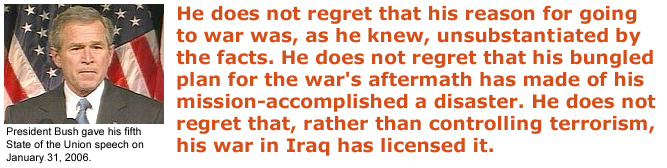
A small circle: The Unfeeling President - An essay by E. L. Doctorow |
Category: Opinions 41 comments 14 Feb 2006 @ 01:18 by Hanae @69.33.46.10 : Meanwhile on CNN:A bit of History revisionism: Bush administration's deception presented as 'honest error.' CNN (AKA the mouthpiece of the White House) ran their documentary "Dead Wrong," again last Sunday, their so called "coverage" of what went wrong with the "intelligence failures." This is how CNN's documentary opens: ------------- quote -------------------------------------------- "(voice-over): In early 2001, George W. Bush, urged by his father, who had been a director of central intelligence, keeps George Tenet in charge of the CIA. The new president is applauded for putting the agency above politics. And Tenet, who was appointed by Bill Clinton, becomes the first CIA director in more than three decades to survive a change of party in the White House. But theirs will be a fateful relationship. The president will take the country to war, a decision he will justify using intelligence produced by Tenet's CIA." ------------------- end quote ----------------------------------- The whole premise, the opening statement, the forgone conclusion suggested by the terms "intelligence failures," all reeks of disinformation in what came all too clearly to me as an effort to exonerate the President and take the attention away from his responsibility and the duplicitous role his administration played. The terminology itself, "intelligence failures," pretty much says it all, as some failures just simply were not apparently deemed worthy enough by CNN to be looked at in their "coverage," like for instance the White House's failure to head Tenet's recommendations to tone down the rhetoric. CNN placed, instead, the emphasis---chose to place the emphasis---on the "intelligence," not on how the commander-in-chief and his top aides heavy-handedly influenced the production/presentation of the so-called intelligence (parts of which were ignored while other parts were hyped despite their known weak credibility) and abused the process to make the case for war. I find CNN's astonishing complete omission of some of the major elements of the story (Excellent overview and recap on "The Selling of the Iraq War,"{link:http://www.globalpolicy.org/security/issues/iraq/unmovic/2003/0630selling.htm|here} on Global Policy Forum), like the fight put up by Bob Graham, the Florida Democrat who chaired the Senate Intelligence Committee, which was the greatest congressional obstacle to the administration's push for war,) is very significant to that regard. Anyway, unlike Greg LLoyd (Official Newswire) who had watched the program first time it was aired, back in August 2005, I was not holding my breath for informed and balanced journalism on the part of CNN, so I can't say I was taken aback by the coverage, like he was. This is what Greg had to say: As I watched the trailer for a couple days before I finally caught the program, I had such high hopes that CNN would "uncover" something new, or even offer an independent opinion about the events that lead America into an illegal war, but in the end, I guess that merely proved my naïveté. (...) CNN’s "Dead Wrong", even with Wilkerson's comments, offered little in the way of new information and served only as another example of how the Bush administration seeks to revise history through an ever-submissive mainstream media. 14 Feb 2006 @ 01:43 by i2i : Questions you won't hear on CNN Thank you for taking the time for posting, Hanae. I have just read the reprint of the article from The New Republic by John Judis and Spencer Ackerman on the Global Policy Forum website. This is a lot of information to take in and to evaluate. Here are some journalists who have investigated the facts and put them together in a coherent and intelligent form. Why couldn't CNN do it (straighforward and simple: "just the facts, m'am,") or as you put it why did they chose not to do it? Anyway, here are some challenging questions from readers of the {link:http://www.washingtonpost.com/wp-dyn/content/linkset/2005/04/11/LI2005041100879.html|Washington Post} (the kind of questions CNN won't ask) that I've found via {link:http://www.newciv.org/nl/newslog.php/_v63/__show_article/_a000063-000354.htm|jazzolog}, whose blog might be familiar to you: 1. On the Cause of War From Steve Walach: "Referring to intelligence that claimed Iraq had an extensive program to construct and use weapons of mass destruction, you, Mr. President, now sheepishly admit that those assertions were plain wrong. However, by way of disclaimer, Mr. President, you attach this bizarre epilogue: 'Knowing what I know today, I'd make the decision again.' "Taken to its logical conclusion, Mr President, your statement means that the casus belli -- the WMDs -- mattered not a lick in your decision to invade. Doesn't your statement mean that you would have invaded Iraq regardless what the CIA and all the other spy agencies said about WMDs, making the war in Iraq your decision entirely and a decision based only on your desire to attack Iraq and eliminate Saddam?" 2. On the Run-Up to War - From Adam Blackwell: "Many people, including officials in your own administration, have claimed that you decided to go to war in Iraq long before you announced you had given up on diplomacy. Are they all lying?" - From Steve Shepherd: "You repeatedly said you had not made any decision to invade Iraq in the run-up to the actual invasion. Yet numerous sources, including administration insiders such as Richard Clarke and Paul O'Neil, say otherwise. And for more than 10 years, invading Iraq had been a publicly stated goal of the so-called 'neoconservatives', including Paul Wolfowitz and Donald Rumsfeld, within your administration. Wasn't it always your intention to invade Iraq but you first had to fix 'the intelligence and the facts around the policy,' as the Downing Street Memo suggests? - From Phillip Daniel: "President Bush, according to Bob Woodward's book 'Plan of Attack,' you attended a presentation by then-CIA Director George Tenet regarding WMD at the end of which you reportedly said words to the effect of 'nice try, but I'm not convinced.' This led Mr. Tenet to his now infamous 'It's a slam dunk' endorsement. However, this meeting came months after your administration, led by yourself and Vice President Cheney, had been asserting to the American people that there was no doubt that Iraq held WMD. How do you think these revelations of private doubt affect your credibility when the American people recall your trying to convince them there was no doubt about WMD, and therefore no choice but to go to war?" - From Don and Charlotte Lamp: "Did you tell Tony Blair on Jan 31, 2003, that you were prepared to invade Iraq regardless of whether the inspectors were able find evidence of weapons of mass destruction? Did you tell him that you were considering sending a U.S. plane, painted in U.N. colors, over Iraq, so that if Iraq fired on it there would be a pretext for charging it with a violation of U.N. resolutions?' This is based on an alleged memo cited by Prof. Phillip Sands of University College London in the revised edition of his book, 'Lawless World.' " 14 Feb 2006 @ 20:58 by Hanae @69.33.46.10 : CNN the White House handmaiden? In an article highlighting the role of the corporate media in playing the Bush administration handmaiden, Steve Breyman ("{link:http://www.newtopiamagazine.net/modules.php?op=modload&name=News&file=article&sid=24|Time for Another Corporate Media Mea Culpa}," on NewtopiaMagazine - 4/19/05) had this to say: "The whole post-9/11, post-war-gone-wrong “review” process is surreal given the baldness of the mountain of facts readily available to any and all of us. [We] knew all this long before the US invasion. The evidence was overwhelming. Appeals to the facts appeared futile. We knew this was an administration bent on war with Iraq years before it came to power (as evidenced by PNAC), and eager for a pretext once it took office (as claimed by Richard Clarke and others)." But as Rahul Mahajan sharply pointed out on AlertNet ("{link:http://www.alternet.org/waroniraq/21687/|We Told You So},") "Those of us who knew better in opposing the invasion of Iraq know better now. We know that "intelligence failure" is just a neat rhetorical device to shift the blame from the coterie of top officials who deliberately deceived us into a war to the intelligence agencies who were pressured to come up with those lies. The WMD commission was not created to help us arrive at the truth, but to head off any chance of a serious investigation into the administration's wrongdoings. So in the end, the commission did its job well. It's unfortunate that its job was a political cover-up." I wish it would have been different of CNN and of their faux-documentary "Dead Wrong," but despite the Media big public display of contrition, here we go again - nothing has changed: "None of these reports is willing to acknowledge the proverbial elephant in the debate over Iraq, i.e. the complicity of the Bush administration in creating this so-called "intelligence failure." Some ten months later Steve Breyman's point is validated: Clearly, we need more than just a show of false contrition from the media, we need structural media reform: "We demand an industry-wide commitment to not broadcast or publish government propaganda parading as news or analysis (video press releases, paid pundits, etc.)" "This is, of course, but the tip of the media reform iceberg, but it’s a start." Don't hold your breath. 14 Feb 2006 @ 23:39 by i2i : Is CNN the White House handmaiden? "What might be different today if the press hadn't swallowed so many administration lies, hook, line and sinker? Is it the media's responsibility to report what the people need to know, or what the government wants us to hear? And which -- if any -- journalists got their reporting right?" So asked Kristina Borjesson in her new book (October 2005) in which she asks some of America's top journalists for insight on why post-9/11, pre-Iraq War news coverage was so shoddy: {link:http://www.alternet.org/mediaculture/29833/?comments=view&cID=70227&pID=70210|link} I did google around on the web to try and see what's out there on CNN and what I could find about the perception of media bias in general. {link:http://www.newciv.org/pic/nl/artpic/119/000119-000029.jpg|Here} is a picture from the antiwar Hollywood march back on March 2003. And {link:http://www.motherjones.com/mojoblog/archives/2006/02/zahn_moves_cnn.html|here} is a recent article (02/01/06) on MojoBlog posted by Diane E. Dees who echoes Hanae's comment about CNN, which in Diane's opinion, "has been an effective mouthpiece for the Bush administration, mostly through innuendo, flag-waving, and omission." I don't know, I should probably try to watch CNN and make up my own mind about it, but watching corporate media in general----not just CNN----has been more than I could bear lately. So maybe I will leave that to Hanae. What about it, Hanae? Maybe a Blog of your own dedicated to the Media? Something like "What I learned today on CNN." I am not saying this in jest. I can relate to some of the things you have observed and I do believe that the media should be watched (as in monitored). There are already some sites on the internet devoted just to that purpose, but someone running a Blog reporting what CNN "taught" her during one hour of viewing a day, like between 7 AM and 8 AM, or whatever, would be something different. Anyway, I understand and I agree with the general idea here. I do believe that the first duty of reporters should be to the People, not to the President, or to the corporation or financial institutions and various interests who pay their wages or contribute financially to them or to the company that employ them in one way or another. I know it is easy for me to say, but this is what being a reporter means. This is also what patriotism means. It is all starting to look as if all of a sudden people were understanding patriotism as meaning one should stand behind the President no matter what. And this is not right. Patriotism is standing for the Nation and for the People and for the principles that make this great country what it is, or what it claims to be about in any case. And if the President for one reason or another is, knowingly or unknowingly, undermining those principles and hurting the country it is the patriotic duty of every reporter to come forward and raise questions about it. From what I have been able to ascertain from my web perusals, I do not believe that anyone (with the exception of a rare few fringe fanatics) is expecting of CNN, or of the media in general, that they launch and all out attack on the President. Only, that they do their job and ask the right questions and lay responsibility where responsibility belongs. As it stands, not only haven't they done that, but it is as if they are doing everything they can to obfuscate the issues any chance they get, oftentimes under the pretense of bringing the light on an issue, like in the case in point of CNN's "Dead Wrong" documentary. And as if this were not enough more often than not their view of the world and events in the world happens to closely espouse the views of the White House to which they give credence and support, as has been documented aplenty during the time the Bush administration was pressing for the invasion of Iraq. 21 Feb 2015 @ 05:26 by emmardy @182.186.225.245 : http://www.csautostore.com This is the first time I visited this blog. Really this is awesome work with the blog. www.csautostore.com | 23 Feb 2015 @ 16:10 by business-rating.org @39.36.198.193 : Your site is really nice and unique. Thi Your site is really nice and unique. This is one of the best idea that you had come up for the children and I do hope that they can have better future. 21 Mar 2015 @ 07:12 by speedanycar @182.186.209.42 : From your blog it seems that you are en From your blog it seems that you are en expert of writing article. Your contents are amazing and facts are true. I agree to all of your points that you have mentioned. 19 May 2015 @ 05:17 by 3ann-house.com @182.186.241.133 : This web site is really a walk-through f This web site is really a walk-through for all of the info you wanted about this and didn’t know who to ask. Glimpse here, and you’ll definitely discover it…. 15 Jan 2016 @ 12:57 by Jack Jenny @182.69.151.6 : Your substance are astonishing and reali Your site is truly pleasant and one of a kind. This is one of the best thought that you had come up for the youngsters and I do trust that they can have better future.From your web journal it appears that you are en master of composing article. Yvalid. I consent to the majority of your focuses that you have specified. This site is truly a stroll through for the majority of the data you needed about this and didn't know who to inquire. Look here, and you'll unquestionably find it… 24 Apr 2016 @ 15:03 by mawar @36.72.138.170 : vig power capsule first one vig power capsule position 22 Jul 2016 @ 08:11 by obat kolesterol @222.124.116.142 : reza thank for share 29 Jul 2016 @ 02:40 by QnC Jelly Gamat Store @36.72.67.16 : QnC Jelly Gamat Store Terimakasih informasinya.. 6 Aug 2016 @ 02:32 by OBAT ASMA @180.245.99.116 : ADD Today I learned a lot from your website. thank you 6 Aug 2016 @ 02:33 by OBAT BATUK @180.245.99.116 : ADD Thank you for sharing the information very useful. It is very pleasant to read this article from your website. 21 Aug 2016 @ 23:15 by pelangsing terbaik @36.72.151.225 : Wsc Biolo web web ini banyak sekali dikunjungi orang yang menyimpan backling twermasuk saya, semoga seukses selalu 21 Aug 2016 @ 23:17 by obat asam urat @36.72.151.225 : agaricpro punya asam urat menahun, segera konsumsi agaricpro. kunjungi webku yaa 1 Sep 2016 @ 16:40 by obat herbal @36.79.248.29 : distributor agen obat herbal asli tradis distributor agen obat herbal asli tradisional mujarab ampuh terpercaya 10 Sep 2016 @ 10:00 by Obat Kanker Rahim Serviks @36.72.164.169 : Obat Kanker Rahim ovary nutrition adalah Obat herbal alami kanker rahim dan serviks yang alami, paling aman, tanpa efek samping dan ampuh dalam detok penyembuhan penyakit kanker mulut rahim atau serviks, maupun kanker rahim sampai normal. Untuk mendapatkan kesembuhan terbaik kombinasi dengan jus herbal toko asli herbal adalah solusi terbaik untuk kesembuhan kanker rahim dan kanker serviks 10 Sep 2016 @ 10:36 by pemutih wajah alami @36.72.164.169 : pemutih wajah Pemutih wajah alami yang aman tanpa efek samping cara cepat memutihkan kulit wajah dengan racikan tradisional tanpa campuran bahan bahan kimia berbahaya. www.tokoasliherbal.com/pemutih-wajah.html Banyak wanita yang menginginkan kulit yang lebih cantik, putih dan cerah serta tergiur dengan merk produk pemutih abal abal yang berbahaya, pemutih wajah dari apotik yang . kandungan zat kimia seperti mercury dan hidroquinon adalah jenis zat yang tidak aman dan sebaiknya dihindari, terutama bagi anda yang berkulit sensitive. Anda tentu mengharapkan kulit cantik mempesona secara permanen dan tidak menimbulkan efek samping berbahaya. Keputusan terbaik adalah dengan produk terlaris minuman nutrisi Glueberry. 21 Sep 2016 @ 01:39 by GEJALA ASAM URAT @36.79.174.115 : sds Today I learned a lot from your website. thank you 21 Sep 2016 @ 01:41 by GEJALA ASAM URAT @36.79.174.115 : sds Thank you for sharing the information very useful. It is very pleasant to read this article from your website. 21 Sep 2016 @ 01:42 by GEJALA ASAM URAT @36.79.174.115 : sds waiting for next article, so interesting. 21 Sep 2016 @ 01:44 by GEJALA ASAM URAT @36.79.174.115 : sds Today I learned a lot from your website. thank you Thank you for sharing the information very useful. It is very pleasant to read this article from your website. 21 Sep 2016 @ 01:46 by GEJALA ASAM URAT @36.79.174.115 : sds Thank you for sharing the information very useful. It is very pleasant to read this article from your website. waiting for next article, so interesting. 21 Sep 2016 @ 01:47 by GEJALA ASAM URAT @36.79.174.115 : sds Thank you for sharing the information very useful. It is very pleasant to read this article from your website. waiting for next article, 21 Sep 2016 @ 01:47 by GEJALA ASAM URAT @36.79.174.115 : sds so interesting. 21 Sep 2016 @ 01:49 by GEJALA STROKE @36.79.174.115 : sds Today I learned a lot from your website. 21 Sep 2016 @ 01:50 by GEJALA STROKE @36.79.174.115 : sds Thank you for sharing the information very useful 21 Sep 2016 @ 01:51 by GEJALA STROKE @36.79.174.115 : sds Today I learned a lot from your website. thank you Thank you for sharing the information very useful. 21 Sep 2016 @ 01:52 by GEJALA STROKE @36.79.174.115 : sds thank you Thank you for sharing the information very useful. It is very pleasant to read this article from your website. waiting for next article, so interesting. 21 Sep 2016 @ 01:53 by GEJALA STROKE @36.79.174.115 : sds Today I learned a lot from your website. thank you Thank you for sharing the information very useful. It is very pleasant to read this article from your website. waiting for next article, so interesting. 21 Sep 2016 @ 01:53 by GEJALA STROKE @36.79.174.115 : sds Today I learned a lot from your website. thank you Thank you for sharing the information very useful. waiting for next article, so interesting. 21 Sep 2016 @ 01:54 by GEJALA STROKE @36.79.174.115 : sds thank you Thank you for sharing the information very useful. It is very pleasant to read this article from your website. waiting for next article, so interesting. thanks 8 Feb 2017 @ 04:54 by Obat Khusus Untuk Kanker @125.163.77.0 : Obat Khusus Untuk Kanker Cara Jitu Mengatasi Susah Tidur Manfaat Daun Cincau Untuk Kesehatan 9 Feb 2017 @ 07:20 by obat kolaps pparu tradisional @36.72.200.145 : helty I still liked this article, good, good content, and unique design.Thank you for sharing the article. pengobatan untuk sembuhkan kolaps paru 19 Feb 2017 @ 14:34 by crystal x asli @36.72.171.163 : crystal x asli HASIL LUAR BIASA 19 Feb 2017 @ 14:35 by procomil spray @36.72.171.163 : procomil spray jos mantap 20 Feb 2017 @ 00:16 by cream pembesar payudara @36.72.157.112 : cream pembesar payudara LKJJ;J;J;LJ;L 20 Feb 2017 @ 16:04 by sepeda downhill murah @36.72.157.112 : sepeda downhill murah TAJSAKDASLDASDFAASF 23 Feb 2017 @ 12:44 by Qnc Jelly Gamat Asli @36.72.81.43 : Qnc Jelly Gamat HARGA MURAH MANFAAT LUAR BIASA 31 Mar 2017 @ 08:06 by Obat Ginjal Kronis @36.80.43.108 : Obat Ginjal Kronis Free 10 btl bagi anda yang sudah membeli Obat Ginjal Kronis dan memberikan kesaksian positif berupa Foto before after dan video kesaksian Other entries in Opinions 19 Sep 2006 @ 00:09: My God’s better than your God… 13 Jul 2006 @ 23:06: The Law of Attraction? 30 Mar 2006 @ 08:03: We and They: The Polarization of America 10 Oct 2004 @ 05:39: Consistently Dogmatic 20 Jul 2004 @ 00:59: Racism, Oppression, Poverty and Social Injustice 7 Apr 2004 @ 13:10: What would you ask? 25 Mar 2004 @ 13:17: Candles in the Sun - A culture of hidden violence
|
 4 Feb 2006 @ 04:45, by D