MUSE LOG: The Nameless    
 The Nameless2 comments
4 May 2003 @ 20:44, by Quidnovi

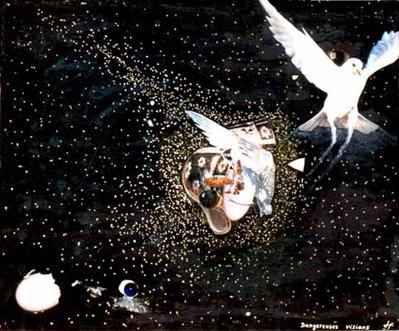
Artwork: F.Dujardin, paint, ink & collage (3ft x 2ft)

"Forces that we cannot understand permeate our universe. We see the shadows of those forces when they are projected upon a screen available to our senses, but understand them we do not. Understanding requires words. Some things cannot be reduced to words. There are things that can only be experienced wordlessly. This says our universe is magical. It says all arbitrary forms are transient and subject to magical changes. Science has led us to this interpretation as though it placed us on a track from which we cannot deviate."
---Frank Herbert, Heretics of Dune

NEXUS
nexus (nèk´ses) noun
plural nexus or nexuses
1. A means of connection; a link or tie
2. A connected series or group
3. The core or center

Latin, past participle of nectere, to bind


[< Back] [MUSE LOG]

Category:  


2 comments

15 Aug 2003 @ 16:15 by quidnovi : The Riddle of pain
"Maybe some things cannot be reduced to understanding either. Such as, why does the universe designer like to include suffering so much?"
---jazzolog, 08.06.2002

"How could the creative genius of evolution work its slow miracle---gradually stirring raw chemicals into soul-carrying beings---without enormous numbers of trials and outcomes? The "real" world needs consistency and countless failures in order for natural selection to do its job, drawing complexity out of chaos. It is the answer to the Riddle of Pain."
---David Brin, Kiln People  


30 Jan 2007 @ 02:12 by Hanae @68.164.53.190 : Spirituality = Reality = Freedom

I found this here, floating in cyber space - it is not claimed by anyone and I've not been able to cross-reference it with any current web content. It is a nice piece and I thought that it would be a shame if it were lost to the world, so here it is in its entirety:


SPIRITUALITY = REALITY = FREEDOM


The 20th Century was anything but concerned with the spiritual; negativity, banality, materialism and narrow rationalization dominated this period, entrapping people in a man-made prison.

The beginning of the Twenty-first Century invites the inversion of this trend, drawing on the countercultural shadow side of the last century and an alternative current bridging millennia.

Such a change is not without its dangers in order to be authentic it must be rooted in a new ethos with an open but sharper rationality and a broader philosophy, else we fall foul to other delusions; irrationalism, superstition, wish fulfillment fantasy and New Ageism.

The reason for this shift is obvious, we have reached the nadir of our collective alienation, an alienation from the aspects of experience that can only be captured by the concept of spirit. Spirit of course need not necessarily imply 'supernatural' as some radical materialists might justifiably fear. There is only one nature and we are in it, what it consists of is still a mystery.

The notion of Spirit or 'the spiritual' might be best described as an open human category, a mysterious term attempting to capture our consciousness of an inexpressible reality. In clearer terms, it is our point of contact with absolute reality, or the roots of our existence. A reality not directly expressible through ordinary human categories, or within the context of artificial logic. The 'everyday reality' we know is merely a 'representation', constructed from our filtering of sense data through arbitrary mental categories, our neural and linguistic scanning patterns, that have been selected by evolution merely for our survival within a limited range of experience (capitalizing on the islands of 'order' within overall 'chaos').

Reality is beyond the reach of conventional rationality and reductionist philosophies. A metaphysical view best understandable within the traditional dichotomy between 'appearance' and 'reality', though this in itself is another rationalization of course. A view that frees us from narrow reason without undermining it - retaining it as a useful mapping tool, with the ability to reveal partial truths and thus empower us in the world - while accepting that there are no rationally accessible Absolute Truth. Believing otherwise falsifies reality.

The nearest we can get to absolute reality is thus the mysterious, non-rational, direct experience which we label as 'the spiritual' and objectify as spirit.

An awareness of 'the spiritual' is an awareness of the true nature of the world.

For the poets rather than philosophers, the 'spiritual experience' is the epiphany and the direct experience of the fullness of reality, the inexpressible situation that must be expressed at all costs. Beyond this it is the Aesthetic - the intuitive awareness of an underlying order, or rather an underlying chaos, or rather of both as one!

Spirit is the foundation of every aesthetic experience that cannot be reduced away.

The ultimate sense of reality is the awareness of the absurdity of what is called 'reality' and the humor of the actual reality it seeks to bury in its man-made dungeon.

For the more 'worldly', spirit is our innermost reality, instinctual, unfiltered by thought. It is not part of the conceptual 'consensual reality' shaped by lazy, passive minds, by conventional thought and cultural preconception, but the source and motivation of our existence, that which we occasionally glimpse deep in ourselves as something of great value. Whether we regard this as 'visceral,' 'biological,' 'paraphysical,' or 'mystical' is irrelevant to its reality and power. We can conceptualize it afterwards according to our tastes.

This 'inner reality' can also be experienced as an 'external reality' in moments of exceptional clarity and euphoria. An experience confirming the false duality of inner-outer.

At its deepest and most intense, 'the spiritual' is the personal psychedelic experience - the stripping away of consensus reality - and the encounter with the roots of our consciousness, or the mystical vision of a world transformed in ecstatic states of consciousness.
This can be a profound and disturbing experience.

It can also be found more subtly in the close examination of the mundane.

This understanding of 'the spiritual' is not the familiar one of transcendental spirituality, it is not an escape from everyday reality into something 'higher' or 'truer', nor is it born from a dissatisfaction with ordinary existence and a search for something 'greater'. While all such moves are understandable under the conditions of contemporary life, they are never the less disempowering illusions. The kind of 'spirituality' at issue here entails a greater engagement with reality, and rather than a 'lifting of the veil of nature', to enter a 'supernatural realm,' is actually a passing through the conceptual 'veils' of the human mind into immanent, concrete reality, 'veils' that isolate us from direct contact with nature at the same time as they mediate it to us as 'representation'. It nothing more than the living of life to the fullest extent possible.

Likewise it is not the 'pseudo-spirituality' of most religions (and some secular ideologies) that neurotically denounce the 'profane earthly world', and in its place affirm some coming 'heavenly' ideal, to which all pleasure is deferred. It is a 'spirituality' of the real world, in which satisfaction is sought in the here and now not postponed to some future state (or restrained by what is past). In short it is a mode of real liberation not of phony escapism.

Most importantly, at it's core this awareness is not some idle curiosity about 'absolute reality' or ideological need for 'Truth,' nor is it merely the product of the negative situation of our alienation from reality through its cultural falsification (though that is part of it!), it is primarily a manifestation of our positive desire for freedom. Only through our connection with reality can we be genuinely free and fully alive. Increasing logicism, rationalization and negative 'materialism' only serve to imprison us further, while of some genuine value, they need to be reined in if freedom and spirituality is to be allowed to reign on .

No ideology should be associated with this notion of spirit, nor any particular fixed ideas (not even 'traditional spiritual' ones such a peace, love, good, evil etc), this would be another conceptual falsification of reality. The authentic experience is always an open ended, ongoing one of exploration and discovery, not a comforting support. One that seeks to go beyond traditional notions, particularly dualistic ones, seeking their source, not to affirm them.

The ultimate expression of spirit is the affirmation, as a supreme value, of the preservation and enhancement of Zoë ('embodied life' or nature) both ecologically and individually (a viewpoint completely agnostic on any other unexperienced forms of existence).


MYTHOLOGY:

Any 'spiritual reality' as described would be a largely subjective and personal experience, but to become a cultural and social reality would need to be communicable and acquire a shared, intersubjective existence. This has long been the province of poets and visionaries. Art and metaphor are the only known ways yet found to express such subjective material in a communicable way. When the subjective matter being communicated is concerned with spirit the metaphors are usually referred to as myths. No judgment of the truth or untruth of the material expressed here should be implied by the term 'myth,' it is deployed in this context in its original meaning of 'an imaginative narrative', rather than modern sense of fiction. In a sense all of our human knowledge is myth, none of which is strictly true, such myths of course differ in their closeness of approximation to reality. All such myths must correspond to experience to some extent, to be something more than fantasy, even if none are strictly true (in the classical 'pictorial' sense), but the situation is a paradoxical one. The more specific, detailed and logically consistent the myth, the more 'realistic' it is held to be (a scientific theory or a rigorous description), but the more incomplete and prone to contradiction it is (as wave vs. particle theories demonstrate even in an exact a science as physics). While the more general, universal and totalizing the myth (or even the more specifically non-rational), the more metaphorical and paradoxical it needs to be, but the closer to absolute reality it will be. This is the realm of mythological discourse. A realm of metaphorical side speak.

Mythology is not necessarily ancient. Mythographers create myths all the time, in many ways the best myths are probably those freshly created, drawing on modern images in a contemporary context. However the virtue of ancient myth is that of time testedness and insight. Ancient myth has its ultimate origins in the shamanic 'explorations' of primitive man. A time when the bonds of civilization were far weaker, and psychedelic tools had less negative enculturation to work against. The insights obtained at this time and encoded in primeval myth were passed on through generations, those that proved to hold the most valuable insights surviving longest. Further exploration no doubt evolved these original myths, and over time positive enculturation provided a richer language of metaphor to couch them in.

Early depth psychology believed that ancient myth held many clues to the basic nature of human psychology and consciousness, some went further, Jung believed that such myths reflected metaphors so significant that they had become rooted in our 'collective memory' (he may have even believed that they represented fixed structures within the minds of our species, in a sense metaphorical categories). But we needn't take our speculation so far to realize the importance of myth in the exploration of human psychology and culture. Some even regard ancient myth as an insight into the wider cosmos beyond the 'confines' of consciousness.

Problems with ancient mythology do limit its value however. The most common being cultural dilution and recuperation. In the former a once insightful myth may become little more than a fairy tale over a long period of time, as it is constantly retold and modified, if its trivial features become more attractive than its profounder features. Evolution isn't always progressive. In the latter, as myths become cultural 'explanations' they are prone to modification by political power interests. Thus aristocratic Olympian gods of conquerors supersede the popular, often chthonic, deities of the conquered, and kings become 'incarnations' of deities. Any cultures mythology tends to become a mirror of (and justification for) its own socio-political structures. This does not necessarily mean the rulers, or their theologists, sit down and rewrite or invent myths (though sometimes they have), it more often means that an evolving mythology reflects the norms and cultural assumptions of those involved in developing those myths. Any study of mythology intending to isolate its insightful elements needs to carefully filter out these falsifications. One way of doing this is to focus on the ancient mythology of popular, grassroots paganism, harder to discover than recorded classical religion, and the beliefs of the contemporary survivals of 'primitive' tribal societies, and to assess myth in the light of our own modern knowledge (such as empirical psychology and comparative anthropology) in cross-discipline studies.

An area of mythology of particular interest in the Dionysian Underground is the lore of Dionysos, which is an ideal area of study. As is that of Shiva and the Nagas, the Horned God, the Great Goddess, the Androgene, The Nagual and the liberatory cults 'Voodoo'. All of which have similar roots in a Dionysiac spirituality of the most ancient world culture.

But perhaps the most interesting mythology consists of a fusion of the ancient and the modern, with the myths constantly evolving within the context of contemporary situations and explorations.


RELIGION:

The danger of mythological discourse is that it can lead to Religion, with which it has been most closely associated. Religion at its best can be an attempt to unify a culture, or subculture, by creating a collective myth which can contextualize the 'spiritual experiences' of its members.

It can also have a personal importance in providing a familiar framework for the interpretation of individual experience. However it is a regrettable fact that Religion at the very least simplifies and rigidifies such 'spirituality' (or even 'pseudo-spirituality') into a restrictive dogma, and worse often falsifies it into a 'fairy tale', that at best provides comfort and escapism and at worst becomes a mechanism of social control. When a priesthood becomes involved matters are worse still, as biased human mediation separates us even more from reality. While Religion may have a minor role to play for some individuals, the benefits of collective organized religion are far outweighed by its dangers. One thus need to be on constant guard against this form of falsification of reality. Both in its traditional 'priestly' formats and its modern New Age format. Perhaps an important thing to remember regarding this is even if we believe 'nothing is true' it doesn't mean that something can't be false! All the benefits of Religion can be replicated by an open 'spiritual culture', Religion is simply an anachronism in the modern world. Perhaps the only exception to this rule (for rules always must have exceptions) might be Religions that are closest to this ideal of an open 'spiritual culture', Taoism springs naturally to mind, but even here it is easy to find corrupted Taoism. The best policy might be to create our own culture! But then the Tao that can be spoken is never the true Tao (and yes even that is a lie!)


MAGICK:

A more productive aspect of any 'spiritual culture' is the use of Magick. If pagan mysticism is the theoretical exploitation of spirit, Magick is its technological exploitation. Just as Science is the means to a produce technology that exploits the ordered aspects of reality, Magick might be seen as an Occult Science that produces techniques that exploit patterns of the pre-rational.

Magick, like Religion, can be dogmatic and superstitious of course, but its most effective manifestations have always been more open and pragmatic. It can also be based on false conceptions when it ceases to be experimental. But good Magick like any science is always experimental. Today whole schools of so-called 'Chaos Magick' have been developed that put the science back into the Occult in this way. Magick is also prone to moralism and politics, a good example of which being the false dichotomy of Black and White Magick, where the former is sometimes identified as evil and the later good. Though surprisingly afflicting someone with a pathological obsession that seriously disrupts their brain chemistry (a love spell) is considered White Magick under this analysis, and defending ones friends with a demonic 'hallucination' is considered Black Magick! Clearly this dichotomy is insane. Of course the true origin of the dichotomy is that White Magick was that Magick sanctioned by pagan establishments, under the control of specialist priests, while Black Magick was illicit and unregulated. Thus the paranoiac concepts of 'witchcraft' and the 'evil eye' as magick outside of legitimate or 'safe' limits. In reality there is only one Magick and like any technology it can be utilized with a variety of intentions.

As for what Magick is, that remains a mystery in a scientific age. But perhaps it can best be understood of as exploiting patterns of a synchronistic order in the world, in the same way that science and technology exploit law-like patterns in the world. The observance and utilization of synchronicity being the most basic form of Magick experiencable by everyone.

Most of all our task is to re-enchant the World and make it magical again.  


Your Name:
Your URL: (or email)
Subject:       
Comment:
For verification, please type the word you see on the left:


Other musings in
12 Jul 2004 @ 11:13: The Nameless
4 Jul 2004 @ 19:33: Moriae Encomium
14 Jun 2004 @ 09:43: Defying Gravity
7 Jun 2004 @ 18:15: The Stuff
25 May 2004 @ 10:51: Healing Israel/Palestine
28 Apr 2004 @ 12:14: Place Your Bid
3 Apr 2004 @ 17:08: The Hunted Sky
1 Apr 2004 @ 12:15: Orlando
21 Mar 2004 @ 17:55: Walking a Literary Labyrinth
17 Mar 2004 @ 16:54: Judariya


[< Back] [MUSE LOG] [PermaLink]?