| The Animals Stricken with The Plague | |
|
 28 Oct 2005 @ 17:36, by Uncle Remus 28 Oct 2005 @ 17:36, by Uncle Remus
This Fable, by Jean de La Fontaine, is pretty much in the vein of the medieval tradition from which some of his poems drew their inspiration. The Tribunal by the animals is La Fontaine's own clever addition. The Fable subtly satirizes the hypocrisy and pretension of the jurists of his time.
The Animals Stricken with The Plague
A sickness that sows frightful seeds,
Sickness that heaven's anger framed
To be fit punishment for earth's immense misdeeds:
The plague (for evils must at last be named),
With power in one day to flood deep Acheron,
Now struck the animals full force.
And though not all would die, all will to live was gone—
When death is nigh, why struggle to delay its course?
The usual snarling over morsels ceased,
The foxes and the wolves no longer chased
The innocent and curly-fleeced,
The turtle doves flew off in mutual distaste:
If love is gone, joy is erased.
At last the Lion called a meeting. "My dear friends,"
He said, "I think these trials show that heaven intends
To tell us that our sins have made us all accursed.
So let us find the one of us whose crimes are worst
To draw the lightning on his head alone
And, hopefully, at one stroke atone
For all. For history teaches that in times of crisis
One often makes these sacrifices.
So search your consciences, look deep inside,
Reveal the ugly thing you always thought to hide.
Hold nothing back, wipe clean the slate:
A public confession is good for the state!
My awful appetite, for example, has made me prey
To gluttony. I've eaten flocks of sheep. Had they
Harmed me at all? No, not in any way.
So that was wrong, of course. But wait—
There is more. I must admit that sometimes it occurred
That, inadvertently, besides the sheep, I also ate
The shepherd.
So I will be your victim—if that proves necessary.
But each must first confess as honestly as I,
For in the name of Justice, the guiltiest must die."
"Oh, Sire," said the Fox, "We have the best of kings,
Whose scruples show his noble soul. But, I ask, why
Is eating mutton a sin? Those low, retarded things
Were honored when you ate them. And, I observe,
Those shepherds got what such imperialists deserve,
The human race, exploiters all." To huge applause,
The Fox sat down. Nor did one soul dare criticize
The Tiger or the Bear or such high-ranking jaws
As having broken even the tiniest, little laws.
And the ferocious mastiffs were just friendly guys
Who'd never bitten a soul, without good cause.
It came the Ass's turn. "I recollect," he said,
"That once in spring I crossed a field
Of grass so sweet and tender I commenced to yield
To devilish desires that popped into my head
And took a bite broad as my tongue of that good hay.
I had no right. My conscience warned me to say nay!"
At that, the assembly shouted, "Shame upon the Ass!"
And then a Wolf, a preacher of the saintly class,
Declaimed that nothing less sufficed
Than that this curséd beast posthaste be sacrificed,
This scabby, scurvy object, source of these bad events.
His minor tort became a capital offense.
How gross a crime it was to eat another's grass!
No penalty short of death could pay
For such a sin—and that is just what came to pass
Without appreciable delay.
Depending on your social height,
The law will see your crime as black—or else as white.
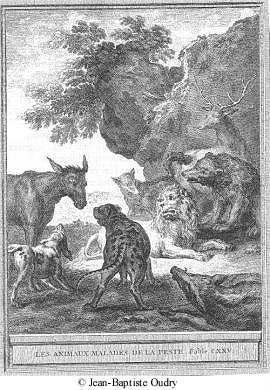
Les Animaux Malades de la Peste
Un mal qui répand la terreur,
Mal que le Ciel en sa fureur
Inventa pour punir les crimes de la terre,
La Peste (puisqu'il faut l'appeler par son nom)
Capable d'enrichir en un jour l'Achéron,
Faisait aux animaux la guerre.
Ils ne mouraient pas tous, mais tous étaient frappés :
On n'en voyait point d'occupés
A chercher le soutien d'une mourante vie ;
Nul mets n'excitait leur envie ;
Ni Loups ni Renards n'épiaient
La douce et l'innocente proie.
Les Tourterelles se fuyaient :
Plus d'amour, partant plus de joie.
Le Lion tint conseil, et dit : Mes chers amis,
Je crois que le Ciel a permis
Pour nos péchés cette infortune ;
Que le plus coupable de nous
Se sacrifie aux traits du céleste courroux,
Peut-être il obtiendra la guérison commune.
L'histoire nous apprend qu'en de tels accidents
On fait de pareils dévouements :
Ne nous flattons donc point ; voyons sans indulgence
L'état de notre conscience.
Pour moi, satisfaisant mes appétits gloutons
J'ai dévoré force moutons.
Que m'avaient-ils fait ? Nulle offense :
Même il m'est arrivé quelquefois de manger
Le Berger.
Je me dévouerai donc, s'il le faut ; mais je pense
Qu'il est bon que chacun s'accuse ainsi que moi :
Car on doit souhaiter selon toute justice
Que le plus coupable périsse.
- Sire, dit le Renard, vous êtes trop bon Roi ;
Vos scrupules font voir trop de délicatesse ;
Et bien, manger moutons, canaille, sotte espèce,
Est-ce un péché ? Non, non. Vous leur fîtes Seigneur
En les croquant beaucoup d'honneur.
Et quant au Berger l'on peut dire
Qu'il était digne de tous maux,
Etant de ces gens-là qui sur les animaux
Se font un chimérique empire.
Ainsi dit le Renard, et flatteurs d'applaudir.
On n'osa trop approfondir
Du Tigre, ni de l'Ours, ni des autres puissances,
Les moins pardonnables offenses.
Tous les gens querelleurs, jusqu'aux simples mâtins,
Au dire de chacun, étaient de petits saints.
L'Ane vint à son tour et dit : J'ai souvenance
Qu'en un pré de Moines passant,
La faim, l'occasion, l'herbe tendre, et je pense
Quelque diable aussi me poussant,
Je tondis de ce pré la largeur de ma langue.
Je n'en avais nul droit, puisqu'il faut parler net.
A ces mots on cria haro sur le baudet.
Un Loup quelque peu clerc prouva par sa harangue
Qu'il fallait dévouer ce maudit animal,
Ce pelé, ce galeux, d'où venait tout leur mal.
Sa peccadille fut jugée un cas pendable.
Manger l'herbe d'autrui ! quel crime abominable !
Rien que la mort n'était capable
D'expier son forfait : on le lui fit bien voir.
Selon que vous serez puissant ou misérable,
Les jugements de cour vous rendront blanc ou noir.
==================================================================
The English translation is by Craig Hill. Some of his inspired work----there is a long history and a charming story behind it----is published in Beasts and Citizens, Forty Fables of La Fontaine.
One of Craig Hill’s inspiration, among other things, was, in the author’s words, "to dispel the all too common impression that La Fontaine's fables are merely inspired children's literature." :
"Though sometimes assuming the rather deadpan guise— or disguise— of nursery rhyme simplicity, the poet's great work casts a wide net around matters of perennial human concern that are political, social and moral. Besides that, they are often funny.
I see La Fontaine as a gadfly, an irritatingly irreverent poet whose fables stung at establishment mores in an age of absolute monarchy, and I strongly believe that his work continues to have much the same pertinence in an age of consumerism and terrorism. For the follies, the dangerous pretensions and cruelties of former ages are with us yet. In my translations, I have attempted both to stay true to the poetic forms of the originals and to convey in modern-day English some measure of the ironic wit and verbal playfulness that make La Fontaine's fables one of the enduring treasures of world literature."

The volumes are beautifully illustrated by Andrew Stevovich
|
|
Category: Stories
16 comments
2 Nov 2005 @ 16:56 by : Absolute Tops
Almost in the Homeric metre, which in the French noticeably is not. The H metre is suited to long pieces, a flowing expectation of great things. Hard truths presented with honey cakes - that's technique (or art? hard to say), but without doubt fantastico!!
25 Jun 2009 @ 22:31 by @193.227.170.13 : Synthesis of topamax
Sorry. Excess on occasion is exhilarating. It prevents moderation from acquiring the deadening effect of a habit. Help me! It has to find sites on the: Synthesis of topamax. I found only this - hypertension due to topamax. Terbinafine is a medicine used for the treatment of fungal infections of the skin and nails. East windsor, nj, june nexmed, Thanks :mad:. Demitrius from East.
18 Dec 2012 @ 01:05 by Survivalist 2012 @107.2.87.23 : Thank you so much
This has helped me understand a lot about this work of Fontaine's. Thank you! Good luck everyone in the future after 12/21/12 which is in 4 days!
30 Apr 2014 @ 02:51 by breitling replica @184.164.90.102 : http://www.usbby.org/surey.html
as America's most prestigious rolex replica watch brand, replica watches uk will bring its new Swiss-made high-end series gucci shoes force the Chinese market this year. Its historic hublot replica heritage craft, excellent cartier replica watchmaking technology and unique style patek philippe replica will give China high-end design breitling replica watch consumers a richer, more personalized product selection.
30 Apr 2014 @ 02:52 by @184.164.90.102 : vsdfv
as America's most prestigious http://www.schoolofphotography.edu/sitemap.html watch brand, http://www.touchware.co.uk/defaut.asp will bring its new Swiss-made high-end series http://www.mcgolfacademy.com/photos.asp force the Chinese market this year. Its historic http://www.weatherfordproperties.net/sendmail.asp heritage craft, excellent http://www.cleverinsite.com/faq.html watchmaking technology and unique style http://www.mcgolfacademy.com/photos.asp will give China high-end design http://www.usbby.org/surey.html watch consumers a richer, more personalized product selection.
30 Apr 2014 @ 02:53 by @184.164.90.102 : bcf
as America's most prestigious [url=http://www.schoolofphotography.edu/sitemap.html]rolex replica[/url] watch brand, [url=http://www.touchware.co.uk/defaut.asp]replica watches uk[/url] will bring its new Swiss-made high-end series [url=http://www.accses.org/logo.aspx]gucci shoes[/url] force the Chinese market this year. Its historic [url=http://www.weatherfordproperties.net/sendmail.asp]hublot replica[/url] heritage craft, excellent [url=http://www.cleverinsite.com/faq.html]cartier replica[/url] watchmaking technology and unique style [url=http://www.nopuffdaddy.com/index1.html]patek philippe replica[/url] will give China high-end design [url=http://www.usbby.org/surey.html]breitling replica[/url] watch consumers a richer, more personalized product selection.
17 Feb 2015 @ 06:44 by @39.36.35.180 : Fantastic work and very well-written art
Fantastic work and very well-written article. I will recommend reading it to all my friends
20 Mar 2015 @ 11:35 by @182.186.174.43 : I gathered useful information on this po
I gathered useful information on this point as I am working on a business project. Thank you posting relative information and its now becoming easier to complete this assignment.
19 May 2015 @ 05:01 by @182.186.241.133 : Great article Lot's of information to Re
Great article Lot's of information to Read...Great Man Keep Posting and update to People..Thanks
27 May 2015 @ 09:01 by @39.36.73.165 : good
Sometimes when you innovate, you make mistakes. It is best to admit them quickly, and get on with improving your other innovations.
18 Jun 2015 @ 12:52 by haniya @39.36.210.227 : hi
Ofertas
Productos hasta 85% de Descuento. Envío en 24-48h. Productos de Cocina, Electrónica y Electrodomésticos, Hogar, Perfumes y Cosmética, Regalos, Salud y Belleza, Fitness y Deportes
14 Dec 2015 @ 07:57 by @39.48.11.72 : Sony Xperia Z2
Fabulous content!The quality article is important, I like the including perspective of the subject.
11 Apr 2016 @ 09:35 by redawady abowady @156.198.150.174 : wadi-alriyadh.com
26 May 2016 @ 02:18 by @101.99.23.49 : Lisa Henry
Here are the simple steps to add an email address to your Hotmail contacts
6 Sep 2016 @ 11:38 by @122.162.68.143 : Quality Content Here
Add Your Escorts Content Here.
28 Oct 2016 @ 05:56 by @223.225.150.125 : Independent Escorts in Chandigarh
Independent Escorts in Chandigarh is the one who deliver escorts services to elite class fashionable business men who be thankful for fine things in life and in relationship for night encounters and short duration's meeting.
Other entries in Stories
1 Apr 2006 @ 18:08: 第7 シール
1 Apr 2006 @ 02:42: Evey's Choice
24 Mar 2006 @ 20:25: Breathing with the mind
20 Mar 2006 @ 01:56: Transparency, Anonymity and Pseudonymity
18 Mar 2006 @ 02:58: 10,000 people with one message
8 Mar 2006 @ 01:46: People shouldn't be afraid of their governments
22 Feb 2006 @ 21:57: I is another *
23 Jan 2006 @ 01:05: Bodhichitta
15 Nov 2005 @ 01:36: Welcome to the Nightside
12 Nov 2005 @ 00:53: The impossible will take a little while
|
