|
|
2013-12-08
There is a fundamental inconsistency at the core of the scientific method / world-view that makes it unable to comprehend quantum mechanics (which seems paradoxical due to the inconsistency) nor can it comprehend consciousness or spirituality.
I have been identifying, explaining and challenging this inconsistency in a series of articles to help motivate the paradigm shift that will eventually make quantum mechanics understandable as well as making research into consciousness and spirituality understandable to modern science and recognised as vitally important.
There is an entry point here: http://anandavala.info/article/Are-we-today-as-wrong-about-any-scientific-fact-that-is-widely-accepted-as-geocentrism.pdf
If what I say is correct, which it seems to be, then these documents point towards the possibility for a radical paradigm shift!
Pass on the good news if you know people who would be interested, the more people who help figure this out, the sooner and the clearer the shift will be.
Especially people interested in the interface between science, consciousness and spirituality. As well as the hard problem of consciousness, psi-phenomena, scientific realist interpretation of quantum mechanics, cybernetic interpretation of quantum mechanics, virtual realism, virtual reality hypothesis, simulation hypothesis, computational metaphysics, reinterpretation of ancient mystic wisdom, etc... It's all connected!
Enjoy :)
|
|
|
|
2013-12-02
Only a few hours ago the I Ching urged me to commit to my highest
aspiration and to announce my intention. It said "Make known
the arrival of a message from heaven and announce it at the Earth
altar. If you don't deliver your important message you will be cut
off and isolated. Call out. Tell us now. Now!" Then along
comes an invitation to do so on Facebook, which motivated this... :)
So, what is the highest
perceived benefit or aspiration of my Life?
More >
|
|
|
|
2013-11-28
When one sufficiently overcomes the habit of naive realism one can
coherently understand the nature of reality rather than remain
trapped in a self-reproducing closed loop of unconscious assumptions
and resulting misunderstandings.
A coherent understanding can be attained personally and also
examined scientifically. A personal understanding will transform
one's life. A scientific understanding will transform civilisation.
The main features of a coherent understanding:
Reality is that which perceives rather than that which is
perceived. The objects of perception are not objective because they
depend on how we perceive them. The objective reality is the stream
of awareness within which the objects of perception arise and which
is our true self.
We have experiences of "being in a world", which is
how the situation appears from our perspective. However those
appearances do not reveal the true nature of reality, just as
experiences of a VR game world do not reveal its true nature to be
computation.
There are underlying processes that animate our stream of
awareness and give rise to the appearances that we apprehend. These
processes are that by which we perceive and cannot be apprehended as
objects of perception, thus they themselves seem unmanifest and
abstract.
All manifest forms are inferred to
exist from our perceptions, however they have no independent
self-nature. Hence the ideas of matter and a physical universe are
myths.
The underlying processes animate all systems and enable them
to experience, react and thereby interact. All system interactions
are driven by reciprocal experiences and there are no inanimate
systems.
The underlying processes that enable our individual streams
of awareness are part of a unified process that animates everything.
There is a global coherence to this unified process, which
imparts a global coherence to the realm of manifest forms. Thus no
event is local, every event is a 'movement' of the entire cosmos.
We can operate via sensory perceptions and thereby exert
influence locally, or we can operate via the inner-most animating
process 'within' us and thereby exert influence globally or
remotely.
Our individual state of being (both body and mind) arises
from the many levels of interacting sub-systems that comprise us. If
these sub-system interactions are dysfunctional we suffer.
Our interactions and relationships integrate us into many
levels of super-systems (groups and organisations) that comprise
society as a whole. The collective state of being emerges from this
integration. If our interactions are dysfunctional the emergent
collective suffers.
The main results of the work from which this world-view arises can be found
here http://anandavala.info/OIPVSE.pdf
|
|
|
|
2013-11-26
My initial motivation was the need to resolve the tension between my rational and spiritual sides. Once that was eased my attention also turned to the civilisation-wide tension between science and spirituality.
There is so much needless suffering and destruction that arises from misguided sciences, misguided religions, the conflict between them all and the resulting confusions and dysfunctions that permeate our cultures and minds.
I really believe that this tension can eventually be resolved and out of that will arise a unified science/spirituality that will have a lasting positive influence on our whole civilisation; so profound that we can barely even imagine what it will be like from our current vantage point.
There are so many people contributing in different ways to this process of unification at present and my greatest hope is to serve some useful role in that effort...
"There is this hope, I cannot promise you whether or when it will be realized - that the mechanistic paradigm, with all its implications in science as well as in society and our own private life, will be replaced by an organismic or systems paradigm that will offer new pathways for our presently schizophrenic and self-destructive civilization." (Ludwig von Bertalanffy, Founder of general systems theory)
Schizophrenia seems to be a problem where there is no means for thoughts to be coherently 'grounded' in truth or reality, hence the tension of confusion builds upon itself creating more confusion and running out of control.
If the wikipedia description is interpreted as applying to our civilisation rather than an individual person it is surprisingly relevant to our current situation as reflected in politics, media, social breakdown, etc:
"Schizophrenia is a mental disorder characterized by a breakdown of thought processes and by impaired emotional responses. Common symptoms are delusions including paranoia and hallucinations, disorganized thinking and a lack of emotional intelligence. It is accompanied by significant social dysfunction. The onset of symptoms typically occurs in young adulthood." https://en.wikipedia.org/wiki/Schizophrenia
In the case of our civilisation I would propose that the core confusion is naïve realism, which gives rise to numerous other confusions such as exoteric religion, empirical science, mechanistic views of human nature, oppressive legal and social systems, entrenched struggle for dominance over others, etc. These reinforce the confusions and generate vast amounts of tension throughout civilisation.
I explain this in more detail in "Simplified Anatomy of the Global Systemic Crisis and How to Heal Civilisation" http://www.anandavala.info/STAR/anatomy.html
|
|
|
|
2012-05-09
This is an edited version of my comments from a recent conversation with a good friend Glisten (with extra comments to clarify a couple points). More >
|
|
|
|
2011-03-06
Worldly concepts, words and thought processes cannot give the mind
enough traction to grasp reality. However the mind itself CAN grasp
these things and the intellect can understand. Although the word
'mind' means different things to different people... Hence I'll
explain a little of where I'm "coming from" in regards to
'mind'... More >
|
|
|
|
2011-03-06
The following is a brief overview of an information system
ontology and metaphysics, i.e. those concepts, entities and processes
that provide a foundation for a non-materialist, consciousness based
world-view. The explanation is kind of technical because it is
difficult to explain non-materialist issues in a mostly materialist
language, however the understanding itself is very simple and intuitive
once one shifts to a non-materialist paradigm. This explanation starts
from general principles and works towards particulars. More >
|
|
|
|
2011-01-09
I was recently asked my opinion on the work and teachings of A.H.
Almaas, called the Diamond Approach. This article is not a general
review of his work, it is about something that I believe to be a
common misconception of spirituality, particularly throughout the
West (e.g. many proponents of Integral philosophy). However I found
in Almaas' work a clear and succinct expression of that
misconception, which has inspired me to say something about it now.
Firstly let me say that I am not familiar with Almaas or his work,
however after reading an
article on the core principles, written by him and an
interview with him I think I can sense the gist of where he is
coming from. He has many deep insights that suggest genuine
realisations, hence I suspect that many spiritual aspirants could get
some benefit from his fusion of depth psychology with aspects of both
dualist and nondual spirituality. That is all I have to say regarding
his work in general.
However, from my perspective and the perspective of Eastern
spirituality, he succumbs to a critical mistake. It is this mistake
that I will discuss here because it is very limiting and it is
prevalent and growing in popularity throughout the West.
I am talking about a misconception of spirituality that is based
on a partial realisation that is mistaken for a full realisation. The
seeker attains a degree of realisation, but mainly at an intellectual
level, which has not penetrated very deeply into their subconscious /
unconscious mind – they are often not even aware that it should
penetrate deeply or how deep it must go before one has full
realisation. Hence they believe themselves to be realised and to
understand the spiritual path, even whilst the bulk of their mind is
unconsciously dominated by the ego and still bound within the
illusory world that the ego imagines itself to inhabit and the
illusory life that the ego imagines that it is living.
The partial realisation results in thinking that could be phrased
as “Okay, so now I'm realised, but I'm still
me, an individual person in the world - so what now? How can this
realisation help me and others to lead a better, more spiritual life?
That is after all what spirituality is really about.” This
thinking results in the tendency to approach spirituality more as a
spiritually themed lifestyle for the ego as it lives its illusory
life in the world. Rather than seeking to deepen their realisation
and eventually attain full and complete realisation of reality and
truth, and thereby overcome the ego and all of its delusions; thus
traversing the greatest paradigm shift of all and coming to apprehend
and live in reality, which is radically different to what the ego
imagines. More >
|
|
|
|
2010-12-28
I just read a very thought provoking article The
Truth by Eric
Gross, which I thoroughly enjoyed. In response to it something
came to mind, certainly not as a criticism but simply as an extra
dimension to consider... More >
|
|
|
|
2010-12-28
Some quotes from Advaita Vedanta:
“Truth must be discovered, but there is no formula for its
discovery. You must set out on the uncharted sea, and the uncharted
sea is yourself. You must set out to discover yourself…” (J
Krishnamurti)
- # - # - # - # - # - # - # - # - # - # -
"No person from outside can make you free... No one holds the
Key to the Kingdom of Happiness. No one has the authority to hold
that key. That key is your own self, and in the development and the
purification and in the incorruptibility of that self alone is the
Kingdom of Eternity..." (J. Krishnamurti)
- # - # - # - # - # - # - # - # - # - # -
“That which is the subtle essence, in it is the self of all that
exists. It is the True. It is the Self, and thou ... art it.”
(Chandogya Upanishad 4:10:1-3)
- # - # - # - # - # - # - # - # - # - # - More >
|
|
|
|
2010-12-27
Recently I have been feeling harassed by someone and yesterday during
"peace negotiations" with them I realised why they were
behaving how they were, and I took a fresh look at myself and saw that I
also do a similar thing - it helped me to understand many things about
my life. I'll try to explain what I realised and what that meant to me.
Perhaps this insight might be of some use to you if adapted to your
life...
Firstly, I'll describe how they were behaving, at least according to my
perceptions. Have you ever known someone who came to look at you through
shit-coloured glasses and assume that was the real you? And then tried to
“help you” by seducing you and others to see you in that shitty way? And
they did all this in the name of Love? And they misunderstood your attempts
to clarify things as defensiveness? And they remain staunchly self-righteous
– believing themselves to be a beacon of loving kindness?
I realised that I also do this to others by looking at aspects
of society (such as propaganda, entrenched confusions, self-reinforcing
closed loops of hidden assumptions, outmoded paradigms, etc) through
shit-coloured glasses and stating my views rather harshly at times. I
do this out of love for the victims of illusion and its resulting
suffering, the oppressed, the deceived and the exploited. I also do
it out of love for truth, reality, decency, honour, peace and
health. However this is only one view and most people see things
differently, for instance those seeking comfortable illusions or
distractions, those seeking power and dominance, those seeking mayhem and
chaos, etc. It is a subtle trap to fall into one-sidedness and to denigrate
the ways of others. Even if one knows that those ways are destructive and
dangerous it is not productive to denigrate them. Even if those
following those ways (e.g. authoritarians, mass media, materialists,
egotists, fanatics, etc) routinely denigrate other ways.
As part of a propaganda campaign it is standard practice to spread
a one-sided view and to denigrate other views, however this is really a
form of cultural violence, and violence begets violence. If one truly
believes that it is truth that will set us free, then one must accept
all ways no matter how abhorrent they may appear. One should not condone
them, but one shouldn't react with hatred towards them. Instead
accept them as part of what is and find ways to help the whole situation
evolve towards a healthier state. Rather than focus on attacking the
negatives one can focus on nurturing the positives.
Of course, this doesn't mean that I should never warn people of dangers.
That would be irresponsible, it just means that there are times, places and
ways of doing this. I must also learn to accept that many people will blindly
wander into suffering and despair and there is nothing that I or anyone else
can do about it. Making regular snide remarks and disparaging comments about
these destructive paths is not going to turn anyone away from them, it will
only make people bitter towards me and more entrenched in their ways, whilst
at the same time corrupting my expressions and obstructing my communications
with others.
Overcoming negative reactions is not easy though, there are subtle
mind-games that must be overcome. I have found that in myself some of
these are related to the activities of the shadow, that part of ourselves
that we habitually deny even exists. That is what this article is about... More >
|
|
|
|
2010-12-16
Hello again everyone :)
I hope you have all been well!
I have been away for a while, maintaining abstinence
from all in-depth discussions in order to still the mind and focus
it. I'm not about to dive back into the fray of online discussions
but I have re-opened my facebook profile for now and will generally
hover on the periphery of cyberspace for a while. For those of you
who are interested, I'll share a little of what has transpired for me
over the past couple of months.
I've journeyed far and wide in a metaphorical sense, stilling the
mind to explore deeply into certain issues, as well as going beyond
the realm of ideas and emotions (the symbolic content of awareness)
to penetrate deep within consciousness itself (the stream of
awareness). Delving down through the layers, from the conscious mind,
down through the unconscious and into the psychosomatic interface
between body and mind. From this vantage point some very interesting
work has been done and will continue. However this is getting ahead
of myself, I'll back track and tell a little story, which also sheds
light on information wars, propaganda, oppression, authoritarianism,
effective resistance and other issues relevant to our times. More >
|
|
|
|
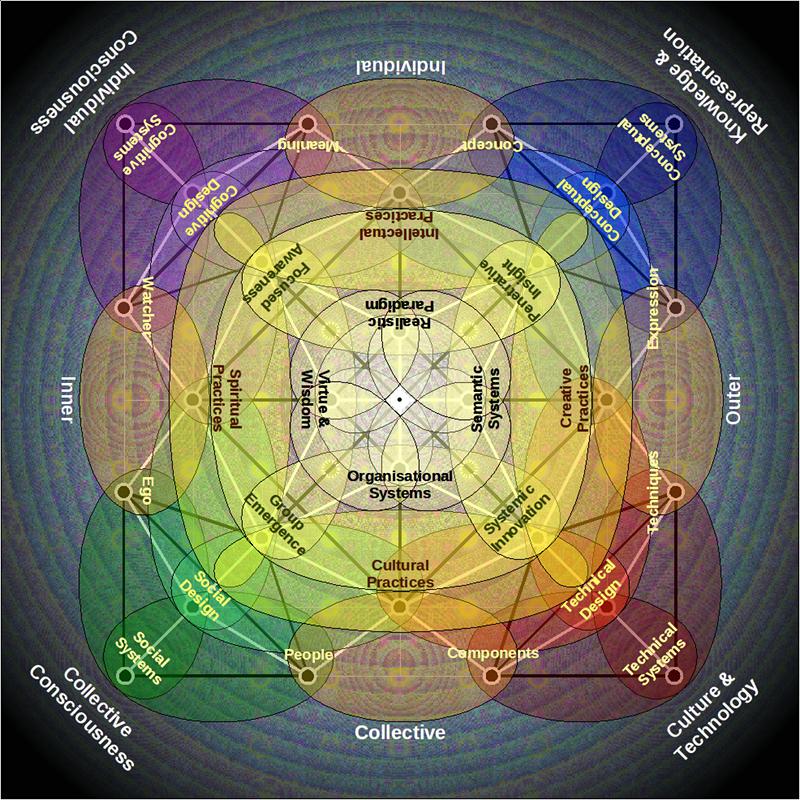
2010-07-31
This is the latest version of the structural basis of the high level design for a general innovation project. Note: I'll keep updating the diagram and adding comments until this design reaches a steady state...
Here are some slides of the various components shown separately... More >
|
|
|
|
2010-07-22
See the original and other answers at
http://www.quora.com/Is-the-universe-a-simulation
At the bottom of this page there are also
some other answers and my comments on them.
I will not attempt to answer this question here, but merely
provide some links to instances where the idea has been discussed.
This idea is becoming increasingly popular within the scientific
debate because it provides an explanatory framework that allows us to
comprehend quantum phenomena that were previously incomprehensible...
Whilst it is impossible to comprehend the quantum mechanical
description of the universe in terms of 'physical' phenomena, at the
same time we are finding that thinking in terms of information
processes allows us to understand quantum phenomena, not as something
bizarre and paradoxical, but as the natural & necessary
properties of a simulated virtual reality. More >
|
|
|
|
2010-07-16
Quoted from my comments to a facebook
conversation...
Some Information Theoretic Background
In terms of communication, the issue of coherence is related to
the transference of pattern/structure between information spaces.
E.g. the transference of an idea between minds or an email between
computers. More >
|
|
Page: 1 2 3 4 5 6 Older entries >> |
|
