|
|
 6 Aug 2004 @ 10:49, by quinty. Politics 6 Aug 2004 @ 10:49, by quinty. Politics
Yes, like the proverbial bull in a China shop we have created a mess in Iraq and now we, the US, have a responsibility to clean up after ourselves. And this sense of moral obligation is understandable. But before concluding that we have no other choice but "stay the course," I think we should also ask ourselves some questions. More >
|
|
|
|
 23 Jul 2004 @ 14:52, by quinty. Politics 23 Jul 2004 @ 14:52, by quinty. Politics
We all know that politicians always talk about doing the “courageous” thing, perhaps because they so rarely do so. And that boasting of being “courageous” is merely another method of pandering. They know, or believe, this is what voters may want to hear. More >
|
|
|
|
20 Jul 2004 @ 21:30, by craiglang. Politics
I discovered a rather disappointing thing today, as I got to my car at the end of the workday. A couple of months earlier, I had placed some new bumper stickers on the back of my car: One expressing environmental thoughts, and one with an American flag, and the words "Peace is Patriotic". When I came out to the parking lot after work today, I noticed that some turkey had ripped off the Peace bumper sticker. More >
|
|
|
|
 16 Jul 2004 @ 19:51, by ming. Politics 16 Jul 2004 @ 19:51, by ming. Politics
Al Qaida couldn't dream of a better government in the U.S. than George Bush's. They're a splendid help in the direction of destroying the United States, in providing plenty of new places to have terrorist bases, and plenty of new well-motivated recruits. And Bush could sure use another terrorist attack to boost his ratings. Quite some win-win synergy there. So, what do you say are the chances for that happening before November? Or, even better, around the election itself? Bush's people seem to be planning for just that. Cancel the election, declare a national state of emergency, and just stay on as a dictator. That's a great plan.
It would be quite appropriate if the U.N. would monitor the U.S. elections, like a group of congress people proposed. The U.N. unfortunately said no. And the Bush government wouldn't have let them, of course. The system probably wouldn't stand up to any kind of organized scrutiny. You know, faulty voting machines without a paper trail, run by companies that support the Republican campaign. Plus the long list of other tricks and irregularities. The kind of stuff that Congress strikes from the record if somebody dares to mention it.
Anyway, just wanted to complain a bit. I'm no longer there, but the state of the U.S. unfortunately affects the rest of the world greatly.
Oh, and for something more to be freaked out about, Thomas mentions this story about a lady who believes she experienced a dry run for a terrorist attack on a plane, and the apparent inabilities for the system to respond well to that, because of rules for political correctness, etc. For example, an airline can't take aside more than two middle eastern people at a time, or they get big fines. More >
|
|
|
|
 15 Jul 2004 @ 12:29, by jazzolog. Politics 15 Jul 2004 @ 12:29, by jazzolog. Politics
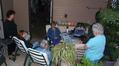
In the photo Dana, Ilona and other guests at a houseparty "interact" via computer with Michael Moore.
The universe is like a safe to which there is a combination, but the combination is locked up in the safe.
---Peter De Vries
June gone, now, July's moon.
I age: how many more to meet?
Won't let mind linger on the endless things beyond me.
I'll try to finish this one small cup.
---Tu Fu
Nothing is often a good thing to do and always a good thing to say.
---Will Durant
It's hard to follow Professor Durant's witty truism with a Log entry, but I'll promise at least to be brief. Whitman wrote the great American poem and called it Leaves of Grass. In this political season we are reminded the leaves turn brown and die without healthy, well-nourished roots. This is the election of the grassroots in America! More >
|
|
|
|
17 Jun 2004 @ 15:37, by ming. Politics
Via Wealth Bondage, here's this from the Cato Institute: An ownership society is a society that values responsibility, liberty, and property. An ownership society empowers individuals by freeing them from dependence on government handouts and making them owners instead, in control of their own lives and destinies. In the ownership society, patients control their own health care, parents control their own children's education, and workers control their retirement savings. Yes, too bad you don't qualify. What a chilling bunch of crappy double-speak. What it means is: This is why you have no healthcare insurance, why the public schools are enormously underfunded, and why the social security fund has been depleted years ago. It's because you're supposed to do all of those things yourself. Because that's what it means to be a free person: that the government isn't doing anything for you. If you pay for everything yourself, you're in control. I guess that's a particularly American illusion. Or a conservative political ideology, or whatever we'll call it. Pretty much from the same people who've increased the U.S. taxation and national debt and corporate welfare, orders of magnitude more than any of their democratic counterparts who were actually expected to do so. A couple of Republican presidents have succeeded more than any communist revolution would have. The reality of an ownership society unfortunately became that for 99% of the population, somebody else than you owns you and the output of your creativity and productivity.
If it were for real, it would be nice of course. I.e. that people can be in control of their own lives, and own what they do. And be responsible and free. But that requires real ownership and real freedom. Not just that the government takes half your money and doesn't give it back, and you're free to have a mortgage and buy a big car on credit, and that you just barely can afford your health insurance. No, rather real freedom and real democracy and ability to live by your own devices. Owning your own life. Co-owning society. Would be a nice idea. More >
|
|
|
|
 9 Jun 2004 @ 13:23, by quinty. Politics 9 Jun 2004 @ 13:23, by quinty. Politics
Is there any truth in this? What this author says doesn't seem inconceivable to me. Now this is not intended to be a jab at the president, George Bush. Nor do I gloat in putting this article up. It is because this man is so powerful that if he hiccups tectonic plates shake. That his state of mind is too important to the world for us to merely pity him if the pressure, which he himself created, is causing him to crack up. If what this author says is true then this is serious stuff.
From Capitol Hill Blue More >
|
|
|
|
 26 Mar 2004 @ 10:31, by ming. Politics 26 Mar 2004 @ 10:31, by ming. Politics
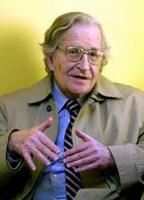
Noam Chomsky has a blog now, called "Turning the Tide". And, as always, he speaks hard-hitting words about things he knows well about. Here's one sample:What can we do about it? Just about everything.
The IMF is hardly more than a branch of the Treasury Department. Economist Jagdish Bhagwati, no radical, refers to the IMF- Treasury-Wall St complex that is a core part of de facto world government. The Treasury Department is part of the US government. If we had anything remotely resembling a democratic culture, actions of the government would be under the control of citizens, which would mean that citizens have to at the very least know something about them. And beyond that, we would have mechanisms to engage in political action. And in a more democratic society the third component, Wall St., would not exist in anything remotely like its present form, and what would exist would be under popular democratic control.
But any of this requires constructing the basis for democratic participation, which has been very badly eroded in the US, creating what's often called a "democratic deficit" when we refer to others -- in our own case, a huge democratic deficit.
People in the more civilized sectors of the world (what we call "the third world," or the "developing countries") often burst out laughing when they witness an election in which the choices are two men from very wealthy families with plenty of clout in the very narrow political system, who went to the same elite university and even joined the same secret society to be socialized into the manners and attitudes of the rulers, and who are able to participate in the election because they have massive funding from highly concentrated sectors of unaccountable power that cast over society the shadow called "politics," as John Dewey put it.
But it's up to us whether we want to tolerate this, and if we could begin to approach the level of democracy of, say, Brazil, we could do quite a lot about IMF conditionalities. And it doesn't happen by just showing up once every four years to participate in an "election". More >
|
|
|
|
24 Mar 2004 @ 11:00, by craiglang. Politics
Last weekend, I attended the local DFL (Democratic-Farm-Labor party, the Democratic party in Minnesota) convention, where we selected delegates to the state and congressional-district conventions. Politics is always a fascinating thing both to participate in, and to observe, and this time was no exception. At this convention, I noted some very interesting dynamics between the people involved. More >
|
|
|
|
2 Mar 2004 @ 20:36, by craiglang. Politics
A fascinating evening at the Minnesota Democratic caucuses. Several things things truly impressed and amazed me.
1) The number of people who turned out to the caucuses. There were about twice as many people present as I normally see at a precinct caucus.
2) The intensity of the feeling in everyone present.
There was a powerful feeling of coherence there - a single focus, returning control of the country to the people. I found that consensus was formed very quickly on resolutions, although there was discussion on nearly every point. It appeared that everyone was focused on an objective, rather than on political division, or making smaller individual points. There was the sense that there is too much at stake.
It is the same wherever I look. The deep-seated political division in the USA is so thick, it feels like you could cut it with a knife. This political season is going to be deep and emotions are going to run hot and heavy. More >
|
|
<< Newer entries Page: 1 ... 7 8 9 10 11 ... 13 Older entries >> |
|
