|
|
 28 Jun 2010 @ 00:03, by ming. Systems Thinking 28 Jun 2010 @ 00:03, by ming. Systems Thinking
Synchronicities are meaningful coincidences. Subjectively meaningful. Several things happen in adjacent space or time that somehow fit together, even though they supposedly didn't have anything to do with each other.
Really, everything is always connected with everything else. The multiverse is probably really all in one piece. But there are so damned many pieces, and we're so out of touch with the inter-connectedness of everything, that most of the time most of the pieces just don't fit together at all.
Just look at your own day and the inflow you probably got today. Loads of e-mails, news stories, tweets, advertisements, phone calls, etc. Some of them were maybe exactly what you needed at the right time, but more likely, most of them didn't hit any spot and were just distractions.
A synchronicity would be if you suddenly get a bright idea, say that you could have a mushroom farm. Two seconds later you check your e-mail and, lo and behold, one of your friends just sent you an article about basement mushroom farming. It is a synchronicity. We could say that it is a random coincidence, because your friend didn't really know you just got that idea, and he sent the article for totally unrelated reasons. But it is meaningful to you, like a sign from the universe that, yes, that's a good idea.
Or, you join some new group on Facebook, and immediately run into somebody who you went to school with, who incidentally is into some other obscure unrelated thing you're into too, like paragliding or 12th century Russian poetry. A synchronicity. It isn't just some superstitious silliness. It tells you that stuff is connecting.
Just imagine now that we can jack up the rate of synchronicity in your life. More synchronicity per unit of time, and less non-synchronicity. What if most of the chance meetings you had turned out to be tremendously meaningful and useful? What if most of the unexpected pieces of information you received turned out to unexpectedly be exactly what you needed at the time?
There are lots of quite straightforward ways of increasing relevancy in your life. If we were talking ads, you could receive more targeted ads. Instead of ads targeted at "anybody and everybody", you might get ads that fit your profile, and that are likely to suggest something to you that you actually might want. Of course it would be even better if they only suggested to you exactly what you want, but it would still be an improvement. Amazon's book suggestions are pretty good, because I've bought from them and they can approximate what I might like that I don't already have. Book suggestions in random magazines in my mailbox are not very good.
By simply increasing the number of things I'm exposed to, we might increase the number of fits I run into. Particularly if we can lower the cost per exposure at the same time. It requires me much less effort to scan the twitter feeds of hundreds of people than it would take me to read all their blogs, which again is much less effort than would me needed if I had to interview each one to find out if we match somehow.
What we need and want, what inspires us, what triggers us - it is like the receptors on genes and anti-genes. OK, it probably isn't, but it is a suitable metaphor. Certain anti-genes will fit together with certain genes, because their "plugs" fit together. It is a general principle for many parts of living organisms. Receptors are essentially protein molecules to which certain types of signaling molecules can attach. Put a bunch of each together, in a big mix of other stuff, shake and stir it vigorously, and a lot of the receptors will end up connecting with the matching molecules. Increase the volume of any of them, or increase the speed of flow, or increase the random shaking, and you'll see more of them connect. Meme-receptors probably work the same.
It is a selection bias as well. One sees what one is looking for. But it is more than that. Synchronities are matches that we weren't particularly looking for at that time. Granted, we were looking for them elsewhere, so they were still present in our consciousness somewhere.
But it is all also more than that.
I would claim that synchronicities are a sign of collective intelligence. You see more synchronicities, something about the bigger system around you is working at a higher level. There's an alignment happening, possibly at a level you couldn't easily understand all by yourself.
It is like being "in the flow". Things are aligned. But not just aligned in a very straightforward one-dimensional way. Things are aligned at levels you aren't conscious of. So, things just appear when you need them, answers appear seconds after the question, solutions show up when there's a problem. You take a step into the river and a rock happens to be there to support you.
None of us appear to be smart enough individually to solve the big problems in the world. It doesn't matter if we put everything we know into a neat spreadsheet and analyze it carefully. We just tend to think in too few dimensions, like trying to solve five dimensional problems with two-dimensional logic.
So, we really, really need to find ways of operating at a higher order. The hope is for collective intelligence. That somehow we'll succeed in organizing ourselves in such a way that our efforts not only don't cancel each other out, but all together we accomplish more than the sum of our individual efforts. And that somehow the net result of our actions demonstrates a higher level of intelligence than what any one of us could have demonstrated individually. Collective Intelligence. Being smarter together.
Since it isn't just something we can *figure out* brute force the same old way we'll figure out what career to pursue or why our car makes a funny sound, we need some new types of tools.
We need tools that increase collective intelligence.
We also need ways of being aware of an increase in the signs of collective intelligence. I claim that synchronicity is one of those signs. If you see more synchronicities, more collective intelligence is happening. Something is lining up.
Like bio-feedback, if you have an indicator of whether something is going in the "right" direction or not, you might suddenly find that you can increase it, even though you didn't think you could. It certainly beats operating in the dark.
So, if you experience more fits, something more intelligent is going on. Even if you don't understand what it is, you might still be able to steer towards even more.
More surprisingly meaningful connections will, of course, weave even more coherence, and give rise to even more delightful just-in-time surprises.
More >
|
|
|
|
 27 Jun 2010 @ 02:28, by ming. Systems Thinking 27 Jun 2010 @ 02:28, by ming. Systems Thinking
The old civilization (human civilization in the last few thousand years) is pretty much based on the observation that humans, on the average, work badly together, but they can be controlled. Thus, history is the story of individuals, the lucky few who were in the right position to control others, and who knew how to do so. Alexander the Great couldn't have conquered much all by himself. His genius was in persuading 100s of thousands of soldiers to do what he said, to go and get killed so that he could be the dictator of a huge empire. Most memorable parts of history worked pretty much the same. Some guy used force and persuasion to make lots of people do what we wanted done, and the result became something impressive. Empires. Pyramids. Roman aqueducts. Greek temples.
Our society isn't much different today, other than that the control mechanisms have gotten much more clever and convoluted, and they've been camouflaged as democracy, free markets and free speech. What's different is that it is no longer the very visible kings or presidents who are in charge of very much. They go with the flow almost as much as everybody else. What hasn't changed is that it is the very, very few who control the majority of what's going on. But it is the vast majority that enable this to happen and that provide all the manpower. Despite that what they're getting isn't really working very well.
Western civilization - it would be a good idea, like Gandhi said. Democracy, that would be good idea too. Free markets would be an excellent thing to implement. We don't really have those, even though most people on the street would tell you that we do. They'd also tell you that money represents value, and that everybody has an equal opportunity, and one is free to say whatever one wants. All of which is a cartoonish propaganda reality which doesn't really exist anywhere on this planet.
However, the really good news is that all of it could change very, very quickly.
The thing is that we simply haven't worked out how to work together yet. The groups we're familiar with are simply collections of people who follow one leader, or a few leaders. Corporations. Governments. Religions. The News. We're talking about thousands or millions of people who voluntarily choose to do what a handful of people tell them to do. Usually towards their own ends, for their own gain, or simply based on their particular personal insanity.
Mind-boggling. Why do we do that?
Because collective intelligence hasn't worked for us so far.
You put a group of people together, most of the time, you'll end up with something more stupid than any of the individuals you put together. They'll argue, posture, waste time, and probably end up agreeing on something not very useful. But give them a leader, somebody who'll inspire them, give them a purpose, while making sure they get paid and fed, suddenly they'll all line up and do what they're told.
But imagine that a group of people actually suddenly could become more than the sum of its parts.
Imagine that the natural order of things would be that a group of people would self-organize in order to maximize their common interests. Imagine that together they'd accomplish more than simply the sum of their individual contributions, because of the synergy between then. They'd operate at a bigger order. Surprisingly clever and wonderful stuff would happen that none of them individually could have predicted, and that none of them directly caused.
That's called Collective Intelligence. That's when a group of people becomes smarter than any of them individually, and even smarter than them all together. It's a positive sum. 1 + 1 + 1 = 5.
That's not a wild-eyed fantasy. It is simply that humans haven't been very good at it so far. The result of that has been that 0.01% of the population control the other 99.99%, who do what they're told, and who're rewarded in some mediocre way for doing so.
Imagine that it changed one day. Maybe somebody came up with a tool that allowed people to actually work together. Maybe it just started happening by itself. Evolution. Suddenly we see win-win relationships around us.
Just like Alexander the Great by himself in his underwear wouldn't be worth much, and just like Adolf Hitler was just a little angry Austrian guy, part Jewish, mediocre painter, chronically constipated, most of the great leaders of civilization don't amount to much by themselves. Oh, some of them do. Some leaders would remain leaders even if we had a choice about it, because they're inspiring, because they're empowering and enabling catalysts who know how to make things happen.
But most of those very, very few who call the shots should probably be very afraid.
Because if we actually figured out how to work together, they'd be out of a job from one day to the next.
Elected leaders are only there because they've been elected. One little scandal, the truth coming out, will remove them from office in a couple of days. And nobody might vote for them next time.
Multi-billion dollar multi-national corporations are only in the position they are because people are buying their products, voluntarily, but without really knowing what's behind it, who's doing what, where these products come from, what the money is used for, etc. If they knew, they'd make different choices right away.
While we're scattered, disjoined, dispersed, unconnected, distracted and confused - we're not very effective.
We, the people, are the real power. If a million people agree on what is in our common interest, what's one anti-social asshole gonna do? Go hide? Unfortunately, today, that one guy is the CEO, and you could be laid off any day if you don't do what you're supposed to. But if we actually were talking with each other, he'd be the guy who'd be running for cover. Assuming he's one of those guys who got there by deceit and coercion.
There is one problem to solve. It is THE problem. How can we work together, towards our common interests, in a way that is constructive. In particular, how can we together solve complex problems that we wouldn't be able to solve individually.
It is called collective intelligence.
It isn't just some crazy left-wing idealist dream. It is probably the natural order of things. The universe works perfectly well. Stars are born, stars die. Evolution has gone on for billions of years. Billions of life forms coexist in great diversity and synergy. It is just us humans that for a few thousand years have gotten lost in the dark ages of mental and emotional separation. We found that we could think abstractly, invent stuff, communicate, organize, manipulate. That made us surprisingly productive and simultaneously surprisingly malleable and controllable.
Chances are that we don't remain dispersed for much longer. One way or another we'll figure out how to actually work together. Or we'll go extinct within the next couple of generations. Evolution happens when there's a bit of a crisis. Probably we'll change and we'll make it.
When we change, it will probably happen quickly. Because, really, it is not exactly about what any one of us are up to. Rather, when we find out that we can work together and the sum will be greater than the parts, there will be no way back.
That will be the Singularity.
When suddenly we no longer all are working against each other, allowing the few to manipulate us for their personal gain, when suddenly there is positive gain in all our collaborations. When suddenly humanity starts to feel smart and creative and constructive, rather than homicidal and suicidal. When humanity wakes up.
There are really only a few anti-social fucktards who'd even be against this. Most all of us want humanity to succeed. We want to be free. We want to make a difference. We want to be happy. Duh. Most people are good people.
If the truth is available, and easily communicated, and large groups of people can work together on common goals, big things can happen. It hasn't happened so far. It probably will soon. In part because technology is evolving rapidly. It will probably soon be impractical to keep us all apart.
Doesn't really matter if you're left wing or right wing or religious or scientific. There are a lot of artificial abstract ideas that separate us. But if we actually could talk about what we really care about, and work together on the solutions, nothing much would need to stop us.
Until we get there it is maybe a bit of a pain to try to work with others. Might be easier to either force somebody else to do it our way, or to follow somebody else's program.
But once we learn to actually network... the world will not be the same again. There probably won't be any way back.
So, if you're in the business of deceiving the many, for your own personal gain, be afraid. You'll need a new job soon. Something is emerging that you can't possibly compete with. More >
|
|
|
|
 23 Nov 2008 @ 22:54, by jhs2. Systems Thinking 23 Nov 2008 @ 22:54, by jhs2. Systems Thinking
Joachim's 13. Buch wird hier in Auszuegen vorgestellt, uneditiert, gekuerzt, und verhunzt, aber DA... !!!
(de Ortografie werde mer auch noch hinkrieche..!) More >
|
|
|
|
 20 Oct 2008 @ 18:48, by jhs. Systems Thinking 20 Oct 2008 @ 18:48, by jhs. Systems Thinking
Worldwide Conference On Systemic Flaws and Solutions in Society 2009
A global conference to document systemic flaws in our society and to point to existing or to new solutions with emphasis on how to prevent systemic flaws in the future.
------------------------------------------------------------------------------
Rationale:
Human Civilization is threatened by a systemic collapse. Not just in some isolated segments but as a whole. In the case of a systemic breakdown repairing isolated errors becomes pointless. Only the elimination of the principal structural abnormalities within the system will avert the danger of collapse. In a time like this, every Human is being challenged to confront and assess the damage already done and to work together to determine the course of our future as we cannot defer this responsibility to 'higher' authorities any longer.
In the past decades the awareness of the importance of systemic thinking for society at large has already been rising steadily. However, applications and proposals for solutions of identified problems have not yet been forthcoming in significant numbers. Whether this was be due to resistance in academical circles or due to the circumstance that the field of Systemics in itself has been usurped and abused by other interests, will be one of the topics of the Conference. We will take special care and attention that this conference will not be a victim of such reprogramming.
This conference aims to:
- document the major systemic flaws in our current civilization
- point to existing or new solutions
- investigate how systemic flaws can be avoided in the future
- provide an interdisciplinary platform and is not limited to contributors with academic degrees
The contributors are requested to:
- strive for excellence in form and essence of their presentations
- heed attention to not getting entangled in the contemplation of cartesian (mechanistical) errors within society such as the critique of representants of flawed power structures instead of analyzing the present systemic deficiencies themselves
- add their submissions for the conference themselves in the Wiki : www.systemicflawsandsolutions.com.
If the number of participants exceeds the capacities of the conference, an election process may limit the number of contributors.
The conference is planned as a multi-cultural event but organizational help can currently only be provided for the languages English, Portuguese Italian, Spanish, French, and German,
The Conference itself is planned for:
March 12th-15th, 2009.
Besides the Virtual Conference itself, 'traditional' conferences may be organized in various countries and their languages.
The submitting authors grant the publication of their articles in the 'Proceedings of the Conference On Systemic Flaws and Solutions in Society 2009' and their video presentation(s) in a future video documentary. Both publications are projected to be not-for-profit and will be realized only if appropriate funding will be available.
You may submit only your own work and use only your own images or those drawn from public domain resources. You may not use offensive language or images.
Please post any questions via the community portal. Official e-mail address of the conference: systemic.flaws.and.solutions@gmail.com More >
|
|
|
|
 7 May 2008 @ 09:27, by anandavala. Systems Thinking 7 May 2008 @ 09:27, by anandavala. Systems Thinking
Before joining the conversation, please read and accept this Invitation to a Conversation.
What is a System?
A system has two aspects, its
transcendent aspect is as a transitory pattern of transcendent
information that conditions the flow of transcendent information.
When the system is perceived from an empirical perspective by another
system within the common network of interacting systems, then it is
experienced via its observable attributes, which result in
information that flows into the observer system's inputs. This
results in an experience of a manifest form, which is the empirical
aspect.
Subsystems interact to form
supersystems; i.e. patterns dynamically merge to produce larger
patterns. Whilst the transcendent patterns are what they are the
empirical forms exist only in the eye of the beholder. A system may
interact with other systems that are considered to lie 'within'
different supersystems so it may be considered a subsystem of either,
thus there are no absolute system boundaries. Different observers may
observe different interaction channels and thereby resolve different
system boundaries thus they experience very different empirical
forms.
Why should we care to clearly know
what a system is?
We are systems formed out of
interacting subsystems and we interact to form supersystems. All
manifest forms are systems. All events and processes are system
interactions. Our transcendent part we call our 'soul' and our
empirical part we call our 'body'. The empirical universe is a
construct of the experiential aspect of systems and behind this
perceptual veil there is an information theoretic aspect. Some call
this the quantum realm, spiritual realm, Brahman (Vedic), Hundun
(Daoist), Heaven (Christ) and so on.
Everything that is and everything that
happens is the experiential aspect of a unified transcendent process.
This is analogous to the way that a virtual reality is the
experiential aspect of a unified transcendent process.
Understanding the nature of systems
leads us to an understanding of ourselves, of the universe, of what
is happening and how we should respond in order to harmoniously and
effectively participate in the process of evolution that is underway.
What fundamental questions can it
help answer?
A deep understanding of the nature of
systems can help answer all fundamental questions except one, and it
can explain why it cannot answer that one.
There is only one true mystery – What
is the true nature of the fundamental reality generative process?
A manifest form cannot approach this via enquiry; e.g. a sentient AI
character in a virtual reality could realise many things about their
situation all the way down to the computational process itself, but
they cannot realise that the computer is a particular machine sitting
in a particular room, they can only ever know the computer from
within. Similarly, we can systematically comprehend all the general
principles of our reality right down to the fundamental reality
generative process and we cannot enquire beyond that.
Holism is a metaphysical paradigm that
focuses on the whole and comprehends the parts as discernible
features – objects of perception – within the whole. Reductionism
is a metaphysical paradigm that focuses on the many parts and their
interactions and envisages the whole as the product of the many parts
and interactions. Unified system science can comprehend both
paradigms and show how they relate to each other. Similarly it can
unify duality and non-duality. Transcendent and empirical. Subjective
and objective. For these reasons I propose that a unified system
science could provide a useful conceptual framework for the
development of a unified awareness that can flower into a new
consciousness for humanity.
Best Wishes,
John Ringland
Before joining the conversation, please read and accept this Invitation to a Conversation.
|
|
|
|
4 May 2008 @ 01:08, by anandavala. Systems Thinking
Before joining the conversation, please read and accept this Invitation to a Conversation.
Excerpts from brainstorming notes related to
SMNDesignView
For more information on SMN see SMN
on Anandavala.
I am exploring the idea of developing a Netbeans 6.0 module,
either as a plugin or as a rich-client application.
Things to consider:
I need a good vision of what I am building before I start
designing it.
What is it that the SMN functionality seeks to provide the
application user? What will people want the whole application or
plugin to do?
What sorts of things will people want to be able to do with the
GUI and with the model and with the simulation space itself via the
GUI? How best can the GUI facilitate this?
If developed as a plugin then how will the SMN functionality be
integrated into the rest of Netbeans?
If developed as a rich-client application then how will it come
together as a single whole application?
How best to implement the matrix itself? As some kind of table? It
needs to be programmatically controlled and not set in the code –
we may want more or less rows or columns, we may want different types
of elements altogether (e.g. instead of text fields they are buttons
perhaps).
The matrix-view is a small window that allows for detailed access,
but for large models we need a lower resolution but broader scope
view, we could have subsystem / supersystem viewing levels for the
matrix. One could view systems at the atomic scale, or as a single
whole system, or at many different levels between these. The designer
can click on systems (either by row, column, vector element or rowOp)
and choose to collapse all sibling subsystem and show only their
supersystem. Or they can drill into a supersystem and show all or
selected subsystems.
The state vector needs to be represented somehow in the
matrix-view so that the system designer can visualise the current
state of the model. The multiple system viewing levels apply to the
state vector as well.
Whether an SM or an SV element, at each level there is some screen
graphic to represent it to the designer. If the element is an atomic
system it shows a text field to display and edit the data. If it is a
conceptual system then there is an icon that displays the subsystems
as small squares within the element.
When the designer double-clicks on an element they drill into the
system and reveal all subsystems. There is also a right-click option
on elements that brings up a dialogue box for selecting which
subsystems to show. More >
|
|
|
|
25 Apr 2008 @ 11:32, by anandavala. Systems Thinking
Before joining the conversation, please read and accept this Invitation to a Conversation.
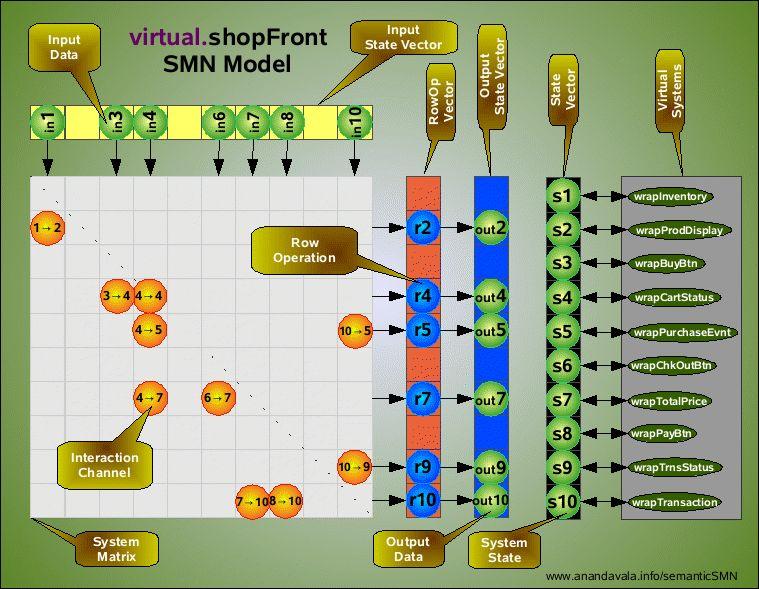
Here's a posting to let you know what
I'm up to lately. Like I said in the post on What
exactly is SMN and how does it connect with other technologies?
I've been focussing on concrete implementations lately, rather than
on discussions. One project was an artistic collaboration with
Glistening Deepwater, called Mystic
Visions. I've explored quite deeply into semantic and web 2.0
technologies. I've implemented the core algorithm for SMN in Java and
the system simulation engine now has full functionality and the
models can be imported or exported as XML files (this is still in
further development but will be available for download soon).
But the current project on my mind is
the idea of a System Oriented Modelling Paradigm. To give you
some idea of what I mean, below are some excerpts from recent design
documents – they are just a brainstorm at present. If these ideas
make sense to you and you want to get involved then contact
me – it will soon be released as an open source project.
The
project involves an analysis of general computational processes and
general systems, which re-orients system modelling practices upon a
coherent metaphysical foundation rather than on a
commonsense naïve realist foundation. Traditional modelling
practices are seen in a new light and minor optimisations are
proposed that can considerably extend the potential and overall
functionality of designed systems. A detailed example is given in the
context of software engineering.
More >
|
|
|
|
23 Apr 2008 @ 09:25, by johnjoseph. Systems Thinking
Pascal’s Triangle, Self-Similarity and Phi
In maths the simple operation of adding two consecutive elements in a sequence and then iterating, which process is well-known to us in the Fibonacci sequence, leads to many of the more remarkable properties we come across in nature and mathematics. The Fibonacci sequence, as I pointed out in my last article, is based on self-similarity and exhibits the mystical number and proportion called the “Sacred Ratio”, approximately 1.618… which is an irrational number.
Now something very similar occurs in that very famous table of numbers, known to the ancient Chinese, but known to us as Pascal’s Triangle. This is a symmetrical table, with ones at the apex and at each edge, with the intervening numbers created by adding together the two numbers directly above and to either side. Pascal’s triangle has a multitude, maybe indeed an infinite number of remarkable properties. Every interesting thing in mathematics more or less, can be found in different ways in this pyramid. Fibonacci itself, can be found in sequence if you add the short diagonals. This of course yields Phi, the Golden Proportion. However, this is a bit misleading, because Phi is conspicuously absent from the other patterns you will find in this triangle. This is because if you divide any two of the numbers in the table they will be a rational fraction, not irrational. Adding different numbers together, as in the Fibonacci example, is the only way to get a sequence which gives Phi. The whole structure is based on the iterative technique mentioned above, and I suspect that this technique is a cornerstone of self-similarity, though I can’t demonstrate it as convincingly here as I did in my previous article on Fibonacci.
I believe, since Nature produces Phi all over the place, and Fibonacci sequences in the number of petals of flowers and the spirals of shells, that at an early stage in the evolution of life, in plant RNA and animal DNA, the simple iterative technique I refer to, was encoded and passed down to following generations. Thus we find Phi everywhere in Nature. Why it leads to very remarkable properties in mathematics is another issue and one I will address in a later article. More >
|
|
|
|
13 Apr 2008 @ 09:47, by johnjoseph. Systems Thinking
Mysticism and Science: A new Union
1. Phi is the constant of self-similarity
It is my belief that the way forward involves the coming together of mysticism and science, to give a new holistic discipline which will combine the quantitative strengths of science with the holistic and qualitative strengths of mysticism.
What I am writing is not “sacred geometry” or “sacred mathematics”, but just plain true knowledge. My first assertion is that the number or ratio Phi, known from antiquity, is the constant of self-similarity. Let me illustrate this with a simple numerical example. Take the Fibonacci sequence
1 1 2 3 5 8 13 21 34 55 89 144 … … …
each number is the sum of the previous two terms, thus 8 = 5 + 3. It is very significant that if you divide any term by the immediately preceding term you derive a fraction which is alternately greater then less than Phi, and which quickly closely approximates its value of 1.618…. For example 89 divided by 55 is 1.61818, whereas 55 divided by 34 ( the preceding number) is 1.617647058
Now, the next thing to observe is that this sequence is self-similar:
1 1 2 3 5 8 13 21 34 55 89 144
0 1 1 2 3 5 8 13 21
taking away each previous term, in sequence leaves a sequence which is identical to the original one. The whole thing appears to be nested and self-similar, and this process can be repeated ad infinitum.
Now let us look at the famous right-angled triangle and Pythagoras’ theorem. There are, it seems, hundreds of valid proofs of the theorem that the square on the hypoteneuse is equal to the sum of the squares on the other two sides. One of the least well-known of these proofs is the one which uses the fact that the two small right-angled triangles formed when you drop a perpendicular from the original right-angle to the opposite hypoteneuse, are similar to each other and to the larger triangle. In other words this is another example of self-similarity. It is possible to construct spirals ad infinitum around the vertices of the ensuing smaller and smaller right-angled triangles which you can construct within these two triangles. And where you find equiangular spirals you will always find the ratio Phi, approximately 1.618
There are many other sequences e.g. the Lucas sequence, which like the Fibonacci show the Phi ratio, and they always display a form of self-similarity. I will leave it to you to investigate.
Phi is indeed the constant of self-similarity. More >
|
|
|
|
1 Dec 2007 @ 16:36, by rdbunston. Systems Thinking
January 1975, a 2AM brain flush
A long slow response to a chance encounter in Sydney Australia in 1972 with a "critical path systems analyst" who introduced me to the global systems dynamics programs of Dr.s Forrester, Meadows et al of MIT and the Club of Rome sponsored Limits to Growth Studies.
The ensuing decades have been shelves full of books, 4 years of consultant work in the 1980's with international efforts to resolve increasingly desperate third world housing issues..a lot of frustrating discussions with governments and business circles and facing the undermining realities of layers of conspiracies and international piracies.
The scale of the self evident unfolding events forces reconsideration of personal responsibility and most importantly, personal capacity. More >
|
|
Page: 1 2 3 4 Older entries >> |
|
