|
|
2010-12-27
Recently I have been feeling harassed by someone and yesterday during
"peace negotiations" with them I realised why they were
behaving how they were, and I took a fresh look at myself and saw that I
also do a similar thing - it helped me to understand many things about
my life. I'll try to explain what I realised and what that meant to me.
Perhaps this insight might be of some use to you if adapted to your
life...
Firstly, I'll describe how they were behaving, at least according to my
perceptions. Have you ever known someone who came to look at you through
shit-coloured glasses and assume that was the real you? And then tried to
“help you” by seducing you and others to see you in that shitty way? And
they did all this in the name of Love? And they misunderstood your attempts
to clarify things as defensiveness? And they remain staunchly self-righteous
– believing themselves to be a beacon of loving kindness?
I realised that I also do this to others by looking at aspects
of society (such as propaganda, entrenched confusions, self-reinforcing
closed loops of hidden assumptions, outmoded paradigms, etc) through
shit-coloured glasses and stating my views rather harshly at times. I
do this out of love for the victims of illusion and its resulting
suffering, the oppressed, the deceived and the exploited. I also do
it out of love for truth, reality, decency, honour, peace and
health. However this is only one view and most people see things
differently, for instance those seeking comfortable illusions or
distractions, those seeking power and dominance, those seeking mayhem and
chaos, etc. It is a subtle trap to fall into one-sidedness and to denigrate
the ways of others. Even if one knows that those ways are destructive and
dangerous it is not productive to denigrate them. Even if those
following those ways (e.g. authoritarians, mass media, materialists,
egotists, fanatics, etc) routinely denigrate other ways.
As part of a propaganda campaign it is standard practice to spread
a one-sided view and to denigrate other views, however this is really a
form of cultural violence, and violence begets violence. If one truly
believes that it is truth that will set us free, then one must accept
all ways no matter how abhorrent they may appear. One should not condone
them, but one shouldn't react with hatred towards them. Instead
accept them as part of what is and find ways to help the whole situation
evolve towards a healthier state. Rather than focus on attacking the
negatives one can focus on nurturing the positives.
Of course, this doesn't mean that I should never warn people of dangers.
That would be irresponsible, it just means that there are times, places and
ways of doing this. I must also learn to accept that many people will blindly
wander into suffering and despair and there is nothing that I or anyone else
can do about it. Making regular snide remarks and disparaging comments about
these destructive paths is not going to turn anyone away from them, it will
only make people bitter towards me and more entrenched in their ways, whilst
at the same time corrupting my expressions and obstructing my communications
with others.
Overcoming negative reactions is not easy though, there are subtle
mind-games that must be overcome. I have found that in myself some of
these are related to the activities of the shadow, that part of ourselves
that we habitually deny even exists. That is what this article is about... More >
|
|
|
|
2009-11-11
Personality
In general a personality can be described as an integrated set of
modes of behaviour through which a system interacts with an
environment. Each system has a range of potential behaviours and a
set of stimuli / response associations. A stream of particular
behaviours arises in response to a stream of events, which are part
of an experiential interaction with some environment. Within this
stream of behaviours and associations there are patterns and this set
of patterns can collectively be called the generalised personality of
the system. Different 'modes' of behaviour correspond to different
sub-personalities.
Ego
The ego is a point of identification. It is a simulacrum of the
system symbolically represented within a complex system's stream of
consciousness. It functions as a point of self-reference and
self-control.
Ego + Personality More >
|
|
|
|
2008-11-30
Some comments inspired by two fascinating essays written by David
Chalmers, The Puzzle
of Conscious Experience and Facing
Up to the Problem of Consciousness.
The “hard problem of consciousness” is the issue of why is it
that we experience anything at all, or why is it that there is
something that it is like to be something? The reason why this
problem is intractable to empirical science is because in its
philosophical foundations empiricism
takes the contents of experience (phenomena)
to be the foundation of its ontology,
upon which all its later knowledge depends.
However it is impossible to use the contents of experience to
construct a theory of experience because, in a causal sense,
experience precedes the contents of experience. Empirical science
studies phenomena, their perceivable attributes, behaviours and
functional relationships hence it can explain much of the functional
aspects of consciousness such as how do we integrate information from
many sources into a coherent knowledge base or how can we verbalise
our internal states (the easy problems of consciousness) but it
cannot explain experience itself (the hard problem).
However, empirical science is not the whole of science. There are
rationalist
methods which, as quantum physics shows, can be very accurate
(quantum physics is by far the most accurate science ever developed
and it has rationalist rather than empiricist foundations).
Rationalist approaches must eventually connect with, and be verified
by their correspondence with the objects of experience, however these
are not their starting point. They take a rational theoretical model
as their ontological foundation and only when this foundation later
connects with experience are they considered to be verified. It is
conceivable that a rationalist theory could overcome the limitations
of empiricism and provide a scientific explanation of conscious
experience. More >
|
|
|
|
2008-06-07
Before joining the conversation, please read and accept this Invitation to a Conversation.
There are ancient roots to the use of observation and
rational thinking to understand the world but here I am addressing
the issue of modern 'empiricism'.
Also see these articles on naïve
realism, Scientistic
Heresy, Reclaiming
Genuine Religion for Humanity and Thoughts
on the Outline of a Unified Science. More >
|
|
|
|
2008-06-06
Before joining the conversation, please read and accept this Invitation to a Conversation.
General systems are naïve realist and it takes a high level
sentient awareness to overcome this.
The table below describes the ramifications of naïve realism
and unified realism as evolutionary forces. Each row of the table
follows on from the preceding row, thus evolving toward the bottom of
the table. We see that naïve realism produces successive levels
of illusion which build up through meta-system transitions into
higher level systems, which are driven by conflict and fear. Whilst
unified realism remains firmly connected to reality thus there is no
proliferation of illusion and the situation remains unified and at
peace. More >
|
|
|
|
2008-06-06
Before joining the conversation, please read and accept this Invitation to a Conversation.
The following table maps out the ramifications of naïve and
unified realism in different contexts. Each row can be read as:
“In the context of ________ naïve realism leads toward
________ whilst unified realism leads toward ________.” More >
|
|
|
|
2008-05-26
Before joining the conversation, please read and accept this Invitation to a Conversation.
I have been thinking a lot about Naïve Realism lately. It is a profoundly important concept to understand if people wish to safe-guard both their individual and collective sanity.
It came to my notice that the Wikipedia article on Naïve Realism was only a few paragraphs long, not referenced, quite biased and VERY misleading. So I rewrote the article using many quotes from philosophical and scientific sources with full references to map out the progression of our understanding of what it is and how it applies to our lives, the world and everything that we experience.
The new article is posted below but it will keep evolving (wikipedia version). More >
|
|
|
|
2008-05-09
Before joining the conversation, please read and accept this Invitation to a Conversation.
Also available as an A4 PDF.

|
|
|
|
2007-09-03
Before joining the conversation, please read and accept this Invitation to a Conversation.
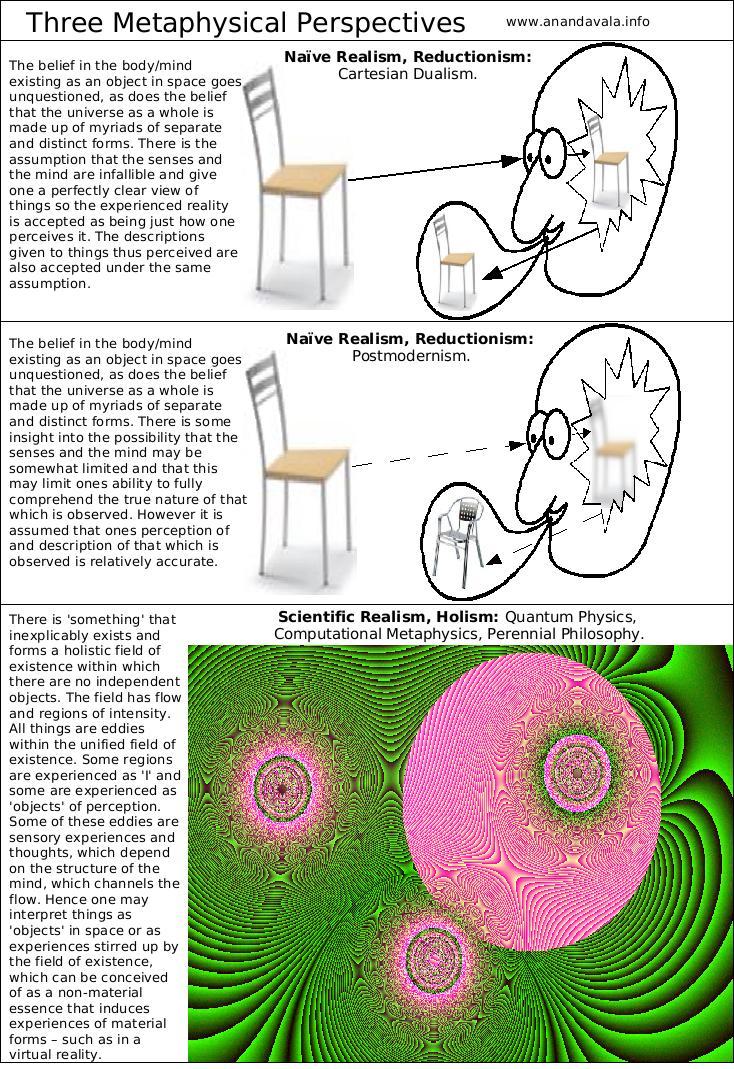
This is a very simple and very brief distillation of some very profound ideas. If you think about it the profundity will grow exponentially :)
Check it out... Three Metaphysical Perspectives.
|
|
|
|
2007-07-24
Did you know we all have blind spots! See for yourself. Just cover
one eye and stare at the central smiley, but observe all three, then
slowly move your face closer to the screen.
:)
:)
:)
At a certain distance (about 15cm) the left eye cannot see the
left smiley and the right eye cannot see the right smiley.
These are localised points of blindness and their dimensions are
apparent if you rotate your head.
These blind spots occur because at the point where the optic nerve
attaches to the retina there are no retinal receptors.
This means that there are holes in our visual perception. But
these holes don't show up in our experience! This is an important
fact. Think about it! More >
|
|
|
|
2007-06-28
Before joining the conversation, please read and accept this Invitation to a Conversation.
Commonsense, Fascist Regimes and the Ego
Whilst talking about
commonsense realism and truly overcoming it, are two
very different things it is still very useful to talk about something when there is
extreme misunderstanding about it.
To give an example - talking about the dangers of smoking and actually
quitting are two very different things however if a person believed that smoking
was totally natural and normal and there was no reason to quit then first they
need to overcome that illusion before they have any chance of actually quitting
and becoming healthy. Talk can be a vital preliminary to actually doing.
So I'll clarify commonsense realism a little more by talking about
commonsense in general. Commonsense is just a blanket term for whatever
unquestioned belief system is dominant at the present time.
At various times it has been commonsense to keep slaves or to beat children
or to oppress women or to carry a sword or to wear high heels or to smoke
cigarettes. Commonsense is a collective trance that changes over time according
to its own dynamic.
Furthermore, civilisation is a communal understanding and commonsense is the
foundation of that understanding. It is a subtle dogma that maintains a regime.
See
The Gaian-Ego Hypothesis and
Collective Meditation to Counter the Collective Ego.
Every regime has its dogma which is a set of beliefs that are protected from
reason by a culture of denial. The nature of a regime is determined by the
nature of its commonsense. More >
|
|
|
|
2007-06-27
Before joining the conversation, please read and accept this Invitation to a Conversation.
Psychological Manipulation
This is an excerpt from the e-book
The Gaian-Ego Hypothesis. Throughout the 20'th century vast resources and great minds were employed in
the research and development of psychological manipulation. For example, the
CIA's program of research in behavioural modification called MKULTRA
[FR,
FR];
it was a top secret project and little is known of its real depth and scope but
some indication of the nature of this project can be seen from this archive of almost
20,000 pages of declassified documents [FR],
also see these other archives [FR]
and here is some information on Russian efforts [FR].
Such projects were a major initiative throughout the 20'th century because the
technology became available and the motivation was irresistible. When the minds
of the masses are ideologically placed in the centre of power, research into the
technology of mass manipulation became critical and enormous effort was expended
in perfecting the science of manipulation. With trillions of dollars of vested
interests and the power of vast nation states dependent on the minds of the
population through their spending and voting choices, a means had to be found to
control the minds of the population, this is simple pragmatism and market
forces. The motivation is obvious, who would let their corporate empire and
imperial aspirations be left to the whim of the masses? Especially when it is
certain that competitors will be vying for control; every sensible power broker
had to get involved or otherwise be left behind. It essentially became an arms
race in psychological weapons that can be used against the population.
A degree of social conditioning is vital and leads to social cohesion but
when it ceases to serve society and starts to dominate and manipulate society it
starts to destroy society and to erode the very foundations of our civilisation. More >
|
|
|
|
2007-06-27
Before joining the conversation, please read and accept this Invitation to a Conversation.
A Psychological Perspective on Civilisation
This is an excerpt from the e-book
The Gaian-Ego Hypothesis. As background to this essay see the related essays on Psychological
Manipulation and the
The Man Machine - Organisms to Organisation.
The process of constructing
energised thought forms is the creation of
conditioned stimuli or symbols
that arouse an inner response. It is a cultural
memetic
technology that is the core technology with which
civilisation has been built. A system of coordinated symbols, in the old
language, is called an
egregore and
in the new language, it may be called a
paradigm.
Once conditioning has been imprinted in a population it provides hooks in
people's minds by which influence can be exerted, either by the people
themselves or by external power structures. It unleashes and harnesses the power
of the subconscious mind, thus it is a very powerful technology.
Once these hooks are in place they can be subtly manipulated and turned to
different purposes. For example, the rhetoric of "freedom and liberty" may have
been imprinted to encourage people toward personal freedom and liberty but once
this becomes a conditioned stimulus and it becomes a strong egregore/paradigm it
can be gradually distorted. This may take place within the context of an
authoritarian discourse so that it implies collective freedom and liberty
through greater strength, 'security' and authority for the governmental system,
which in turn promises to provide personal freedom and liberty, but in order to
do so it must impose measures that ultimately destroy people's freedom and
liberty. More >
|
|
|
|
2007-06-24
Before joining the conversation, please read and accept this Invitation to a Conversation.
Commonsense realism is a profoundly important concept that impacts
on all subjects. It is central to The
Scientific Case Against Materialism and The
Mystic Meaning of Original Sin is essentially that "Commonsense
realism IS the original sin". It is the root cause of all
delusion (which is the real meaning of 'sin'), the first of which is
the ego, which then forms the centre of a whole world of delusion
(maya or samsara). Without understanding commonsense realism we
cannot truly understand the ego (see these
articles for a systemic perspective on the ego).
In each moment of awareness commonsense realism blinds us to
reality and causes us to dwell in a fantasy land that is constructed
from false beliefs within our own minds that we unquestioning mistake
for the external objective world. With our thoughts we construct a
subjective experiential world with the ego as the main fictional
character at its centre and commonsense realism causes us to confuse
this as being the objective reality. I have discussed commonsense
realism in the above articles but I'll go into more detail about it
and its relation to the ego here. More >
|
|
|
|
2007-06-22
Before joining the conversation, please read and accept this Invitation to a Conversation.
The Mystic Meaning of Original Sin
This was inspired by
comments from Astrid. She associated it with selfishness and greed; the need
to take from the world. I agree but the original sin, I think, can be clearly
identified, let me explain...
Firstly regarding sin, in all the mystic traditions that I have studied my
understanding of the concept of 'sin' is that it is associated with illusion and
delusion, which causes us to get out of synch with the harmony of the cosmic
symphony. This then gives rise to acts that are out of harmony with the whole
and creates dysfunction and suffering that spreads like ripples through the
interconnected system. The act isn't the sin, it's the delusion that is. It is
only in mystic traditions that were corrupted for political / authoritarian
purposes that this meaning was twisted to mean certain actions that were
prohibited by the set of rules imposed by the authoritarian structure.
As for original sin, I agree, it doesn't mean "in far distant time", it means
the originating illusion as in the root cause of illusion. This operates in each
moment of awareness. As each impression is interpreted by the subconscious it
becomes distorted by false beliefs and agendas. This distorted impression is
then experienced by the conscious mind which is oblivious to the fact that it is
experiencing a subjective impression and it assumes that it is experiencing "the
world" as it is "out there".
It is this last step, called
commonsense realism or naive realism that is the root cause of all further
delusions. NAIVE REALISM IS ORIGINAL SIN. Even with a mind free of other false
beliefs this last step soon fills the mind full of false beliefs. It is the
cause of our "fall from grace".
In reality: “That which permeates all, which nothing transcends and which,
like the universal space around us, fills everything completely from within and
without, that Supreme non-dual Brahman – that thou art.” (Sankaracharya) More >
|
|
Page: 1 2 Older entries >> |
|
