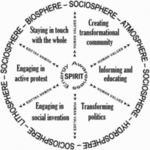

| New Civilization News: Ways I: Forms of Presentation Circle/Wheel & Matters of Consequences |
Category: Philosophy 2 comments
5 Mar 2005 @ 18:04 by Colene Riffo @24.127.68.200 : Resonating Vibrations...seeds...ceeds 22 Jan 2007 @ 20:04 by Matthew Tripp (criminal mental illness) @71.81.7.200 : save the text of my page and share it The website where the creator of this poster advertizes it is at www.dharmaprinting.com to the best of my knowledge. First and Second Circle: The first circle is brown or a shade of brown and contains nothing but empty white space the brown lines extend out three times from this circle sectioning the outer perimeter into three equal parts. Which are like keystone of an arch shape , which is how poster is structured. In each of these arc blocks are a word the arc blocks form another circle which is also brown. IMPERMANANCE has no internal arc block color so it is described in the descriptive box outlined in brown. NO-SELF is in the brown circle of the second ring but has an internal arc block color of red so it is described by the text box at the bottom of the poster outlined in red. The third circle: Is a dark purple color and has three arc blocks. The word greed and aversion are in two separate purple blocks. The third block of the third circle has the word delusion in it and has an internal arc outline color of Brown. The fourth circle: Is all red with a perimeter line of blue for the whole red circle and the arc blocks individually contain the following words consciousness, body, feeling, perceptions, and mental formations both the words mental and formations are contained in one block. The Fifth Circle: Has an external color of Blue and contains arc blocks with the following words in each block word or grouping of words is separated by a comma to represent each block and its color(s). With an internal color of green the words NOBLE EIGHTFOLD PATH, are in one Ark block of the fifth circle. With an internal color of Brown, the word SUFFERING, and a number is on this block it is 2. Another block of the fifth circle with an internal color of yellow contains the words ORIGIN OF SUFFERING. Another circle segment here is in blue with the wording: CESSATION OF SUFFERING. The sixth circle: Is mostly yellow with green surrounding the entire yellow circle. Here there is a grouping of three yellow boxes with the words present causes lining the external parameter of the three yellow blocks. This means that the words are associating with present causes; the words becoming and grasping, in another yellow block and with an internal outline color of blue and a numeral annotation of two is the word craving. Another section of this circle is associated with future results the word's future results are spread along the outside perimeter of the two blocks, which are both yellow containing the word birth, and the words death & decay. Another section of the circle with the words past causes spread along the outermost perimeter so as to be associated with the two blocks to which one block has a number annotation of three with an internal perimeter outline color of dark purple and the word ignorance, another block with a number annotation of four and an internal parameter outline around the word with the color red, there is the word volition. Another section of the sixth circle has four blocks to which the words spread along the external perimeter are present results. Two separate blocks in yellow contain the word contact, and the other block also in yellow contains the word's six senses. This section of blocks which is associated with present results also contains red blocks, one block with an internal outline color of red contains the word feeling and has a number annotation of two. Another block with an internal outline color of red contains the words mind & body this block has a number annotation of one. The seventh circle: Has an external color of Green, with eight arc blocks that represent the Noble Eightfold Path. The word concentration is spread along the perimeter of three blocks with an internal blog color of orange, there is found the words RIGHT MINDFULLNESS in one of the three blocks in another block are the words RIGHT CONCENTRATION, in another block are the words RIGHT EFFORT in this block outlined with thin green lines are words in smaller blocks these are, restraint, abandoning, development, and preservation. In another section of the seventh circle the word MORALITY is spread along the perimeter of three blocks, each of these blocks is colored green, RIGHT LIVELIHOOD is in one of the blocks, another block has the words RIGHT ACTION with three smaller blocks inside it containing the word no stealing, no harming, no adultery. Another block has the words RIGHT SPEECH and here with smaller blocks again outlined ingrain or the words no lying, no abuse, no gossip, no chatter. Another section of this seventh circle contains two word blocks, with the word WISDOM, spread all on the perimeter of the two blocks yeah, a block with an internal perimeter outline of the color blue has the words RIGHT VIEW, and the other block has the words RIGHT INTENTION, its color is green. The eighth circle from the center to the outside of the poster: Has a main color of orange which means that it is further explained primarily by the text box at the bottom of the poster with the orange color outline. This circle becomes much more complex; a number five is annotated to the block with the words MIND STATES, which has an internal outline of the color red. That is the simplest block in this circle. Another block, which has an internal outline of the color red and an annotation of the number two; contains the word FEELING, and with smaller red lines in smaller internal blocks are the words, pleasant, unpleasant, neutral. Another arc block has the number annotation of the number one; along the external perimeter of this block is the word BODY, this block is broken into individual blocks which separately contain the words, BREATH, POSTURES, CLEAR COMPREHENSION, 32 PARTS OF THE BODY, FOUR ELEMENTS, STAGES OF DECAY. The next arc block has a primary internal outline color of red, and number annotations of three and four. Along the outside perimeter of this block is spread the word's MIND OBJECTS, this block is somewhat to complex to describe its layout, so I recommend looking at it. The simplest internal block to this section of the arc and eighth circle, has an internal outline of the color blue, and the words FOUR NOBLE TRUTHS. The next simplest block has a thin line of purple through the internal outline of red, contains the words FIVE AGGREGATES , Another block has the words FIVE HINDERANCES, are primary to this block with smaller internal blogs and thin red lines dividing the words: DESIRE, AVERSION, SLOTH, UNREST, DOUBT. Another block in red has the primary words SIX INTERNAL & AND EXTERNAL SENSE BASES, which is subdivided by these thin red lined blocks of words: EYE & VISUAL OBJECTS, EAR & SOUNDS, NOSE & SMELLS, TOUNGUE & FLAVORS, BODY & OBJECTS, MIND & ITS OBJECTS. The next section has an internal perimeter color of green and its primary words are: SEVEN FACTORS OF ENLIGHTENMENT, which is subdivided in smaller thin lined green blocks with the words: MINDFULLNESS, INVESTIGATION, EFFORT, RAPTURE, CALM, CONCENTRATION, EQUINAMITY. The ninth circle is the outermost circle :) art of war book (nine grounds) conflict resolution? DIVINE ABODES is spread along the perimeter of this section of the circle: subdivided by the words to the right and the arc block color is purple. EQUINAMITY SYMPATHETIC JOY COMPASSION LOVING KINDNESS TEN PERFECTIONS is spread along the external perimeter of this dark green section of the circle and is subdivided by the words to the right in this table. EQUINAMITY LOVING KINDNESS RESOLUTION TRUTH PATIENCE ENERGY WISDOM RENUNCIATION MORALITY GENEROSITY SEVEN FACTORS OF ENLIGHTENMENT has a circle segment outline of purple and internal perimeter color of light green. NOBLE EIGHT FOLD PATH is circle segment color purple and internal perimeter outline color dark green. FIVE POWERS is spread along the external perimeter of this circle segment in purple and subdivided by these words WISDOM CONCENTRATION MINDFULLNESS ENERGY FAITH FIVE ACUITIES is spread along the external perimeter of this circle segment in purple. FAITH ENERGY MINDFULLNESS CONCENTRATION WISDOM FOUR BASES OF SUCCESS is spread along the external perimeter of this circle segment in purple INTEREST ENERGY CLEAR MIND INVESTIGATION FOUR FOUNDATIONS OF MINDFULNESS has an external outline color of purple and internal perimeter color of orange FOUR RIGHT EFFORTS is outlined in purple with and internal perimeter of green I am unsure of how to lay this last circle segment out so I will make a couple of five tables for it :) TEN FETTERS is spread along the external perimeter of this brown circle segment and is subdivided very much, so, I will put it in its own table TEN FETTERS is spread along the external perimeter of this brown circle segment and is subdivided very much, so, I will put it in its own table SELF-BELIFE SCEPTICAL DOUBT BELIFE IN RITUALS SENSE DESIRE AVERSION DESIRE FOR BEING DESIRE FOR NON-BEING CONCEIT RESTLESSNESS IGNORANCE Along the inner diameter of this segment of the circle there are the words FULLY LIBERATED. So below the words which are associated to the TEN FETTERS there are two arc segments, one of those segments has the words: STREAM ~ ENTRY, ONCE ~ RETURNER, NON ~ RETURNER. The other segment has a thin dark blue line box around the words: FOUR STAGES OF REALIZATION. Again for clarification, the inner perimiter of the TEN FETTERS segment has the words FULLY LIBERATED. this is a link to some site that someone put in a buddhist chat room I dont' know that it will continue to be good stuff forever: [link] BOXES FROM THE BOTTOM OF THE POSTER WHICH EXPLAIN FURTHER THE WORDS OF THE POSTER The paragraphs below are the color of the line around the text boxes at the bottom of the poster which associate and further explain the words on the poster; these paragraphs were typed using voice to text software so there may be some phonetic errors in the text, and missed groups of words. Another Green Box (Title box?) The Wheel of Buddhist Terms The Three Characteristics, The Three Unwholesome Roots, and The Five Aggregates are the facts of our human existence. The Four Noble Truths And Dependent Origination are seeing those facts in terms of the possibility of liberation. Ennoble eightfold path That and The Four Foundations of Mindfulness describe the practical path to be followed to realize that liberation. The Thirty Seven Requisites of Enlightenment are a restatement of the essential factors of the path. The Ten Perfections are qualities that support the practice and benefit others. The Four Divine Abodes are developed as beneficial emotional responses to experience. The Ten Fetters are the attachments that perpetuate our delusion and The Four Stages of a Realization are the progressive eradication of those patterns that prevent the realization of liberation. all of the teachings of the Buddha can be summed up in the phrase "Nothing whatsoever should be clung to as 'me' or 'mine'". All of the teachings exist to serve this goal, to aid in this realization, by either describing the situation or providing a skillful means to train oneself. "To cling to nothing" is a guide to proper relationship to experience, as well as a statement of the way things are when the goal is reached. Each subject (or ring) has its own color and block of text. Some ring segments have another color lining the inside. This refers you to the ring of that color for more detail or a related subject. I lining with a numeral in the corner refers you to that individual segment of the ring of that color. Light Blue box The Four Noble Truths (Cattari Ariya Sacca) There is suffering. (Dukkha, one of the Three Characteristics) Suffering has a cause. (Samudaya, explained as Dependant Origination) It is possible to end suffering. (Nirodha) The path leading to the end of suffering. (Magga, explained as Noble Eightfold Path.) The Four Noble Truths are the Buddhist description of, and a prescription for, the human condition. There is suffering (Dukkha, one of the Three Characteristics.) The changing conditions of life are incapable of providing lasting satisfaction. The action of and the attachment to the Five Aggregates are suffering. Suffering has a cause. (Samudaya, see Dependent Origination.) The cause of suffering is craving (tanha). The three main categories of craving are: desire for sense pleasures (kama-tanha). desire for existence (bhava-tanha). desire for non-existence (vibhava-tanha). It is possible to end suffering. (Nirodha) When craving ceases, suffering ceases. The path leading to the end of suffering. (Magga, explained as The Noble Eightfold Path) When it is understood that craving always results and suffering, one seeks to eliminate craving. This is accomplished by following The Noble Eightfold Path: Right View, Right Intention, Right Speech, Right Action, Right Livelihood, Right Effort, Right Mindfulness, Right Concentration. To become enlightened and liberated, one must gain insight into the Three Characteristics. The Four Noble Truths focus on the characteristics of suffering, since that characteristic is most notable and problematic. Yellow box Dependent Origination (Paticcasamuppada) Past Cause 1. Ignorance (Avijja, one of the Three Unwholesome Roots) 2. Volition (Sankhara, one of the Five Aggregates) Present Results 3. Conciousness (Vinnana, one of the 5A) 4. Body and Mind (Nama-rupa, one of the 5A) 5. Senses (Ayatana) 6. Contact (Phassa) 7. Feeling (Vedana, one of the 5A) Present Causes 8. Craving (Tanha, the second Noble Truth) 9. Grasping (Upadana) 10. Becoming (Bhava) Future Results 11. Birth (Jati) 12. Aging, Death (Jara-marana) Dependent Origination (the details of the second Noble Truth) describes the cycling of the perceived self (the Five Aggregates) in samsara (unsatisfactory existence), the each link leading to and conditioning the next. It is used to show how one existence leads to another (rebirth). Present results (3-7) are experienced in this life because of past causes (1-2). Present causes (8-10) are actions in this life which will shape the next existence (11,12). More importantly, Dependent Origination applies the psychological process moment to moment. The Five Aggregates interact and are conditioned by each other. Ignorance (1), conditions volition (2), which shapes consciousness (3), conditioning body and mind (4), which includes the senses (5), which interact with the world (6), causing feelings to arise (7), to which we react (often unwisely, 8,9), resulting in the suffering of hope and fear (10), leading to birth and death (11,12). If the arising of feeling (7) is accompanied by mindful awareness (see second Foundation of Mindfulness), the tendency toward liking and disliking (craving) can be broken and liberation realized. The constant flux of elements and factors in Dependent Origination also illustrates the truth of the emptiness (lack of any substantial entity in the process). Dark Purple Box The Three Unwholesome Roots (Akusala Mula) Greed (Lobha, attraction to what is pleasant) Aversion (Dosa, resistance to what is unpleasant) Delusion (Moha, not seeing the 3 Characteristics) The Three Unwholesome Roots are those negative mental factors which are the source of attitudes and behaviors that result in suffering. Greed and aversion arise from, and perpetuate, delusion. Delusion means not perceiving The Three Characteristics. When we do not realize that all things are impermanent, unsatisfactory, and without selfhood, we relate to them with greed and aversion, which prevents us from seeing their true nature. Driven by greed, we fight against impermanence, increasing our suffering, and our aversion to it, all because delusion produces the perception of a separate self (not understanding). Brown Box (upper left) The Three Characteristics (Ti-lakkhana) Impermanence Suffering / Unsatisfactoryness No-self These three characteristics are shared by all phenomena. They describe the nature of reality: Everything is impermanent, subject to change, unstable. The characteristics of suffering and no self stem from this and permanence. Any object or mind state is inherently unsatisfying by virtue of its being impermanent, and clinging to it will cause suffering. The sense of self is a product of changing physical conditions and impermanent mental states, (see: Five Aggregates) and does not inherently exist. Our liberation or our bondage depends on realizing the Three Characteristics inherent in every experience or being ignorant of them. If it is clearly and deeply seemed that all objects and mind states are impermanent, unsatisfactory and without selfhood, one sees that there is nothing worth clinging to, which leads to liberation and the end of suffering. When the three characteristics are not seen, this delusion leads to greed and aversion, which are the three unwholesome roots. Orange The Four Foundations of Mindfulness (Satipatthana) The Four Foundations of Mindfulness (7th aspect of NEP) are the categories of experience to be investigated with awareness in order to realize the impermanence, unsatisfactory , and impersonal nature of existence. The Four Foundations of Mindfulness could be seen as a re-grouping of the Five Aggregates, emphasizing those aspects and ways of looking at them that are most conducive to insight and liberation. 1. Contemplation of the body (Kayanupassana, contemplation of the first Aggregate.) Attention is focused and established on bodily phenomena. Mindfulness of the body has six aspects: Breathing Postures Clear Comprehension 32 Parts of the Body Material Elements. Cemetery Contemplations Contemplation of Feeling (Vedananupassana, conteplation of the second Aggregate) Attention is focused and established on the pleasant, unpleasant or neutral feeling that arises following sensory contact. The instruction here is to be aware of how these feelings arise and how they dissolve. Feeling here refers not to emotion, but to the bare experience of pleasant, unpleasant or neutral sensation, physical or mental. Feeling is investigated because it conditions craving and continued suffering (see DO). It is an element of experience with which we identify strongly and the degree of mindfulness of feelings determines whether we will be swept away by them or not. Contemplation of Mind (Cittanupassana, contemplation of the fifth Aggregate) Attention is focused and established on mind states (, hatred, ignorance, distraction, concentration, etc). The instruction here is to be aware of the presence or absence of mind to states and of their arising and dissolution. Mind states are focused on so that we may see how they color perception, rather than identifying with them as reality. Contemplation of Mind Objects (Dhammanupassana, contemplation of the third & and forth Aggregate) one focuses and establishes attention on mind objects. Attention is focused on those factors that should be investigated to facilitate meditation and lead to wisdom. The Five Hindrances - which block understanding, hindering meditation and insight. The Five Aggregates - which make up the sense of self. The Six Senses - which can lead to craving. The Seven Factors of Enlightenment - those mental factors to be cultivated. The Four Noble Truths - seeing things in terms of the truth of suffering, its cause and its end. The Five Hindrances Sense desire Aversion Sloth & Torpor Restlessness & Worry Doubt The Five Hindrances are those mental factors that hinder meditation (concentration and insight). The instruction here is to be aware of the presence or absence of the hindrances, how they arise, how they disappear, and how they are abandoned. When we are swept away by them, the Five hindrances prevent tranquility and clarity. When we investigate them with mindfulness, they can be overcome. 2. The Five Aggregates We investigate them as those aspects of experience which we cling to as self. Introduction here is to be aware of the nature of the aggregates, how they arise, and how they disappear. The Six Internal and External Sense Bases (Ayatana, 5th link in Dependent Origination) Eye and Visual Objects Ear and Sounds Nose and Smells Tongue and Flavors Body and Tangible Objects Mind and Mental Objects The Six Internal and External Sense Bases are the five senses plus the mind along with their respective fields of perception. The meeting of the eye and visual objects, conditions the arising of visual consciousness; these three together constitute contact (the sixth link in DO). It is the same for the other senses and the mindthe instruction concerning this mind object is to be aware of this sense organ and its corresponding object, and the bond of attachment that arises dependent on both (see the Ten Fetters). Also, be aware of how this attachment arises, and how it disappears, and how it is abandoned in the future. The Six Senses are given attention and awareness because they are the basis of all mental activity and this is where we can begin to bring mindfulness to the process described in Dependent Origination. Whereas the second foundation of mindfulness focuses on feeling (the 7th link in DO), here we look at the Six Senses (the 5th link in DO) to investigate the process that conditions contact and feeling. The Seven Factors of Enlightenment Mindfulness. Investigation. Energy. Rapture. Calm. Concentration. Equanimity. The Seven Factors of Enlightenment are those mental factors that, when brought to perfection and balance, lead to Enlightenment. Established in strong and firm mindfulness, one investigates bodily and mental phenomenon with persistent energy; there are rises rapture (both as physical sensation and mental interest) and the mind becomes calm, which enhances concentration; all of these states and phenomena are viewed with equanimity. The instruction concerning this mind object is to be aware of the presence or absence of the factors of enlightenment, how the factors arise and how the factors come to be perfected. The Four Noble Truths To know "This is Dukkha"… To know "This is the origin of Dukkha"… To know "This is the cessation of Dukkha"… To know "This is the path leading to the cessation of Dukkha", according to the reality of the present moment. The instruction hears to be aware of experience in the light of The Four Noble Truths regarding suffering (Dukkha): to be aware of what is the path and what is not the path. Dark Green Box The Noble Eightfold Path (Ariya Atthangika-Magga) Wisdom Right View Right Intention Morality Right Speech Right Action Right Livelihood Concentration Right Effort Right Mindfulness Right Concentration The Noble Eightfold Path, being the fourth of The Four Noble Truths, Is the practice that leads to enlightenment. THE path has eight aspects, grouped under three headings; Morality, Concentration, and Wisdom. Right View is the perspective provided by understanding The Four Noble Truths Right Intention is freedom from sense desire, ill-will, and cruelty. Right Speech refrains from lying, gossip, harsh speech and idle chatter. Right Action refrains from killing, stealing and adultery. Right Livelihood, prohibits dealing in arms, poisons, hunting, usury, etc. Right Effort restrains and abandons negative mental states. Right Mindfulness is explained as the Four Foundations of Mindfulness. Right Concentration is the focusing of the mind associated with wholesome consciousness. And it's highly developed stages, concentration is experienced as eight levels of increasing subtlety called the Jhanas. These refined states of concentration cannot in themselves result in liberation, but their development provides a tranquility and sharpness of mind that can aid in the realization of the nature of reality. All aspects of the Noble Eightfold Path support and reinforce each other, providing a stable basis for the cultivation of insight. Red box - The Five Aggregates (Pancakkhandha) Thursday, November 09, 2006 4:16 AM Body, form (Rupa) Feeling (Vedana) Perceptions / memory (Sanna) Mental Formations (Sankhara) Consciousness (Vinnana) The Five Aggregates are those categories all phenomena which we cling to as me or mine. The first aggregate (rupa) includes the body, the senses and tangible objects. Feeling (vedana) refers to the pleasant, unpleasant or neutral quality present in each moment of experience. Perception (sanna) is of six kinds (relating to the six senses): perception of form, sound, smell, taste, bodily impressions and mental impressions. Mental formations (sankhara) are the psychological elements of experience, including thoughts, emotions, volition, and habitual patterns. Consciousness (vinnana) is of six types (relating to the six senses): eye-consciousness, ear-consciousness, olfactory consciousness, taste consciousness, tactile consciousness, and consciousness of mental objects. The five aggregates influence and condition each other, arising and combining together to form our experience of self and the world. The body and senses receive impressions, and feelings arise together with associative recognitions (memory) and perceptions. The body and senses receive impressions, and feelings arise together with associative recognitions (memory) and receptions, all colored by mental formations (thoughts, emotions, etc.), the entire process taking place with varying degrees of Consciousness. (See: Dependent Origination) The interaction of and identification with the Five Aggregates produces the sense of a separate, inherently existing self which is under the influence of the Three Unwholesome Roots. Our experience of the quotes external world is also a product of these Five Aggregates. There is nothing that we experience that is outside of these Five Aggregates. The Three Characteristics describe how things are (external and internal reality). The Three Unwholesome Roots are the negative mental influence is preventing insight. The Five Aggregates are those factors which produce the experience of self and the world. The Five Aggregates are under the influence of the Three Unwholesome Roots and the Three Characteristics are not seen. These are the givens of the human situation. Dark Blue Box (Larger on the left at bottom) The Thirty Seven Requisites of Enlightenment (Bodhipakkhiya-dhamma) The Thirty Seven Requisites of Enlightenment are those practices that are conducive to insight and liberation. In seven overlapping groups, they are a restatement of the factors essential for a successful spiritual practice culminating in liberation. The Four Foundations of Mindfulness (Satipatthana) Provides the primary methods for the cultivation of insight. The Four Right Efforts Restraint, & Abandonment of unwholesome states; Development, & Preservation of unwholesome states, providing positive mind states and the energy necessary for the cultivation of insight. The Four Bases of Power Interest (Chanda) Energy (Viriya) Clear Mind (Citta) Investigation (Vimamsa) Interest, or aspiration, is the desire to attain liberation. Energy is the perseverance in applying The Four Right Efforts. Clear mind is clarity of consciousness. Investigation is examination of phenomena, arising and ceasing. The Four Bases of Power, also called The Four Roads to Success, are factors which must be present and developed in order to succeed in attaining liberation. The Five Faculties Faith (Saddha) Energy Mindfulness (Sati) Concentration (Samadhi) Wisdom (Panna) Faith -- the confidence developed by meditation. Energy -- the factor of effort. Mindfulness -- awareness of what is present. Concentration -- the ability to sustain the attention. Wisdom -- seeing the nature of reality, and acting in accord with it. Is the exercising of these faculties that give the ability to progress. Their development and wise application can defeat the Five Hindrances. When the Five Faculties are developed and strengthened, they become the Five Powers, incapable of being overcome. The Five Powers (Bala) Faith (Saddha Balam) Energy (Viriya Balam) Mindfulness (Sati Balam) Concentration (Samadhi Balam) Wisdom (Panna Balam) The Smaller Dark Blue Box The Seven Factors of Enlightenment (Bojjhanga) Mindfulness Investigation Energy Rapture Calm Concentration Equanimity The Seven Factors of Enlightenment are those mental factors which incline the mind towards insight. The Noble Eightfold Path (Magga) Right View Right Intention Right Speech Right Action Right Livelihood Right Effort Right Mindfulness Right Concentration The Noble Eightfold Path is the path that leads to insight, enlightenment, and the end of suffering. Practicing the Four Foundations of Mindfulness, one applies the Four Right Efforts, using the Four Bases of Power as a basis, exercising the Five Faculties and the Five Powers, developing the Seven Factors of Enlightenment, all in pursuit of The Noble Eightfold Path. Another Dark Green box The Ten Perfections (Parami) Generosity (Dana) -- sharing with others. Morality (Sila) -- purity in speech, action, livelihood. Renunciation (Nekkhamma) -- abandoning sensual desires. Wisdom (Panna) -- insight into the Three Characteristics. Energy (Viriya) -- exertion into mental development. Patience (Kanti) -- forbearance. Truthfulness (Sacca) -- acting and speaking in accord with truth. Resolution (Aditthana) -- determination in following aspiration. Loving-kindness (Metta) -- benevolence. Equanimity (Upekkha) -- even mindedness toward phenomena. The Ten Perfections are ten qualities of mind and behavior that lead to enlightenment. We can develop these qualities as a basis for responding to the world. The Ten Perfections can be brought to maturity by cultivating the Four Divine Abodes. Light Purple box The Four Divine Abodes (Brhama Vihara) Loving-kindness (Metta) -- benevolence towards others. Compassion (Karuna) -- motivation to relive the suffering of others. Sympathetic Joy (Mudita) -- happiness at other's good fortune. Equanimity (Upekkha) -- undisturbed by phenomena. The Four Divine Abodes are those unbounded states of mind that can be developed as the foundation for out attitudes towards all beings, steering the mind towards acceptance, and away from regret and ill-will. Another Brown box The Ten Fetters (Samyojana) Self - belief Doubt Belief in rituals Sensual Desire Ill-will Desire for Existence with form Desire for Existence without form Conceit Restlessness Ignorance The Ten Fetters are deeply rooted habitual patterns that bind us to condition existence. There are overcome progressively as one advances through the four stages of realization. Self-belief refers to believing that the self exists and some concrete way. Doubt refers to doubt about the Buddha, the teaching, and training. The third Fetter refers to believing that rituals are effective in themselves. Sensual desire means craving for sights, sounds, smells, tastes and contacts. Ill - will is anger and negativity. Desire for material existence is craving embodiment. Desire for immaterial existence is craving this embodiment. Conceit refers to maintaining a sense of self through comparison. Restlessness is a symptom of an unsatisfied, still-seeking mind. Ignorance is not realizing the Three Characteristics in relation to all existence, the same delusion (moha) that had us entangled in the first place. The Four Stages of Realization Stream-Entry Once-Returner Non-returner Fully Liberated One who has overcome the first three Fetters has reached the first stage of realization called stream - entry. One has entered the stream leading to liberation and is assured of success and no more than seven lifetimes. At the 2nd stage of realization, the 4th and 5th fetters are overcome in their grosser forms. One is now called a Once-Returner, achieving success with only one more material existence. One who has fully dissolved the first five fetters has reached the third stage of realization called Non-Returner. Such a one will achieve final liberation without being reborn. Being freed from all ten fetters, one realizes the 4th stage of realization, complete freedom and liberation in this life. Such a one is called Fully Liberated, a holy one (Arahant). Stolen Dissertation (The Interpenetration of Classroom Teaching and Buddhist Practice AKA: do drugs because the criminalization of mental illness is to FUCKING incompetant to make usefull medications that we can use) Serenity Movie. [link] Text from the art of war card deck: Other entries in Philosophy 26 Nov 2008 @ 05:38: Engaged Mind Body Spirit 3 Nov 2008 @ 17:39: Perversion and Abuse of Systemic Concepts 17 Oct 2008 @ 17:44: Matching Energy 19 Sep 2008 @ 16:27: A war cry for the change on the banner of a New Age. 18 Sep 2008 @ 19:41: New-Style Thinking 18 Sep 2008 @ 14:11: EXACTLY ONE CENTURY AGO 31 Aug 2008 @ 15:53: I'm Irish-English-German-Native American-Basque-Canadian-American! 27 Aug 2008 @ 20:05: Old-Style Thinking 11 Aug 2008 @ 12:11: Contexts of Understanding 4 Aug 2008 @ 09:07: Why is Dialectic Important
|