|
|
 12 Mar 2006 @ 18:58, by jerryvest. Medicine, Healthcare 12 Mar 2006 @ 18:58, by jerryvest. Medicine, Healthcare
Learning to become kind, gentle, open, honest and nonjudgmental
What a great discovery I made yesterday while visiting the stacks of our used book store and finding The Pema Chodrin Collection. I was looking for some more resources on the engagement process to assist my students in learning how to more effectively interact with our elders and with individuals, couples, groups and families.
One of our primary approaches for serving others in our profession is to maintain a nonjudgmental mind so that those we interact with can feel free to be open and honest with us. Obviously, if we do not respect others and work on ourselves to maintain an open mind, how can we expect others to interact with us freely or with openness so that we can offer our best service and practice initiatives?
For many years my professional practice has been strengthened by the unitary orientation of our body-mind-emotions-spirit relationship as included in particle science and what is referred to as applied Buddhism. Tarthang Tulku, founder and head Lama for the Nyingma Center, has introduced numerous resources to guide his students in their search for clarity of meaning, purpose and right action. Please visit my other discussions on my web logs, bibliography and links page on my website for further details of this approach. [link]
In Master Tulku’s work with health professionals over many years, he accumulated some valuable knowledge and wisdom to help us with our skills and develop an open mind with meditation, physical exercise, massage, and other integrative practices. As he describes this learning experience:
Meditation is a way of opening our lives to the richness of experience, not an esoteric practice limited to certain times and places. Whether we live in the quiet of the country or in the turmoil of the city, meditation can actually become a way of life. In this kind of meditation, we learn to embrace and learn from whatever we experience.
This all-embracing form of meditation, however, is not as easy as it sounds, for it entails mindfulness in all we do. From the simple act of getting up in the morning to our dreams at night, everything is included in this meditation. We learn to open our senses to each nuance of experience, mindful of even the smallest details of our lives, such as how we walk and how we talk with others. In this way we open to the truth of our experience.(Tarthang Tulku, Openness Mind) [link]
This resource offers us even more opportunities to learn to open our mind and transcend our internal chatter and belief systems so that we can become more effective human service professionals. In this book, The Pema Chodron Collection, three lectures or discussions are introduced: “The Wisdom of No Escape,” Start Where You Are,” and “When Things Fall Apart.” In the first article, that I am focusing, she discusses the three qualities that we can cultivate and nurture to become more open, honest and nonjudgmental—precision, gentleness, and the ability to let go. [link]
I will briefly describe the breathing technique that Ani Pema Chodron introduces in this book; however, I recommend that you aquire this collection and follow her indications.
Precision
The technique to develop precision is to be mindful of our out-breath. “Be with the breath as it goes out, feel the breath go out, touch the breath as it goes out.” Be, feel and touch the breath are the key elements of awareness. For example, it develops our precision because we always return to this out-breath periodically. Thus, our mind becomes clear and accurate without other thoughts clouding our experience while interacting with others.
Gentleness
To assist us in supporting our basic principle and right of ‘self-determination,” this technique of observing our out-breath is done with gentleness. As Ani Pema describes,
the gentle attention of the breath produces relaxation and a quality of kindness so that we can be present in our relationships without judgment, manipulation and intrusion.
The focus on the out-breath is practiced with the eyes open and relaxed. She suggests that our focus on the out-breath is but 25 percent so that we can observe our entire environment with all of our senses. Everything in nature is also interacting with us as we engage others. There is no goal to silence the mind from thoughts. When we see or experience thoughts, just make an internal statement – “Thinking.” And, listen to your voice as you make this statement as it will tell us its quality of gentleness.
Letting Go
Ani describes letting go as a more difficult exercise as it requires the precision and gentleness to mature. “Rather, it’s something that happens as a result of working with precision and gentleness. In other words, as your work with being really faithful to the technique and being as precise as you can simultaneously as kind as you can, the ability to let go seems to happen to you.” Furthermore, she states that we don’t force any of these qualities or exercises. It’s a rediscovery of our original ability to let go and to be open.
With time and practice, Ani Pema gives us encouragement—“You will learn what it is to let go and what it is to open beyond limited beliefs and ideas about things.” You don’t repress thoughts; you just note that this is “thinking.”
Finally, she says that when we get the hang of this meditation, we will no longer be caught in the grip of our angry thoughts or passionate thoughts or worried thoughts or depressed thoughts. I appreciate the introduction to this technique and observance. Hopefully, with practice, we can all achieve our best possible condition and more effectively serve humanity with 'precision, gentleness and letting go.' More >
|
|
|
|
 16 Feb 2006 @ 17:57, by jerryvest. Medicine, Healthcare 16 Feb 2006 @ 17:57, by jerryvest. Medicine, Healthcare
I am very pleased to share our progress in developing our community program to reach out and touch our lonely and isolated elders here in southern New Mexico. This article describes our volunteer organization and support that we have received from our City of Las Cruces, RSVP Program and the In-home Services Program.
We will launch our training program on Friday, March 17, 2006, Munson Senior Center, 1:30-4:30pm.
We are interested in offering this program on a Global Scale so that other communities can use our experience, resources and healthy touch program to serve elders who are isolated and lonely. For more information, do visit our homepage and forum. [link]
Program Description
This volunteer program is designed to support our lonely and isolated elderly population and caregivers in Southern N.M . The 15-Minute StressOut Program, as designed by Emeritus Professor, Gerald Vest, ACSW/LISW/LMT, and the New Mexico State University, Health Promotion Team, is the primary approach used to introduce safe, skillful and appropriate touch with our elders and caregivers. (See home page for a complete description and historical overview of this program--protocol that includes the skillful use of touch coordinated with the breath, ethical guidelines for the safe use of touch, certification requirements, evaluation instruments, participation comments, selected resources and research.)
Selected volunteers will complete an orientation and training program as part of the process in becoming certified to give and to receive the “StressOut Program.”
Safety Guidelines & Requirements
Ethical Guidelines for the Safe Use of Touch:
1. Provide the option for participants to self-administer the program;
2. Always receive permission to touch and remind participants that contact is always in safe areas;
3. Have a witness or partner present to observe the "stressout";
4. Teach the activity to others so that they can be the giver and receiver;
5. Give participants an opportunity to evaluate the experience: and,
6. Encourage participants to use the teaching video and "Study Guide" if the worker does not choose to make physical contact.
Community Organization
Leadership:
This community organization is sponsored by the City of Las Cruces, RSVP, Senior Programs. [link] Aurora Ybarra, LBSW, RSVP Program Coordinator and Francesca Smith, LBSW, In-home Services Manager, serve as professional advisors. Judith Bartlett and Liz Ambrose are chosen to serve as the initial volunteer Co-Team Leaders for the project. Gerald Vest, ACSW/LISW/LMT, is the volunteer program consultant-trainer.
Job Description:
1)Professional Advisors – oversee the organization and the selection, recruitment and training of volunteers; maintain an organization data base of volunteers; supervise student interns; and, provide for certification and recognition of volunteers.
2)Co-Team Leaders – work closely with the advisors, program consultant and senior resources to support the program; schedule workshops and training programs; help recruit, train and place volunteers; maintain organization records; and conduct the business of the organization.
3)As a team we will all work together to sustain a volunteer organization that can support our elders and caregivers with safe, skillful and loving touch.
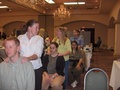
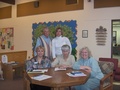
Note: The picture identifies our Leadership Team -- Aurora Ybarra, Francesca Smith, Judith Bartlett, Liz Ambrose and Jerry Vest. More >
|
|
|
|
20 Nov 2005 @ 09:25, by lugon. Medicine, Healthcare
In my previous article I mentioned avian flu and the possibility of a pandemic. The links are still relevant if you want to take a look there.
Here's an update:
It looks like China is having more flu outbreaks in birds, with a couple of human cases. See details.
A Californian man has created a blog to write about his local community preparation. Knowing the ability of influenza viri to cause silent disease and spread while there are no symptoms, and knowing the inability of a number of governments to do their (our) thing all that well, it looks like it's at least one of the right things to do.
Current statistics are not all that important. The important thing is the unknown: when will a mutated strain start spreading effectively and unstoppably?
Lots of extremely well presented stuff is here if you want to educate yourself. I insist: it's really good stuff. Powerpoint/PDF presentations are nice, easy reading.
C'mon: get a bit anxious, despair at the complexity of the challenge (see the "daunting task" article), then roll up your sleeves! More >
|
|
|
|
 2 Nov 2005 @ 13:31, by jerryvest. Medicine, Healthcare 2 Nov 2005 @ 13:31, by jerryvest. Medicine, Healthcare
It is taken for granted in American culture that the individual will identify with his/her emotions and follow their dictates. In recent decades, such dubious cultural values have infected more and more people, with access to greater material wealth, at the same time that the business/religions of our culture have evolved ever more cunning pitches to our emotions. This dynamic is now fueling the disintegration of that culture, heedless of the long range consequences as long as the short-term balance sheet looks good. (Tarthang Tulku - Gesture of Balance)
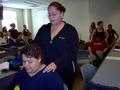
I am proposing that we develop a partnership for introducing Healthy Touch Programs for our Elders and Care Givers on a global scale. This initiative will include using our 15 Minute StressOut Program & DVD with elders and care givers in nursing homes, home-based services, outreach services, border programs, day care, shelters, hospice, hospitals, assisted living arrangements, and other resources for the aging population. This program is widely used with all populations, groups and varied organizations with great success. Because guidlines for the safe use of touch are clearly identified and reinforced by the workers,the StressOut Program is ideal for the use with our elders and caregivers. And, our volunteers have already given the 'stressout' to over 10,000 participants. 15-Minute StressOut Program
The use of touch for promoting health, wellness and disease prevention is an ancient approach to medicine that was introduced over 2,000 years ago in China. According to Eisenberg (1993), “Millions of Americans are already using massage, meditation, acupuncture, and herbal remedies of all kinds, without their doctors’ recommendations.” These alternative health practices are used not only for stress reduction but also for relief of pain, heart disease, anxiety, and inability to sleep. Furthermore, in his dialogue with Bill Moyers in Healing and the Mind, Eisenberg suggested that in the Chinese culture, it is believed that how you live ultimately influences your health: “It’s not just diet or exercise; it’s also a spiritual or emotional balance that comes from the way you treat people and the way you treat yourself. And, since that’s the basis of their culture, it spills over into their medicine.” (Eisenberg, D. (1993), “Another way of seeing;” B.S. Flowers & D.Grubin (Eds.), Healing and the mind: Bill Moyers, NY: Doubleday.)
Our elders are perhaps one of the most abused, neglected and forgotten groups throughout our country and beyond. Our aging population is often considered the ‘throw away’ generation as they are considered non-productive and of little value to a society that bases its success, worth and values on “the bottom line” and on “winners and losers.” Of course, this is a short sighted, limited view of human worth, dignity and self-respect; yet, many of our elderly are continuing to suffer from stress, anxiety and depression and are barely surviving while struggling to meet their basic human needs. US Census
The world population is growing, and it's also growing older. Researchers say birth and death rates are gradually falling worldwide, increasing the number and overall proportion of older people. For many societies, caring for all those aging citizens could be difficult.
The United Nations estimates that about one out of every 10 people on the planet today is at least 60 years old. By 2050, it's projected to be one out of five which means that not only will there be more old people, there will be relatively fewer young people to support them. (“Aging World Population Presents Challenge for Future Young,” Barry Newhouse)
Furthermore, Mr. Newhouse notes:
Some governments see family support systems as a way to avoid the financial problems that industrial nations face with their publicly-funded safety nets. But he says history has shown that familial support systems are generally weakened when nations become more prosperous -- as fewer children live with and care for their parents. And he says if the nations wait too long, it may be too late.
It is for these reasons and because of our compassion for others, especially our elders that our international community can begin to awaken to this dilemma and develop collaborative support systems and networks such as NCN to promote universal health promotion and wellbeing with our aging populations and care givers.
I would like to introduce a beginning Action Plan - An Outline for Advancing the use of Touch with Our Elders in my next NCN News Log. We can help ease the pain, suffering and neglect of our elders and support our care givers throughout our World. I believe that together we can design a plan that has a chance to be realized when each person or individual interested in contributing to the wellbeing of others understands and appreciates that physical interaction or human touch is a BASIC HUMAN NEED or REQUIREMENT for living a meaningful, dignified and healthy life. Beyond this is the fact that when humans do not interact physically, they become angry, depressed and become isolated and alone in the world. This is far too evident in our American society today. In a recent visit to a nursing home, one of the residents told me--“There must be something wrong with me – no one wants to touch me!” How sad is this?
The languages of the senses, in which all of us can be socialized, are capable of enlarging our appreciation and of deepening our understanding of each other and the world in which we live. Chief among these languages is touching. [Touch is] “The powerful means of establishing human relationships, the foundation of experience. (Ashley Montague, Touching: The Human Significance of the Skin),.
In an article our health team published using “Alternative Health Practices in Ethnically Diverse Rural Areas: A Collaborative Research Project,” (1997), we discovered that our touch program was successful in alleviating pain and suffering and reducing the blood sugar levels with diabetic patients in rural health clinics. We also did a successful follow-up program with persons diagnosed with Alzheimer’s disease living in nursing homes in southern New Mexico. [link]
I believe that, with your help, we can use “safe, skillful and appropriate touch” with all populations and especially with our elders who have been neglected, disrespected and abused for far too long. Let’s give TOUCH a chance to heal and to nourish our human family. More >
|
|
|
|
 17 Sep 2005 @ 07:07, by mahendra. Medicine, Healthcare 17 Sep 2005 @ 07:07, by mahendra. Medicine, Healthcare
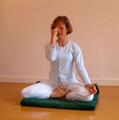
Pranayama is an important, yet little known part of Yoga. Its techniques have been practiced for centuries by ardent students of Yoga in remote ashrams, and have been preserved for us through many generations both in practice and in handwritten books. Until recently, this art and science of Yogic breathing was almost completely unknown to the common man like many other ancient Indian arts. Those who knew it used to be very reluctant to share their knowledge and experience with anyone, unless a student proved by tests that he was ready to receive it. During the last three decades, however, this situation has changed; and subjects such as Yoga, pranayama, meditation, and even Kundalini, are being discussed all over the world, not only by Yoga teachers, but also by the general public and by scientists. More recently, various techniques of Yoga have begun to attract the attention of physicians, therapists, and medical consultants. It is common to find both patients and doctors who can narrate their own experiences about the cure of various diseases by using Yoga techniques. It has been proved beyond doubt that Pranayama is a very important means for preventing and curing many ailments. Its aim is to bring the traditional knowledge of this great art of the common man, it can be used without much external help for the maintenance as well as the restoration of health.Its keeps diseases away by using the age-old techniques of Pranayama More >
|
|
|
|
 8 Sep 2005 @ 14:34, by jerryvest. Medicine, Healthcare 8 Sep 2005 @ 14:34, by jerryvest. Medicine, Healthcare
Free DVD for Victims, Families & Helpers!!!
As an active member of NCN, author and team leader of the 15-Minute StressOut Program & DVD, I want to make this instructional program available to large numbers of victims and helpers of this devastating hurricane.
Please accept this invitation, around the world, to join us in advancing the use of touch to improve the quality of lives, health and relationships. To learn more about us, our methods, research, guidelines, and values, do visit our Links, Resources, and other pages on our website.
Team members and others interested in using our "StressOut Program" for victims, helpers, and others located in shelters and other resources, please contact us and our distributor will send you our DVD, free of charge. 15-Minute StressOut Program
Humanity needs Loving Touch & Support. Please pass this invitation on to others who may be in need of skillful, healthy, loving, and respectful touch. We are here to serve.
Best wishes,
Gerald (Jerry) Vest, ACSW/LISW/LMT
Professor Emeritus
New Mexico State University More >
|
|
|
|
10 Jul 2005 @ 09:10, by swanny. Medicine, Healthcare
% HEALTH CARE PARADIGM
The available data would seem to suggest that health is not a merely objective or subjective matter but a "correlated" and relative degree of both.
Given this complex nature of health how does a useable and suitable treatment methodology emerge. There are now the public and private systems and then the composites therein but given this complex nature how is care and treatment to be administered in an effective yet fair manner.
Is the dollar, to be the sole determiner of health access, and if so is this fair, or is health perhaps some what more an aspect and degree of need and ability to pay.
Given these considerations I would propose a system which incorporates the financial considerations of both the costs and the ability to pay. Such a system would have your basic health and emergency needs covered as some will probably always be so poor and in dire need or state as to render them priorities and some will always be so rich as to afford their own doctors and hospitals.
For the rest, given the somewhat subjective/objective nature of health I would propose a % based system where premium procedures would incur sufficient prices to cover there costs but allow faster access by payment of a percentage based premium of ones yearly income. Say to access faster hip replacement one would have to pay .3% of income. This would allow all to have faster access but determine need and desire on the basis of the proportion of total assets as a means of determining degree of pain perhaps and etc etc..
No it is perhaps in itself not a perfect system and its administration will probably some what problematic but like democracy ...., it may be a bad system but its the best one we've got at the moment.
July 10, 2005
A. G. Jonas More >
|
|
|
|
8 Jul 2005 @ 14:02, by swanny. Medicine, Healthcare
July 8, 2005
THE MEASURE OF HEALTH
Hey Ho.....
This internet thingy .... I don' t know.....????
Well I suppose one has to "work" with what ones got....
No matter it would seem....
anyway "OFF TOPIC"..... OPPS.....
THE MEASURE OF HEALTH....
Is health objective or subjective or both a compound
Is health static or dynamic.....???? or again both.....
and what do you call something that is both static and dynamic
but "life"..... cyclic perhaps....
So then the model of health is ....???
We don't even know....
or is there more than one model....???
Is one persons health perhaps another persons "disease"....
apparently.....
MODELS OF HEALTH
Okay then maybe there are different models of health and different
degrees.....
Who defines them though....
Which ones are "legitimate"....
Does the "market determine" or "need" or compassion or empathy or
morality....
Okay again there's at least two models
Men and women....
What is healthy to a man I would quesstimate is not the same
as what is healthy to a woman.... Venus/Mars....
So there's two different yet equally valid models...
Its a start....
So as a male then what is health or healthy to me...???
Good question?
Hi.....
Alfie More >
|
|
|
|
 19 May 2005 @ 16:12, by jerryvest. Medicine, Healthcare 19 May 2005 @ 16:12, by jerryvest. Medicine, Healthcare
In my previous log I introduced holistic health care practices that I teach in my classes for the US Army, for my university and for prisons and detention centers.
I find that by maintaining a daily health routine, my life, health, and relationships are more balanced. I developed a routine over several years of experimenting with lots of exercises and programs and have now narrowed it down to a few very effective activities.
I start my day with Master Level Exercise-Arica Psychocalisthenics by Oscar Ichazo. These 23 exercises are coordinated with the breath so I find that they balance the body, mind and emotions while also giving me the vitality to maintain high levels of fitness. I follow this practice with some yoga exercises and some movements that I learned from tai chi and quigong or specifically, The Kath State - The Energy of Inner Fire, also designed by Oscar Ichazo. Following these exercises, I sit in meditation for 30 minutes to calm and quiet my mind in the morning and evening.
I also receive a body massage and acupuncture treatments regularly and engage in a 15-Minute StressOut Program several times during the week. I enjoy lots of physical activity so I ride my bike, play golf and take walks with my dogs as well.
I have learned that by maintaining a routine of daily activities throughout the week, it helps build and maintain determination or willpower needed for living in a society that is so scattered and out-of-balance.
As a professional and teacher I have also found that our students appreciate and trust us when we practice what we teach.
Recently, while turning 70 years of age, I discovered that I have prostate cancer and arthritis, especially noticable in my 4th & 5th lower vertabrae. I have thoroughly appreciated the help and support from my family, Dave Chitick, our NewCiv community, especially the interaction with Richard(jassoLog) who shares my plight and experience with prostate cancer. I am in the process of receiving treatment for the prostate and plan to have a speedy recovery.
I am particularly interested in introducing a helpful tool for persons who have back problems in this article. I read in a journal that over 70% of our adult population have back problems. I've recently become part of this back pain group. It is even hard for me to believe that I have back problems with all of the health practices that I have been engaged in for over 40 years; however, some of it can be attributed to farm labor as a child, heavy lifting and some of my athletic activities that I have enjoyed throughout my life. Also, my mother, sister and three brothers inherited arthritis so I am not feeling alone with this pain.
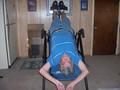
The Inversion Table -- a spacy experience
Recently, I purchased an Inversion Table that has given me complete relief from the back pain and am now able to resume all of my activities, including golf. (I strongly recommend that anyone purchasing this "hang up" table that you follow the instructions given in the video which are included with top-of-the-line tables.) There are many Inversion Tables available on many websites. Honest, I am not a representative of any company--only my own.
Some of the benefits include elongating the spine, increasing the space between the vertebrae, which relieves the pressure on discs, ligaments and nerve roots. In the literature that came with my F5000 inversion table, it is noted that "...Your heart must work against gravity to pump blood up to your brain, which is the body's largest consumer of oxygen. Inversion is a simple way to improve circulation to the upper body." Furthermore, they show their honesty about this experience..."Sometimes there's an explanation for why inversin works and sometimes there isn't." [link] [link]
On a higher note, after hanging with our head down, totally relaxed, our body-mind feels totally free. I put some headphones on and listen to some great music--Enigma-Wispering Spirits.
You can adjust the table's level and balance by moving your arms up or down. I enjoy this experience of finding my equilibrium and harmony while reversing my energies.
Following this hanging or floating experience, I disconnect myself from the foot clamps, I lie down on my mat and observe my body-mind-emotions all evaporating into space. Anyway, I'm sure that you long time meditators and yoga practitioners will love the "table". Hey, even beginners could benefit as this is a very safe and pleasurable way to relax our skeletal and muscular systems.
I now have another addition to my daily health routine and love every moment with this new treasure. Anyone interested in joining an Inversion Table support group, do let me know. :) More >
|
|
|
|
 11 May 2005 @ 08:50, by jazzolog. Medicine, Healthcare 11 May 2005 @ 08:50, by jazzolog. Medicine, Healthcare
Today means boundless and inexhaustible eternity. Periods of months and years and of time in general are ideas of men, who calculate by number; but the true name of eternity is Today.
---Philo
Example moves the world more than doctrine.
---Henry Miller
In Buddhism there is no place to apply effort. Everything in it is normal---
you put on clothes to keep warm and eat food to stop hunger---
that's all.
---Yuan-S'ou
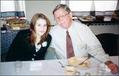
Photo of Ilona and the author on Easter Sunday.
A year and a week ago I underwent major surgery for removal of a prostate gland that had been determined to be a bit cancerous. I wrote about it and talked openly. Cancer is as terrifying to people of our civilization as just about anything we think of. I learned in the waiting rooms, however, that it makes brothers and sisters of us in treatment, as men and women struggle with their own varieties. The silence in those rooms is broken with great relief when we start talking together. I thought writing and letting people know what happens to me might serve some purpose---at least for research because so much effort is going into finding a cure...or even a cause. More >
|
|
<< Newer entries Page: 1 2 3 4 5 Older entries >> |
|
