|
|
8 Oct 2005 @ 18:45, by beto. Philosophy
This Theory of Relational Consistency is the scientific post-quantum expression of the Vedic and Buddhist view on Totality, and the solution of the age-old problem of its subjective/objective double face.
The Theory is well developed and scientifically sound in spite of lacking of mathemathical formalization, yet to be provided. More >
|
|
|
|
 31 Aug 2005 @ 09:47, by jhs. Philosophy 31 Aug 2005 @ 09:47, by jhs. Philosophy
my personal fear, trademarked, perhaps, hehehe
Perfektions-Angst (TM)
Said the Fool to the Wise Man: why don't you tell me what you are afraid of most, Wise Man? I can see it in your eyes!
Answers the Wise Man: Fool, you can't see yourself! How can you see in my eyes what I don't know?
The Fool: don't you see it, Wise Man, or are you just afraid to see what you witness?
Says the Wise Man: Fool, you do everything to not be perfect. That's how you are always happy!
The Fool: you do everything to be perfect, that's how you are never happy!
The Wise Man: Dear Fool, this is the desire of everything conscious in the world: to become perfect.
The Fool: Wise Man, tell me, in all the time the Universe had to evolve... why didn't it happen yet?
The Wise Man: if something becomes perfect, it has reached its end. Hence, it ceases to exist! Ergo, it cannot be observed!
The Fool: neat trick, Wise Man. But tell me what happens exactly if something is coming close to be perfect? Just this tiny moment before happens what can never happen, what happens?
... More >
|
|
|
|
 25 Jul 2005 @ 11:53, by scotty. Philosophy 25 Jul 2005 @ 11:53, by scotty. Philosophy
A few weeks ago I happened to come across a site that is changing my way of thinking ... changing my way of living...
changing my way of Being !
I would just like to share with you some of the things that I've found that have really set me free and helped me to find at last the answers to so many of my questions .
Road Signs ... [link]
Abraham Hicks ... [link]
Inspiration Articles For Wellness by Life Dynamix [link]
Your Influence in this Vibrational Universe [link]
(p.s. - the water was Freeezing !!!)
. More >
|
|
|
|
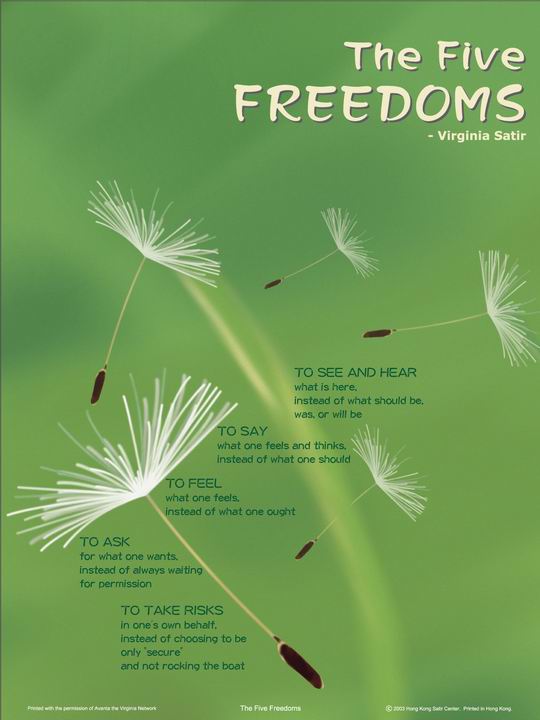
17 Jun 2005 @ 13:34, by scotty. Philosophy
"Our young daughter had adopted a
stray cat. To my distress, he began
to use the back of our new sofa as a
scratching post. "Don't worry," my
husband reassured me. "All he needs
is a little discipline. I'll have
him trained in no time."
I watched for several days as my
husband patiently "trained" our
new pet. Whenever the cat scratched,
my husband deposited him outdoors to
teach him a lesson.
The cat learned quickly. For the
next 16 years, whenever he wanted
to go outside, he scratched the
back of the sofa."
(Reprinted from The Written Wisdom) More >
|
|
|
|
6 Jun 2005 @ 11:41, by swanny. Philosophy
THOSE GOLDEN NOWS
Even in the light of the unfairness of life, we are still called and charged by some distant honor and grace to be fair and honest in our dealings and doings, less that this realm and wonder be pitched into the utter chaos and darkness of the void. We thus Love in this hope and freedom, that by such doing and strive, we are evolving a more just and noble reality. As grand a reality as has never been seen or known before and that stands as proof and fact of the existence and industry of Love, True Love, the Love that never dies.
And if we stand steadfast and sturdy in this we can find and know the Truth of this in those rare and golden moments of this passing now. Those rare and golden "Nows" that we reach and "touch" from time to time.
Carry On...
A. G. Jonas
(c) 2005
Canada More >
|
|
|
|
29 May 2005 @ 00:58, by swanny. Philosophy
THE IMPORTANCE OF PHI ( THE GOLDEN RATIO)
Much of my early life was spent sensing that something was missing or displaced in my life or this world. I am not certain where such feelings originated and had little insight into what they might involve. Needless to say though, as many they caused me to search somewhat blindly for that "missing" something.
Many have had this same quest perhaps for something that came to be called the unifying theory I suppose. We are not that different after-all but I came to question the probability of a static unifying theory in the light of progress and evolution and realized perhaps its inherent impossibility.
Now though in light of my discovery or the rediscovery of Phi (1.6180339...) the golden ratio, while I see it not as a unifying theory, it is or does suggest in a way, a divine unifying ratio.
I can't help but speculate thus, that the current dysfunctional planetary society, is the result of our deviation or such, from the expressions and principles of this golden or divine mean. (phi) We have, it would seem forgotten or taken this very fundamental and important aspect of harmonious existence and development for granted. It is after-all, or can serve as a very basic guiding light, factor or consideration in organizational and holistic endeavor and development.
A fact, which previous earth societies once acknowledged and held in high esteem and regard, as history would seem to indicate but which through some oversight or some such was supplanted or replaced by humanities obsession and fascination with and to itself.
It is only now, once again, as we begin to reap the consequences of such self absorption that we see the real and urgent need to redeem and reacquaint ourselves with this ancient, divine and unifying ratio and its holistic aspects.
Hopefully some remnants of its properties and understandings still remain in spite of our neglect towards its inherent and necessary truth. More >
|
|
|
|
15 May 2005 @ 11:02, by lemus. Philosophy
SPANNER TO SPIN AN ATOM
With a spanner to spin an atom,
A rocket to reach eternity, the
New millennium voyager
Stares at visions of discovery.
In antique words made long ago
Before there was any techno-science
How can anyone express the vision
Of this revealing knowledge?
The poet needs an alien tongue,
An extraterrestrial language
In which to descibe the revelation
Which far-seeing science has made.
Who can describe in any terrestrial tongue
The incomparable beauty of Orion's Nebula?
In any terrestrial tongue who can describe
The wonders of quasar and super nova?
In what words shall we capture the splendour
Of microscopic molecules, telescopic galaxies,
The strangeness of the quark, the charms of quanta?
Where can a poet find the words to tell
The scales between parsec and particle,
Billions and billionths measured,
Between vast intergalactic spaces
And microscopic nanometers?
Mathematics is the language of science
But equations do not speak to the heart.
Science is a cold objective art
But we are warm-hearted humans.
With the power to split atoms apart
And to send rockets into space,
We need the words to invoke our awe,
Science as true revelation.
Have you seen the double helix?
Have you seen a foetus in the womb?
Have you seen the rings of Jupiter?
Have you seen our Earth from space?
It is not a case of theoretical equations,
Not a matter of complex hypotheses,
Nor a question of expert opinion:
It's the passion of your human heart.
In ancient days prophets prophesied,
Creating scripture's revelation.
The revelation is now written in
A new language of divinity.
The universe is no less divine today
Though not inhabited by the ancient gods.
Life revealed by science is no less sacred
Than it was to Moses or the Buddha.
Machines have revealed new wonders,
But even machines with eyes are blind.
Only in the human heart will be discovered
The new vision revealed by science.
|
|
|
|
 14 Apr 2005 @ 23:59, by ming. Philosophy 14 Apr 2005 @ 23:59, by ming. Philosophy
Antony Judge writes a paper about Liberating Provocations. You know, the "rational" approach, if you want somebody to do something that is good for them, has usually been considered to be to positively promote constructive behavior. I.e. tell them why it is good for them, outline all the advantages, provide useful information, encourage them. It is just that a lot of the time that doesn't work at all. Lots of people do the opposite of what they're supposed to. So, one could go a different way altogether and do the opposite. Promote the negative behaviors. Act surreal and start a campaign for doing all the wrong things. Get the government to support them loudly.This is a two-pronged strategy. By advocating a "negative" approach, those resistant to being told how to behave would reactively consider a "positive" approach. Those scandalised by the "negative" approach, would invest their energy in "positive" campaigns -- where previously they would not have been engaged.
We are all familiar, from earliest childhood, with the response to exhortation from those occupying the moral high ground. We either ignore them or consider interesting ways of doing the opposite. If we are told not to do something, then we consider doing it. If we are encouraged to do something, we consider doing the opposite. The point is made by Zoe Williams (Cannabis Comedown, The Guardian, 29 March 2005):
"Thus, if you tell them things are dangerous, they will do them, and if you shrug and say "actually, it doesn't seem to do too much harm", they will do something else. Whole swaths of aberrant behaviour could be addressed with this in mind. Obesity, smoking, drinking, fighting, snowboarding and joyriding would all become terribly passé if the government were to become their advocates, particularly if prominent members of the government were to lead by example and take up dangerous activities in a high-profile way."
This provocative approach is designed to communicate more effectively with those already acting inappropriately or those who are passive in the face of inappropriate action. Now, I'm not even sure if I want to buy the idea that we collectively want to make people do a certain list of good things and not do a certain list of others. Although a society of course needs some kind of list of things one ought not to do. I'd want it to be very, very small, though.
What I'm more interested in, which Tony also brought up, is the angle of infinite game playing. In a finite game there's a set of rules and you're supposed to follow those rules to win, against some kind of opposition. In an infinite game, however, you play with the boundaries and you change the rules, in order to keep playing. A very different thing.
Fixed rules about what you're supposed to do and not do will create a finite game. Obviously. It constrains people. And for it to be a game, different people will tend to take different sides. If some people make a finite game with the goal of making you not smoke, not use bad words, not watch porn on your computer, or whatever, well, that's a pretty dull game. The only way of making it half interesting is to play the opposing part. I don't know about you, but negative campaigns trying to tell me what to do or not to do gives me an instant compulsion to disobey. I don't always bother to follow it, but such a campaign obviously is doing the exact opposite of what it tries to do.
OK, so a fixed game of compulsion or repression will quite naturally and automatically motivate a lot of people to do their best to do something else. It suddenly becomes important, and somewhat interesting. The opposite-game is limited too, but not quite as limited as doing what you're told.
Limited games tend to make people do things they wouldn't do otherwise. Maybe do what you're supposed to, maybe follow the rules, or maybe what you're not supposed to do, specifically disobeying the rules. Which you might not bother to do that way if those particular rules weren't there.
Unnecessarily limited rules can be harmful. I'd say that anti-smoking campaigns is probably one of the biggest killers is our society, probably responsible for millions of unnecessary deaths and many more millions living miserable neurotic lives. Because they present a very limited game. Either you do what we say or you die. Not much fun in it either way. There's hardly even two factions in it.
Having a choice is fun. And if you feel free to make your own choices, changing the rules as you go along, you're probably playing an infinite game. The playing of infinite games defuse the power of a finite game. Which was an illusion in the first place, but one might not notice before one changes the rules.
Carrying out unexpected paradoxical strategies might work, not just because people will do the opposite of what they're told, but because they give a hint of the joys of freedom of choice. It shows you that you don't have to do what you're told. You're free to not smoke, regardless of whether the government unwittingly spends a lot of effort on compelling you to do so, or not to do so. Which is roughly the same thing.
The thing is that most people are quite capable at choosing the best option that is available, or a new option that previously wasn't available, IF they're not being held stuck in some kind of fixed for or against situation. Not surprisingly, most people will choose what they feel good about, if they have the choice. Or, rather, if they have ALL the choices. Because there are a lot more choices then two in life.
That all seems very paradoxical to people who try to rule other people and condition them to do the right thing. That people are more likely to do the right thing if you don't force them, but rather allow them to move the rules around. And, for that matter, you have no business thinking you know what the right thing is for everybody. What people want is to have fun playing the game of life, and playing it as long and as well as possible, and they probably don't really want your stupid little game of following a rule that's known in advance.
Oh, I probably went off on a tangent. Tony's article is superb and gives lots of good examples of provocative and surreal and perverse strategies and pranks that have worked well. Some very amusing ones, like the Cannibal Flesh Donor program, pornocracy, horses running for public office, etc. Humor is great, because it breaks the rules, at least a little bit. It makes people pause and see things a little differently. And that is what is needed. Not being for or against. Life is too short and too big to only use it for playing two-bit games. We need to keep evolving, in millions of different directions at the same time, if we at all are to have a chance. Good paradoxes have much more generative power than clearly stated goals that are handed to you. More >
|
|
|
|
16 Feb 2005 @ 12:05, by beto. Philosophy
How could Jonathan Swift foresee, in his Gulliver's Travels, that planet Mars has two moons which revolve in opposite directions, more than a century before science discovered that? More >
|
|
|
|
31 Jan 2005 @ 09:27, by beto. Philosophy
In this beginning of the 21st century, we still live together with the last remains of Sigmund Freud's, Karl Marx's and Charles Darwin's ideas, three typical products of the 19th century. More >
|
|
<< Newer entries Page: 1 2 3 4 5 6 7 8 9 10 Older entries >> |
|
