|
|
 12 Dec 2008 @ 15:48, by jerryvest. Children, Parenting 12 Dec 2008 @ 15:48, by jerryvest. Children, Parenting
Ask any veteran how life is after war. Most likely in their own words (and ways)they will tell you how it imprinted lasting marks on their minds and souls. Some will let you know all the different ways their war never ends. Many will not even begin to talk about it because they feel that nobody would ever understand unless they had been there too. For the people back home...they need to understand that it is most difficult to fathom how things have changed for their returning troops. After all, how can anyone see inside of a duffle bag that still goes unpacked? Some troops may never unpack it completely, and we cannot expect them to. Down Range to Iraq and Back by Bridget C. Cantrell, Ph.D. & Chuck Dean
******************************
As many of you know, I work with injured Warriors in the US Army's, Ft. Bliss Restoration and Resilience Center as a clinical social worker. During this past year, I meet with soldiers in individual, couple and family therapy while also coordinating Meditation, Water Polo and Health Education activities. Our R & R Center is an experimental center for soldiers who have been diagnosed with PTSD and many who also have experienced concussions or Traumatic Brain Injuries and other physical wounds. We have 2 young soldier who have completed 5 tours of duty in Iraq and Afghanistan. Most of our soldiers have been away from their families for 2 to 3 years and when they return they are often unrecognizable as they have serious mental health issues that prevent them from relating and interacting with their loved ones as they did before they were deployed.
I believe that we have the best program and staff in the world and yet, it is very sad for us to see how our families struggle every day to sustain their relationships. Do read these stories that describe the challenges on military families despite our best efforts to help. [link][link]
*****************************************
As wars lengthen, toll on military families mounts
FORT CAMPBELL, Ky. (AP) — Far from the combat zones, the strains and separations of no-end-in-sight wars are taking an ever-growing toll on military families despite the armed services' earnest efforts to help.
Divorce lawyers see it in the breakup of youthful marriages as long, multiple deployments in Iraq and Afghanistan fuel alienation and mistrust. Domestic violence experts see it in the scuffles that often precede a soldier's departure or sour a briefly joyous homecoming.
Teresa Moss, a counselor at Fort Campbell's Lincoln Elementary School, hears it in the voices of deployed soldiers' children as they meet in groups to share accounts of nightmares, bedwetting and heartache.
"They listen to each other. They hear that they aren't the only ones not able to sleep, having their teachers yell at them," Moss said.
Even for Army spouses with solid marriages, the repeated separations are an ordeal.
"Three deployments in, I still have days when I want to hide under the bed and cry," said Jessica Leonard, who is raising two small children and teaching a "family team building" class to other wives at Fort Campbell. Her husband, Capt. Lance Leonard, is in Iraq.
Those classes are among numerous initiatives to support war-strained families. Yet military officials acknowledge that the vast needs outweigh available resources, and critics complain of persistent shortcomings — a dearth of updated data on domestic violence, short shrift for families of National Guard and Reserve members, inadequate support for spouses and children of wounded and traumatized soldiers.
If the burden sounds heavier than what families bore in the longest wars of the 20th century — World War II and Vietnam — that's because it is, at least in some ways. What makes today's wars distinctive is the deployment pattern — two, three, sometimes four overseas stints of 12 or 15 months. In the past, that kind of schedule was virtually unheard of.
"Its hard to go away, it's hard to come back, and go away and come back again," said Dr. David Benedek, a leading Army psychiatrist. "That is happening on a larger scale than in our previous military endeavors. They're just getting their feet wet with some sort of sense of normalcy, and then they have to go again."
Almost in one breath, military officials praise the resiliency that enables most families to endure and acknowledge candidly that the wars expose them to unprecedented stresses and the risk of long-lasting scars.
"There's nothing that has prepared many of our families for the length of these deployments," said Rene Robichaux, social work programs manager for the U.S. Army Medical Command. "It's hard to communicate to a family member how stressful the environment is, not just the risk of injury or death, but the austere circumstances, the climate, the living conditions."
An array of studies by the Army and outside researchers say that marital strains, risk of child maltreatment and other problems harmful to families worsen as soldiers serve multiple combat tours.
For example, a Pentagon-funded study last year concluded that children in some Army families were markedly more vulnerable to abuse and neglect by their mothers when their fathers were deployed in Iraq and Afghanistan.
In Iraq, the latest survey by Army mental health experts showed that more than 15% of married soldiers deployed there were planning a divorce, with the rates for soldiers at the late stages of deployment triple those of recent arrivals.
For the Army, especially, the challenges are staggering as it furnishes the bulk of combat forces. As of last year, more than 55% of its soldiers were married, a far higher rate than during the Vietnam war. The nearly 513,000 soldiers on active duty collectively had more than 493,000 children.
Jessica Leonard at Fort Campbell says family support programs there have improved since her husband's first combat tour, helping her feel more self-reliant. Yet she's convinced that domestic violence and divorce are rising at the base, which is home to the 101st Airborne Division.
"Infidelity is huge on both sides — a wife is lonely, she looks for attention and finds it easier to cheat," she said. "It does make even the most sound marriages second-guess."
Among soldiers coming home, whether for two-week breaks that often end with wrenching good-byes or for longer stays, she sees evidence of lower morale and rising depression.
"They come home, and find that problems are still there," she said. "Instead of a refreshing R-and-R, a nice little second honeymoon, it's battle for two weeks."
There have been some horrific incidents shattering families of soldiers back from the wars — a former Army paratrooper from Michigan charged with raping and beating his infant daughter; a sergeant from Hawaii's Army National Guard accused of killing his 14-year-old son as the boy tried to save his pregnant mother from a knife attack by the soldier.
In one of the saddest cases, a recently divorced airman who served with distinction in Iraq chased his ex-wife out of military housing with a pistol in February before killing his two young children and himself at Oklahoma's Tinker Air Force Base. Tech. Sgt. Dustin Thorson's former wife had sought a protection order against him, saying he threatened to kill the children if she filed for divorce.
Officials at Tinker, while confirming that Thorson had been getting mental health care, would not say whether those problems related to his service in Iraq.
His brother, Shane Thorson, a sheriff's deputy from Pasco, Wash., who also served in Iraq, has no doubt Dustin's war experiences contributed to the tragedy.
"He didn't want to go — he was afraid, but he had a job that he'd signed up to do and he went and did it," Shane said. "I do think it led up to everything that happened. ... It opened up a world of death and chaos and uncertainty."
Shane, who is married and has an 8-year-old daughter, is sure the deployments have damaged many marriages.
"My wife and friends, they tell me I'm not the same person before I came back — not as loving," he said. "You really realize how insignificant you are in this world, and life moves on whether you're there or not."
Overall, the Army says its domestic violence rates are no worse than for civilian families. However, critics say there is a lack of comprehensive, updated data that reflects the impact of war-zone deployments and tracks cases involving veterans, reservists and National Guard members.
The Miles Foundation, which provides domestic-violence assistance to military wives, says its caseload has more than quadrupled during the Iraq and Afghan conflicts.
"The tactics learned as part of military training are often used by those who commit domestic violence," said the foundation's executive director, Christine Hansen, citing increased proficiency with weapons and psychological tactics such as sleep deprivation.
Jackie Campbell is a nursing professor at Johns Hopkins who served on a Defense Department task force examining domestic violence. She says the military's data on the problem is based only on officially reported incidents, and should be supplemented with confidential surveys such as some that were conducted before the Iraq war.
"They have no clue what the rate of domestic violence is — they only know what's reported to the system, and that's always lower than the actual rate," Campbell said. "I'm disappointed.... I know the system is stressed to the umpteenth degree. But I do think they need to do the right kind of research so they can keep up with this."
One complication, she said, is the high rate of post-traumatic stress disorder among service members returning from war. She said PTSD raises the risk of domestic violence, yet many soldiers and their spouses don't want to acknowledge PTSD or any domestic crises for fear of derailing the soldier's career.
"They know the power of the military will come down on them," Campbell said. "The women are often reluctant to have that happen."
At Fort Campbell, Family Advocacy Program director Louie Sumner — who's in charge of combatting domestic violence — has encouraged people to report suspected abuse, to the point where many allegations turn out to be unsubstantiated.
But Sumner said his program, though considered one of the Army's best, should do more outreach with the majority of families who live off the huge base, in subdivisions, apartments and trailer parks where many couples' troubles may go undetected.
Sumner is sure that the repeated deployments heighten the risk of family violence. "When the soldier goes overseas three, four times, the fuse is a lot shorter," he said. "They explode quicker, and the victim gets hurt worse."
He marveled that some of the hasty marriages by youthful soldiers survive the rigors of deployment.
"My wife and I have been married 38 years," he said. "I'm not sure we could have stood being apart 30 of the next 42 months at the start of our marriage. That's a long time when you're real young."
The independence that wives develop at home alone leads to friction when a returning husband seeks to restore the old order in household decision-making.
"Somebody who's violent and controlling of his partner before he leaves will spend a lot of time while he's away wondering what she's doing, worrying that he doesn't have that day-to-day control," said Debbie Tucker, who co-chaired the Pentagon's domestic violence task force. "He comes back with the attitude that it needs to be re-established as firmly as possible."
Despite the stresses, a study published in April by Rand Corp. concluded that divorce rate among military families between 2001 and 2005 was no higher than during peacetime a decade earlier. But the study doesn't reflect the third and fourth war zone deployments that have strained many military marriages over the past three years.
Maj. Mike Oeschger gets a closer look at struggling marriages than he'd like in his role as rear detachment commander for the 1st Brigade Combat Team at Fort Campbell. Dealing with family crises while the brigade is in Iraq is a critical part of his job.
"The biggest problems usually revolve around money — the husband may not have given the wife access to funds," he said.
Oeschger, a husband and father who served in Iraq himself, has seen infidelity in multiple forms. Some wives at the base are preyed on by men who know the husbands are overseas; some war-zone soldiers pursue extramarital affairs over the Internet.
"Often the guy comes back, tells his wife, 'I'm not interested in you any more. I think we're done,'" Oeschger said.
He'd rather stay out of his soldiers' personal lives, but that's not always an option.
"There's almost nothing that's private in the Army," he said. "Once it starts to affect performance, I'm involved and want to know every detail. It's miserable stuff ... but it's my job."
Col. Ronald Crews, one of several chaplains called from the reserves to help with family counseling, said long-distance marital crises became so severe for two Fort Campbell soldiers recently that they were sent home from Iraq to handle them.
"Their commander said they wouldn't be of any use until the problems were resolved," Crews said. The soldiers were required to meet with him weekly. One returned to Iraq and the other did not.
For some time, chaplains have been conducting marriage workshops for soldiers back from deployment. Now, says Crews, married soldiers also are being required to attend such workshops before they leave.
"Deployments don't help in strengthening a marriage, but they do not have to kill marriages," Crews said. "That's a choice a couple has to make."
Medical personnel, meanwhile, have been directed to be more aggressive in screening spouses of deployed soldiers for depression. More than 1,000 "family readiness support assistants" are being added, as are dozens of marriage and family therapists. A respite child care program is expanding to provide more relief to stressed mothers.
However, for families living off-base, there are often far fewer support programs readily available.
Advocacy groups also say more must be done for families of wounded and traumatized soldiers who leave the service. At a recent congressional hearing, Barbara Cohoon of the National Military Families Association suggested the Veterans Administration is not meeting these needs, and said the anguish of wounded soldiers' children "is often overlooked and underestimated."
Stacy Bannerman, an anti-war activist whose husband served with the Washington State National Guard in Iraq, says many Guard members and reservists don't get adequate treatment when — like her husband — they are diagnosed with PTSD.
"The families are scattered everywhere, and we don't have the support networks that active duty does," Bannerman said. "There's very little attention paid to reintegration — bammo, you suddenly go back to your civilian life. I haven't spoken to anyone who hasn't experienced some degree of stress on a marriage."
Her own marriage nearly became one of the casualties. She and her husband, Lorin, were separated for more than a year, but now — after finding a counselor outside the military — are working at reconciliation even as Lorin faces a second deployment to Iraq in August.
"It's been a long, arduous process," said Bannerman, who has moved to Oregon to work at an animal sanctuary which is seeking to involve traumatized veterans in its programs.
Many returning soldiers experience some form of depression, lapsing into substance abuse, sleeping fitfully, withdrawing from family activities. Children may feel their father is too distant, or unsettlingly changed.
"The kids may not really recognize their parent," said Col. Elspeth Ritchie, psychiatry consultant to the Army surgeon general. "Their expectations build up, and then expectations aren't met."
The Army would like to beef up psychiatric care for children, Ritchie said, but is hampered by a national shortage of child psychiatrists.
"The children of these families are suffering damage emotionally and a lot of them aren't getting any help," said Lee Rosen, whose North Carolina law firm handles many military divorces. "We're going to have fallout from this for a long time."
Rosen says the breaking point for many couples often arrives with a second or third deployment.
"To go off for one deployment for a year is difficult, but when that soldier comes back, people are able to adjust, to heal," he said. "When you go a second time, and are threatened with the possibility of a third, it's just devastating."
Yet many marriages don't survive even a first deployment.
While 1st Lt. Mike Robison was serving in Iraq in 2003-04, his wife, Candance, depicted him as a "good, brave man" in a letter she wrote to President Bush. But the marriage fell apart after Robison's return home to Texas. Candance said they argued over her role managing the household and how he treated her 10-year daughter from a previous relationship.
"It absolutely changed him," Candance said of his deployment. "I still struggle every day — that year has affected every single aspect of my life."
Andrew Brown, an Army Reserve sergeant from Pennsylvania, says his marriage failed to survive the effects of his Iraq deployment in 2004-05. Returning home, he was diagnosed with PTSD and deduced that his wife, lonely in his absence, had been having an affair.
"With the mental state I was in, I was relying on her to provide support, and she wasn't ready to do that," Brown said.
"What I went through is not an isolated incident," he added. "Guys came back — they'd shut down, turn to the bottle, have lots of fights with their spouses."
At their small ranch house near Fort Campbell, Staff Sgt. Brian Powell and his wife, Krystal, expressed determination to keep their marriage on track as they raise two young sons and as Brian faces a second deployment — this time to Afghanistan — starting in December.
Brian was in Iraq when his eldest son, Jamison, was born in 2006. He got home on a brief leave three days after the birth.
"It was just two weeks," Brian said. "You don't want to get attached because you know you have to go back."
"It's a really hard transition, coming back from blood, death, corruption to a wife and baby. You feel you don't know each other," Krystal added. "But if you have faith, you get through it."
Copyright 2008 The Associated Press. All rights reserved. This material may not be published, broadcast, rewritten or redistributed.
[link]
Share this story with friends and others who wish to support our soldiers and their families.
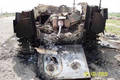
Note: This amazing picture of a Bradley Tank that SFC Scott Milligan served as commander, shows how vulneable our warriors are, even enclosed in our military's best weapon systems. When they are struck by these powerful explosive devices they may survive, but the injuries are extensive. It is amazing that Scott and two team members survived this devastating blow, but he did experience 3 broken vertabrae and a concussion that is still being evaluated.
SFC Milligan has given me permission to show his pictures and his Expressive Art work on my website. [link]. Scott is a great soldier and leader and I am honored to serve as his primary therapist. He wishes to show these pics so that others may learn how war impacts their lives, health and relationships.
More >
|
|
|
|
12 Dec 2008 @ 11:46, by vector8. Spirituality
While I was at my friend's music studio recently, he showed me how he mixes different sounds. He also showed me to adjust the frequency of particular sounds and create balance. He talked about rhythms and how different beats create different song genres giving rise to the equivalent lifestyle. I could very much relate to frequencies and rhythms which I see as feelings that give rise to the equivalent life experiences. More >
|
|
|
|
 11 Dec 2008 @ 21:17, by Unknown. Religion 11 Dec 2008 @ 21:17, by Unknown. Religion
Marsrising, a member of AboveTopSecret.com, claims that 2012 has already happened:
"STOP. THINK. The governments of the world knew 2012 was going to happen. To con everyone they have changed the calendar. So all of you waiting for the world to end or to get saved are wasting your time."
Well, Marsrising, thank you very much on behalf on the rest of us, "conned" little tushies out there, on our way to celebrate the coming new year. Seriously now, how is one even expected to know what year it is anymore, let alone what time it is?
But, thankfully, and reassuringly so (?) before that, there is always Xmas! And, so, Merry Christmas you all! Santa and Satan's Government both want to know (or are they one and the same?): have you been naughty or nice?
What would zz top say?
I been bad, I been good,.......
I aint askin for much....... More >
|
|
|
|
 11 Dec 2008 @ 14:29, by jhs. Economics, Financing, Banking 11 Dec 2008 @ 14:29, by jhs. Economics, Financing, Banking
There is POSITIVE proof that the current economical philosophy is fundamentally flawed.
Its called Grameen Bank and its founder was Muhammad Yunus, Nobel Prize winner 2006 in Peace (NOT in Economy, someone please tell me why!).
I call this kind of proof POSITIVE because Yunus philosophy of borrowing to the poor without any collateral or guarantees at ultra-low rates is considered crazy by common adherents of today's economical structures and yet he achieved a stunning, irrefutable success, and thus a proof of concept beyond the complicated theories of the 'leaders' of today's system.
Recently he started to borrow money to beggars (the title of this little article is no joke!), and with this he is shifting even more the entire cultural concept of an entire country, Bangladesh, considered one of the poorest of the world,
But Bangladesh is a special country. 1999 it was ranked number one in the 'World Happiness Survey' [link] . Even though it is dubious how 'happiness' can really be measured with a survey, it still gives a strong hint.
Helo and I tried to talk to Muhammad Yunus at the recent ExpoManagement 2008 in São Paulo, but, surprise, surprise, we were not the only one, and I guess our connections are not good enough (yet) to skip a line like that in front of us.
Still, at an event at which even I if jumped into a business suit and decorating myself with a Delaveine cravate, no kidding, Muhammad Yunus just walked around smiling in some Bengalese clothes. Sometimes he appeared scared for a short moment when some sudden sharp noises were being heard, a bit as if he lived in fear of an assassination, but for the rest he was... More >
|
|
|
|
11 Dec 2008 @ 06:58, by erlefrayne. Futurism
Please know first that this writer/analyst is both (b) economist and (b) mystic-healer. For some time now, the challenge of contributing to the construction of an ‘economy that heals’ has been knocking at my ‘mental coconut’, a task that explains this article and many yet that will succeed this one.
As an economist, my lines of subspecializations are: (a) development economics, (b) political economy & public policy, (c) international political economy, (d) economic sociology, and (e) enterprise economics (or biz economics). As a healer, my subspecializations are: (a) psychosocial counseling, (b) pranic healing, (c) distance healing (w/ angelic reinforcement); and, (d) soul healing (includes chakra alignment & cleansing, past life issues resolution). More >
|
|
|
|
11 Dec 2008 @ 06:48, by divinityr. Recreation, Fun
Yesterday, I suffered a very traumatic experience disguised as a blessing. My son's grandmother took me out clothes shopping. I was ecstatic! It's been years since I've really gone clothes shopping for myself. What a blessing! I didn't even know where to start. Well, turns out we started with the basics, and by basics I mean TORTURE DEVICES.
We headed to the mall for bra shopping. That's right fella's. Bras, Boobie Slings, breast resters, tittie transports, bosom bindery, mammary manacles. God, I hate bras. Or, maybe I should say Bras hate me. I just bought new bras last spring and they're near useless. Upon suggestion, I visited a new store. I was told they have nice durable bras, even pretty ones, for the blessed . How's that for a slogan? Bare-able Bras for the Blessed!
Read the rest here http://www.associatedcontent.com/article/1290995/divinity_rising_my_bra_cup_runneth.html?cat=5 More >
|
|
|
|
 11 Dec 2008 @ 01:14, by Unknown. Recreation, Fun 11 Dec 2008 @ 01:14, by Unknown. Recreation, Fun
Not such a long time ago, in a political campaign not so far, far away: More >
|
|
|
|
8 Dec 2008 @ 14:53, by vector8. Spirituality
The other day, my mother went to visit a friend. She said when she got out of the train station, she couldn't remember how to get to the house so she asked for directions. She was given a long-winded direction. She reckoned she walked about 2 miles. Fortunately, she found a quicker route back to the station.
"Two miles, hey? I'm impressed," I said.
"I can't believe I walked that far," she said. "At least it was good exercise."
"Well, remember that was then and this is now," I said. "There's no reason why walking should have any effect on who you are now unless you believe it should." More >
|
|
|
|
 8 Dec 2008 @ 05:33, by koravya. Ideas, Creativity 8 Dec 2008 @ 05:33, by koravya. Ideas, Creativity
First Week
Every class is an experiment. More >
|
|
|
|
 7 Dec 2008 @ 16:23, by jhs. Recreation, Fun 7 Dec 2008 @ 16:23, by jhs. Recreation, Fun
Dear Blog Readers,
my mailbox is overflowing after my recent public delcaration and I see myself unable to respond to all of you.
Sorry, truly sorry.
But amongst the many messages, some encouraging, others quite hostile, here is one that impressed me very much and I'd like to share it with you even though it looks like one of those brainless chain letters.
---------------------------------- SNIP HERE WITH SCISSORS ---------------------------------------
PLEASE SEND THIS TO ALL YOUR FRIENDS, WHETHER LULUS, ENKIANS OR ENLILIANS !!!!
An Open Letter to Enlil and Enki
(also known as the "Sermon of the Holy Rock")
by Rev. Herbert Zeta-Czandor
Dear Enlil and Enki and All you Supergods!
The word is spreading quickly that you're about to come back and quite possibly stage yet another Sodom & Gomorrah or a Flood or both or more.
Before you give your orders, please take a sec and consider the following:
Observation 1:
OK, OK, humans made quite a bloody mess around here. But they were created in your image, mind you, and perhaps it is time to confront this fact in all honesty.
Observation 2:
This current civilization is full of corrupt governments and secret and not-so-secret but equally corrupt institutions. It is said that they are following your orders. This would indeed fit into the picture. If so. please go to Observation 1 again.
Observation 3:
It may come as a surprise to your Highnesses that in the few societies of Lulu (humans) that your corrupt followers have NOT (yet) perverted, the Lulu ALWAYS managed to live in perfect harmony.
Observation 4:
Furthermore, it can be observed that WHENEVER your followers on Earth are CEASING to corrupt and pervert the Lulu, social and environmental order are being restored very quickly and righteousness and dignity return to the Lulu and all the beings on Earth.
Conclusion:
Dear Enlil and Enki and All you Supergods! It is YOU who is the problem and not the Lulu you created!
If I should ever find out WHO created YOU, I will personally report your demeanors and demand your immediate removal from this world. Your lies and deceptions are a disgrace to the Creation! And whoever created that lousy script for your miserable performance should forever be barred from the Universal Writers Guild.
Recommendations:
1. You should seriously consider getting some genuine education on the true values of life, dignity, responsibility, and righteousness, and all the values that your actions betray.
2. If the Sumerian tablets are any reflection of your social life, you should further consult a good psychological consultant or life coach to fix your general behavorial problems (I can give you some phone numbers if you want to!)
3. You should cease and desist going ahead with any plans of mass destructions except for those for Nibiru and yourselves.
3. If you are unable to do the above, please never come, go away, get lost, and, very importantly, never return.
PS: Don't forget to take the soulless zombies with you which you installed here on Earth as your shady agents.
That's it.
Rev. Herbert Zeta-Czandor
January 1st, 2009, Holy Rock City
(This is the end of the "Sermon of the Holy Rock")
PLEASE SEND THIS TO ALL YOUR FRIENDS, WHETHER LULUS, ENKIANS OR ENLILIANS !!!!
---------------------------------- SNIP HERE WITH SCISSORS --------------------------------------- More >
|
|
<< Newer entries Page: 1 ... 11 12 13 14 15 ... 279 Older entries >> |
|

These are news items gathered or contributed by NCN members
|
Categories
Activism (97)
Altered States (32)
Alternative Money Systems (17)
Broadcasting, Media (20)
Business (19)
Children, Parenting (28)
Communication (63)
Communities (71)
Conspiracy (34)
Counseling, Psychology (23)
Crime, Policing (7)
Death & Dying (14)
Developing World (19)
Economics, Financing, Banking (51)
Education (34)
Energy Sources (19)
Engineering (1)
Entrepreneurs, Money Making (19)
Environment, Ecology (123)
Exercise, Fitness (1)
Extraterrestrials (27)
Farming (14)
Futurism (13)
Globalization (29)
Government, Public Sector (46)
History, Ancient World (38)
Housing, Building, Architecture (10)
Ideas, Creativity (318)
Internet (49)
Inventions (6)
Investigation, Intelligence (23)
Knowledge Management (21)
Legal, Justice (24)
Liberty, Sovereignty (14)
Medicine, Healthcare (46)
Music (30)
Natural Health & Healing (27)
Neighborhood (12)
Networking (19)
Nutrition, Cooking (7)
Old Age, Retirement (4)
Organizational Development (12)
Paranormal (12)
Peace (35)
Performing Arts (9)
Personal Development (80)
Philosophy (94)
Politics (120)
Poverty (4)
Preparedness, Self-Reliance (12)
Privacy, Security (1)
Publishing (3)
Recreation, Fun (59)
Relationships (19)
Religion (40)
Science (48)
Sexuality (16)
Shared Purpose (30)
Social System Design (47)
Space Exploration (23)
Spirituality (391)
Systems Thinking (31)
Technology (37)
Transportation (9)
Travel (22)
Violence, War (103)
Visual Arts, Graphics (63)
|
| Mon | Tue | Wed | Thu | Fri | Sat | Sun |
|---|
| 1 |
2 |
3 |
4 |
5 |
6 |
7 |
| 8 |
9 |
10 |
11 |
12 |
13 |
14 |
| 15 |
16 |
17 |
18 |
19 |
20 |
21 |
| 22 |
23 |
24 |
25 |
26 |
27 |
28 |
| 29 |
30 |
|
Members can post news items and comments in the member area.
Information and opinions are the responsibility of the posters and do not represent any official position of NCN. Please do your own verification and make up your own mind.

Syndication
|
|

