|
|
 8 Jul 2010 @ 02:27, by ming. Communication 8 Jul 2010 @ 02:27, by ming. Communication
A couple of comments to my recent articles made me consider the importance of truth in effective collaboration networks. How can people truly connect if their connection is based on lies? Maybe collective intelligence is proportional to the amount of truth in the system.
Truth can mean different things to different people, of course, and there are several angles to this. To me truth is a coherence between realities and their representations. There can be many levels of reality and many levels of abstract representations. Truth is when what you say or imply is there actually is what is there, and when you actually say what is there.
It is rather relative, but, still, we recognize truth. Have you ever experienced having a conflict with somebody else, where you dig into the defense of your separate positions, and it is really upsetting, and you judge each other as being wrong, but then at some point, some key piece of information is exchanged, and you both, at the same time, have an "Oh, that's what's going on, now I understand!" kind of realization? It is a big sigh of relief, where the conflict just instantly evaporates. You realize that you defined a key term differently, or that you made assumptions that turned out not to be true, or you used different approaches, valid in their own right, but conflicting. Truth is freeing. It opens doors, makes things flow.
Between individuals, a lack of truth is often unintentional. You just didn't realize a key difference or a missing piece of information, and you proceeded based on different assumptions. Once they're brought to light, the matter is quickly settled, and an effective collaboration or agreement can be reached.
You can control people by intentionally leaving out the truth, by presenting a picture that is different from the reality. You can make a lot of money by making some cheap crap look expensive and attractive. You get votes by leading lots of people to believe you care about their interests.
At a very practical level, you can't make very good decisions when you don't have the correct information.
That is of particular importance in networking, in cooperation and collaboration. It is of huge importance in harnessing the self-organizing power of groups, in the hope of increasing collective intelligence.
See, if every connection formed between two nodes in a network is based on lies and misinformation, not much synergy is achieved, and the connections will not be very effective. Imagine that each node in a network provides some kind of statement of "This is what I'm about. This is what I provide. This is what I need." and nodes connect with each other based on that, then it is important that such statements approximately represent something actual. If the people who say they provide funding have no money, and the people who repair cars don't know anything about cars, and the people who take care of children don't like kids, and the people who say they can fix things have no clue how - obviously the wrong connections are being made. You don't get the right people for the job, you don't find the right collaborators, you don't get the laundry detergent with the best price/quality ratio.
It might not make sense to describe it mathematically, but these errors in connection will certainly add up quickly, maybe exponentially. If you're trying to do something big, or you're part of a big network, these kinds of errors in connection might easily add up to making the whole thing completely ineffective.
Conversely, if you create a network of true connections, where it is clear what each node does, what is supplies, and what is needed, it starts scaling. Imagine the kind of superconductivity that takes place when all information is complete, relevant and correct. Self-organization can scale rapidly if there's little loss of integrity from untruth in each connection.
Currently, most types of organization are having a problem there. Even the very small organization of a single relationship between two people. Even people who've been married for years typically have a considerable problem saying the truth and relating based primarily on what is true. So, even more so, the more people you put together.
Our current civilization is to a large degree based on manipulation through untruth, by the few, of the many, exactly because we aren't good at cooperating truthfully.
The majority of the population in the industrialized world are employees. They produce a value for somebody else which is, on the average, a lot higher than the value they're being paid. They do that in part because they don't know how to produce that value on their own, and in part because they don't know the value of what they're producing. The reason they don't know those things is because the information isn't easily available. Rather, they're presented with entirely different and misleading information, emphasizing the stability of their situation, their benefits, their rights, random entertainment, weather and traffic reports, etc.
It typically isn't a matter of evil intentions on the part of the few who control the many. It is currently the most pragmatic and efficient choice. It is relatively more practical and productive to borrow money to create a company and hire a bunch of people and tell them what to do than it is to participate in a bottom-up self-organizing network of the same number of people. Not always. Sometimes small groups of people will freely do something great, without coercion, without needing payment. It is still a bit of an exception, but it is an important enough exception to indicate significant future possibilities. Sometimes open source communities will create a great product, fairly efficiently, for free, because a number of people voluntarily gather around a need or a solution, communicated clearly and truthfully enough so that they all can sense it, in one form or another.
Fuzzy projects and problems aren't yet easily undertaken by cooperative groups. Oh, strictly hierarchical groups are on their way out, but corporate network-like structures are still based on a hierarchy of control. The top still pays salaries and reaps the profit and outlines what one should work on, even if the finer details are loose.
There is lots of good information easily available. But huge areas are covered only by wildly misleading information, or information is largely missing, and that fact is well hidden. Do you think you know how most people make their money, or how large cooperations make their money? Sure, you can easily learn the average salaries of people in different professions, and the type of work they do, and you can easily look up the profits for public companies. But what actually is going on is mired in many layers of obfuscation.
Good information is something you readily can act upon and use. If I don't know how to fix the faucet in the bathroom, and I receive the right information, then I'll be able to fix the faucet. Maybe I first need to go to Home Depot and get a tool or a part, but that would be part of the good information, and I can still get the result I seek, right here, today.
There are plenty of outfits that will promise you similarly readymade information on how to make a good living doing one thing or another. Say, Internet Marketing or MLM. But once you receive that $2000 get rich quick manual or your supply of MLM vitamins, you discover that the instructions just don't get you there. They might be technically correct, and they might even give you a good overview and teach you something, but they're leaving out the specific information you would need to act in an effective way.
I have lots of friends online and offline. Yet I'm not really sure what to do with most of them. I mean, what can I do for them, what can they do for me? Oh, we don't have to do business in order to be friends, but if we do have something to offer or something we're looking for, it would be nice if we all knew what it was. And, I must admit, as to the majority of the people I know, I don't really know what they can do, and I probably haven't told them honestly what I need and want.
It is hard to be honest. If somebody asks me what I do or how I'm doing, I'm likely to tell them I'm fine, and things are going well, and I'll give them some general idea of what I do, which usually doesn't match neither what I actually do nor what I'd like to do. Why do I do that? In part because I myself am a little fuzzy on what it is I'm here for, and in part because I'm embarrassed if I actually need something, or I'm failing at something, and I'd like to look good. Different people have different hangups, but it is rare to get immediately actionable truth out of anybody.
Now, imagine that we were able to tell the honest truth most of the time. Imagine that it would be easy and natural to record and share the information about what really is there. Then imagine the possibility that lots of things actually would fit together when a lot of us start doing so. You know, I have something you need, you have a solution to my problem, X has the information that Y needs, A has a resource that B knows how to use. Synergy is much more likely when everything is visible.
Do our communication and collaboration tools lead us to be more or less honest? Do they increase truth, or obfuscate it? Do I have to wear a mask in order to protect myself, or do I get empowered by showing my real face?
How can we create environments where the truth is empowering?
I'm not talking about ultimate truth about the meaning of life and the universe. Simply, as I mentioned, a correspondance between what is going on and what one says is going on.
Masses of people who need to keep up appearances, trying to adhere to norms they never consciously agreed to, are relatively easy to control. They can be rendered rather harmless, as they each pursue individual rewards that don't truly match what they need and want.
If we make collaborative tools that simply reinforce our inclination to keep up appearances, they won't go far. If they only help us exchange impressively sounding declarations, abstract positions and lists of accomplishments, they won't have accomplished much.
Good information is actionable. It isn't just something to find interesting and to collect and pass on. There should preferably be something you can do about it or with it right now.
It is in itself a fairly fuzzy proposition to write an article about the need for truth in collaboration. Does that change anything? Maybe, maybe not. What is exactly the truth I'm calling for? I can only give vague examples.
There's a transparency that is needed. A lack of resistance. A matching of receptors. Things that match match. If one puts the wrong labels on stuff, one might erroneously try to match things that really don't fit.
Collective intelligence has something to do with increasing the number of opportunities for stuff to connect up, and lowering the resistance to it happening. Lacking or incorrect information are forms of resistance. Correct and complete information decreases resistance and increases connections. More >
|
|
|
|
 11 Mar 2010 @ 17:55, by jhs. Communication 11 Mar 2010 @ 17:55, by jhs. Communication
Far from making a joke, a pack of Brazilian self-acclaimed intellectuals attacked Brazilian's President as being analaphetic and unable to speak correct Portuguese. In the end it turned out to be a joke but the joke was on them as Lula's choice of words was not only legitimate but even intelligent as I will show below.
However, the problem lies deeper than using a certain word or not. It is symptomatic for a mental, oops, intellectual illness, it is a SYNDROME. One could simply focus on the obvious part and call it 'literal thinking'. But this would easily be dismissed as pertaining only to autism. In reality, an autist DOES conceive outside the framework of words but does not abide to the 'domestication process' that commands people to abstract from words the same way that had been determined by the current 'society'.
In a larger sense, 'literal thinking' also describes the inability to conceive a thought outside a pre- and other-determined frame of words. In other words, to 'think outside the box'. Rigid language thus keeps people captured within a limited range of possibilities and, Heavens forbid they would step beyond those boundaries of the mind. Don't even think of it!
Let's look at languages that are less rigid than Portuguese: the English of the United States is notoriously open to newly constructed expressions and even allows for 'inventing' new words, be it from scratch or through combinations of existing words like 'brunch' (= BReakfast plus lUNCH). It's no news that the American people were world leaders in innovation during the last century even though the vast majority of them is still at the 'literal level'.
The German language provides another example of linguistic flexibility: agglutination. The former communist regime of Eastern Germany wanted to export their fabrications of angels for Chrismas trees without internally referring to religion. They created the new word 'Gefluegelte Jahresendfigur' - a 'figure with wings for the end of the year'.
Back to the pack of predatory journalists in Brazil: they just can't confront the success story of a Northeastern metal worker becoming president. Whenever he speaks in public, they are hunting for some signs of illiteracy and they had a feast when Lula declared the other day: "tenho o casco duro", claiming it should be 'casca dura'. But the class of journalists of Brazil that is hunting for Lula-bloopers outdid themselves in their own smartness:
not being a Brazilian, it took me less than 2 minutes on the Internet to find out who's right and who's wrong!
This is silly, of course, but it comes to show that preconceived thinking combined with literal thinking makes anyone a fool of himself. To add shame to injustice, the same journalists and bloggers that blasted Lula for alleged 'erroneus Portuguese', took down their own pages ridiculizing Lula faster than you can say 'casco duro'.
Where is Google here - to conserve this outrageous, shameful behavior of the Brazilian mass media? Like in the recent case of an accident in Sao Paulo, they quickly remove any links to whatever is not convenient to the wannabe rulers and enemies of the Brazilian president, doing their part in local politics without the official status of a lobbyist. But Google's links (or non-links!) are in part controlling the Memes of the world and in this case local politics. Something that should seriously be looked into on a larger scale!
In any case, Lula, a 'simple' 'Nordestino', from a formerly poor and underdeveloped region of Brazil, rose to power in an unprecedented way and despite a massive mass media campaign of lies, unproven allegations and badmouthing in general. It was in the context of these shameful maneuvers that he stated that he survives these attacks of the mass media because of having a 'thick skin' as we would say in English.
Here is a little Portuguese lesson for the Brazilian mass media who claims that 'casco' should be 'casca' and only an illiterate person could mix those up:
'casca' - the shell of an egg, the rind of a tree
'casco' - the hull of a ship, the hoof of a horse, the shell of a tortoise
So, dear reader, what did Lula mean? That he's like an egg or a tree?
For me the message is clear and it prompted me to engage in some interesting musings about Lula's archetype: one thinks of a metal worker as an Ogun-type person. But Lula changed his career from a worker to being an advocate for workers as a syndicalist and then, much to the surprise to Brazilian Elitists, he went on to become President of Brazil. And reelected. Wow! What a shock it must be! And what a strange way to go for an Ogun! Isn't this a classic, THE classic, path of Shango?
Let's look for clues in Lula's words, not just of the other day but along the past years of presidency and we can see an old warrior carefully scheming his way amongst his own enemies, deflecting all attacks by a strong shield while maintaing his heart soft, warm, and intact, the way of the turtoise (sic!), and, after the storm is over, having the last laugh! What archetype would that be?
(Note: one can find the answer, of course, in the book 'Your Personal Archetype' (by Ed, Aaron, and myself), but you can also find it on the Internet if you sift long enough through all the trash&jewels that's out there about archetypes, Orishas, Archons, Devas, you name it). More >
|
|
|
|
27 May 2008 @ 14:45, by anandavala. Communication
Before joining the conversation, please read and accept this Invitation to a Conversation.
In a recent
conversation here on NCN I indirectly learnt a great deal. Even
though it was not what one would call a functional conversation it
was nevertheless a very interesting experience...
Below is an article compiled from my part in the conversation. It
addresses many issues that are central to the conduct of a
progressive discourse, which can result in cooperative solution
seeking that is grounded in reality and can be genuinely effective
even in the face of cynical attacks and denial. These are just
thoughts on the matter. More >
|
|
|
|
19 May 2008 @ 14:49, by vaxen. Communication
You are governed, your mind is molded, your tastes formed, your ideas suggested, largely by people you have never met or heard of before. This is the logical result of the way in which society functions today. Vast numbers of human beings must co-operate in this controlled manner if they are to live together in peace and prosperity.
The real issue or concern is whether or not you are aware of the fact that your freedom has been substituted by mind enslavement. More >
|
|
|
|
  15 May 2008 @ 06:22, by feecor. Communication 15 May 2008 @ 06:22, by feecor. Communication
A campaign for intercultural, interdisciplinary events and side-events, formal and informal, to promote dialogue and unity in diversity across scales, nations, languages, cultures, diciplines, sectors, lervels,.. is starting today: May 15 to June 15, 2008
TITLE: The Cultures and Powers of Diversity
Map Diversity and Mind Unity in Diversity - Create it & Accept it - Share & Expand it ! [link]
BY DIVERSITY WE MEAN: cultural, natural, biological, genetic, temporal, spacial, lingual, media (signs), artistic and creative diversity !
– even diversity of viewpoints, positions and world-views and world models or world maps ! and the need of not needing to agree and the beauty of difference (diversity) in view of requisite variety.
Why are these “Diversities treated seperately ? cant we learn from each other ? or do we think there is no common language and no overview possible? Can we come to grips with broad issues and vague subject areas?
There is also a diversity of views and positions, representations and displays, call them signs, symbols, schemas, maps and models.
What is needed is to go beyond dualistic approaches, thinking just from an individual an collective, or personal or societal, just as we are seperating goos and bad, black and white, north and south or east and west.
So let us explore and negotiate the merits of having more than one way to go and present, one perspective or one direction.
And see outcomes like from the EcoTHEE - 2008 Agora: [link] More >
   
|
|
|
|
 20 Apr 2008 @ 10:57, by deepwater. Communication 20 Apr 2008 @ 10:57, by deepwater. Communication
Reflections on how the individual system responds to being confronted by its own actual state of being and the physical, mental and emotional manifestations of its resistance to becoming aware of and clarifying its understanding of the true nature of its situation (its relationship with reality), and the specific therapies best suited to address them. More >
|
|
|
|
8 Apr 2008 @ 06:31, by deepwater. Communication
After
much reading, research and web-surfing it has become apparent that
many people are operating with serious limitations upon their
cognitive equipment, of which for the most part they seem oblivious.
There
is, unbeknownst to many of us, an enormous amount of conditioning
that we bring with us in our most vital piece of equipment....the
mind. Without
the awareness that our minds are operating in ways that can distort
or corrupt information, we are powerless to apprehend the truth of
the subjects we seek to understand.
This
situation can lead to all manner of unnecessary miscommunications and
frustrations which can hamper even the most well intentioned
conversation.
Even
the suggestion that ones thought process may require adjustment can
lead to episodes of denial and reactionary behaviour that seriously
undermine even the best effort to communicate around any other
issues.
There
are multiple, inter penetrating layers of confusion, distortion and
pre conceptions which form and reinforce each other as a result of
the subtle nature of this conditioning of the cognitive lens of the
mind.
It is
worth bearing in mind at this point that each of us will find
ourselves in this predicament at some stage and that we are all
fundamentally innocent of any ill intention, it is just that we are
unknowingly subjected to a proliferation of conditioning influences
over which we have no control.
Fortunately
there are many tried and proven methods by which to become aware of
and overcome these conditioning influences with a willingness to
participate being all that is required.
Given
that each of us has a unique, individual point of conscious
perception, then each of us will require a subtly different method of
approach to the clarification of their cognitive equipment. However,
clarifying the mind is the common and necessary goal for each of us
who seeks to operate effectively within the context of the best
possible outcome for all.
If we
can overcome the general tendency to consider our own self interest
as more important than the good of the whole, then we can begin to
work in the direction of manifesting a situation in which the greater
good can be served and the individuals who comprise that whole also
benefit as a result.
What I
am endeavouring to accomplish with this discussion is to suggest many
and various ways that individuals can approach the subject of mental
clarity, each to their own, with the hope that this better enables us
to reach a holistic understanding of the Nature of Reality, and a
greater ability to function in ways that foster right human relations
and greater peace and harmony between members of the human race.
|
|
|
|
22 Feb 2008 @ 16:36, by ming. Communication
Blogging is a bit too much like publishing. I mean, writing articles to be published.
Of course different people use the medium differently. Some people still just write about what their dog had for breakfast. But, with few exceptions, the blogs that are interesting to read consist more or less of articles that people write.
But that makes it less fun and useful to write. Writing an article is for me connected with deadlines and trying to match the expectations of the audience. Where I'd rather write a weblog for me, and then maybe share it with others as a second thought.
So, what happened to the idea of "log" or "logging"?
See, a log is really something more directed. One might keep a log if one is working on something. A record of one's progress, one's discoveries.
Like, a learning log, or a research log. One is working on finding something out, solving certain problems, arriving at certain goals. And one keeps a record, which charts the path, maybe for others to learn from too.
That's not how I use a weblog. I'd like it to be. But that would require a re-framing.
In that case one would set a theme or a goal. It is quite possible that the process would have an end, as one either reaches the goal, or one no longer is interested in the subject. So, one would open up new logs, keep them going as one is continuing exploring the subject matter, and one closes them when one is done.
That doesn't work so well with the way we currently use blogs. I'd expect a person to have preferrably one blog, which I can subscribe to in my blog aggregator. If they have several, it is a little annoying, and if they close them down and start new ones, it would be more annoying.
Regular blogs have categories or tags. Which of course can be used for particular threads. But typically one tries to subscribe to everything one person is blogging, and you might get a mix of postings on very different postings. Which is why most blog owners feel obliged to keep a certain uniform atmosphere in all the postings, as if it were a magazine, with a certain style and theme.
But, say I wanted to log several different of my interests and activities. Like me right now, I'm interested in photography, rollerskating, genealogy, Ruby on Rails programming, plus a whole bunch of other things I'd be more likely to write about on my blog. But, say I wanted to have a log of my experiences as a novice photographer. There are lots of blogs like that, where people share their photos, talk about their equipment, etc. Just like there are lots of blogs about genealogy, where people talk about their research, resources they find, etc. But if I mixed all of that together, it might not be fun for readers who aren't interested in those things, who just want to see me write about alternate dimensions or new civilizations or something. So, would I have a different blog for each? That would be quite feasible, if they were ongoing interests. Less so if they were more short lived. I don't think it is very comfortable to maintain several separate blogs, though.
From the user perspective, the author, the logger, me, I'd really want just one interface for an assortment of logging subjects. I wouldn't want to log into a different account for each one. Rather, one interface where I freely can add new subjects, and add log entries for any of them. Some of those subjects would be just for me, others I would choose to share, and maybe make public.
Of course, those logs that one chose to make public could be channeled into what appeared as different blogs for the rest of the world. But I wouldn't experience it like that. I'd just log stuff in my logging application.
And it would open the door to a different way of presenting or interacting with such logs. I mean, if each one logs the evolution certain subject, which maybe now is done, I'd like better ways of dealing with that sequence of events as a whole. It wouldn't just be an abandoned blog, but simply the log of a finished project.
People do put stuff like that on their blogs, but it might be hidden between lots of other things. A log of remodeling my garage is a perfectly valid and complete project. Doesn't have to either hide between posts about totally different things, or be a very short lived and abandoned blog.
If one keeps a log of actually going somewhere, trying to accomplish something, it also invites additional functionality to give the full picture. A project or a quest isn't just a series of equally important log entries. Some things will be more important than others. There will be key discoveries, reevaluation of priorities, ups and downs, a growing body of knowledge.
As one example, one might have a wiki-like area, functioning in parallel with the log, in which one puts the more permanent record of what one has learned or accomplished, the subject matter of the log. And maybe its versions would be synchronized with the log, so that one could see the evolution of the more permanent part. At the point of that particular log entry, how did the list of links look? How did it look the week after that?
It ties in with a project I'd like to do, but which I haven't carved out enough time for yet, which is to structure environments for particular purposes. Dynamic webpages that are structured so as to support what one is trying to do. A brainstorm takes a different structure and different tools than does a research project or the process of starting a new company. Each one involves some combination of logs, notes, permanent records, links, lists, outlines, ordering, sequencing, randomity, and more. If you don't use an environment that supports what you want to do, it doesn't work so well. A blog or a wiki or a forum do different things and inspire different kinds of behavior. The right constellation of interdependent tools can accomplish something more precise in a more appropriate manner.
This post here could be said to be a log entry in the project of building such things. But putting it right here doesn't help me much in keeping a record of my progress. More >
|
|
|
|
9 Jan 2008 @ 22:45, by ming. Communication
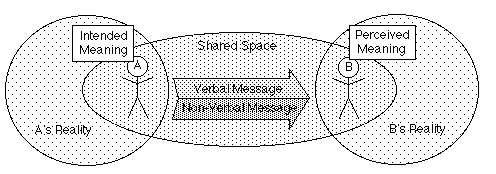
Somebody asked for permission to use my old graphic here in a training course for field epidemiologists in Kazakhstan. Which is kind of funny. And I don't remember if I ever posted it here, so why not. Below is the article that goes with it. Although I thought it was kind of well hidden on the net, I do get these kinds of requests from time to time. ... And now that I notice it, this is actually the #1 "I feel lucky" entry for "Communication Model" in Google, which I can't complain about.
There is always a sender and a receiver in communication. At least there is an intended receiver. In the diagram above A is the sender, B is the receiver.
A and B have different personal realities. They each have their own world formed by their experiences, their perceptions, their ideas, etc. They will perceive, experience, and interpret things differently. The same event will always be perceived a little different by each of two people.
For the consideration to communicate to appear at all there must be some kind of shared space. The participants must have some kind of concept of each other's location and of a possible channel of communication existing between them. They must agree sufficiently on these to agree that communication is taking place.
The sender will have some kind of meaning she wishes to convey to the receiver. It might not be conscious knowledge, it might be a sub-conscious wish for communication. What is desired to be communicated would be some kind of idea, perception, feeling, or datum. It will be a part of her reality that she wishes to send to somebody else.
Something will be transmitted across a distance in the shared space. We can regard it as an object, a particle, or as a wave, or flow. It might be sound vibrations, rays of light, words, pieces of paper, cannon balls, body language, telepathy, or whatever.
Between humans there will be several layers of the message being sent. There will often be a verbal portion, something that is being expressed in language, spoken or written. And there is also a non-verbal portion, covering everything else, most notably body language. Sometimes the verbal and non-verbal messages don't agree with each other, they are incongruent. If they do agree we say that they are congruent.
Based on what the receiver perceives, and based on her interpretation of the verbal and non-verbal input, she will form a concept in her reality of what the meaning of the message is. It will mean something to her. It might or might not be what was intended by the sender. In successful communication the perceived message will approximate the intended message to the sender's satisfaction. However, the sender will only know that if she receives a message back that is congruent with what she had in mind.
One can never take for granted that the receiver has the same reality as the sender. One can never take for granted that the receiver will interpret the message the same way as the sender intended it.
Communication is not an absolute finite thing. Particularly, communication with language is always vague and misleading to some extent.
If A says a word, like for example "trust", she has a certain meaning attached to it in her reality. She has had certain experiences with the subject matter, she has made certain conclusions about it, and she has certain perceptual filters concerning it. The meaning of the word is all the stuff it is associated with in her reality. However, because words also have nice, finite dictionary definitions it might appear as if the word is something very precise.
What travels across the communication channel is NOT all the associations that A made about the word, and NOT the intentions she had with using it. What crosses the distance is symbols.
When B hears the word or sentence she will interpret it based on her experiences, perceptions, and opinions. She might supplement the verbal information with non-verbal information such as body language. She might also hallucinate what it is supposed to mean. In one way or another she arrives at the meaning she assigns to it.
There is wide agreement, at least within a particular culture, on what common physical objects are. When you say "car" or "refrigerator" most people will have an understanding very close to yours. But if you say words for abstract qualities, like "trust", "love", "right", "wrong", and so forth, then there is wide variance on what people mean.
To have effective communication one needs to take all the factors into consideration. The different realities, the space the communication takes place in, verbal as well as non-verbal messages, the intended meaning versus the perceived meaning. More >
|
|
|
|
  26 Oct 2007 @ 08:09, by feecor. Communication 26 Oct 2007 @ 08:09, by feecor. Communication
HERE SOME QUESTIONS:
Is there a “store of knowledge" which we learn about, and jointly explore, share, and apply ??? - see the context, the frame, and the why we should learn? and what??
Should we use Signs, and Symbols, Images, Analogies, Maps and Models and Puzzles to help us digest and share what we know about the world?
See here the http://www.zeit.de/2007/44/Kanon-Auftakt and the themes in our German ZEIT Magazin.
So how to come to shared references or "order" ? as a pile of stone is not a house or canon. How about making use of Intelligences, Minds, Reason, ? and see them as one and combine them - because it is hard and misleading to be one-eyed and self centered only, leaving levels, times and others "out of the picure" instead of comming "down to Earth"?
Pls. see also below regarding grounding and purpose and responsibilities the question to Al Gore about "up to the moon" ? or "down to Earth" !
I hope the texts and references in the "corpus" below make sense and help us to make what we can know more real and shareable. More >
|
|
Page: 1 2 3 4 5 6 7 Older entries >> |
|
