|
|
 28 Mar 2005 @ 20:27, by freo7. Communities 28 Mar 2005 @ 20:27, by freo7. Communities
Personal & Spiritual INTRODUCTION 4
Brenda McCann,aka Freo'7 [link]
My name is Brenda - I live in Idaho/EE DA HO (Light Shining in These Mountains) USA and I have never had a prayer that was not answered nor dream not come true WHEN ITS TIME HAD COME.
Since I was 12 years old this saying is TRUE 4 me: "WE are NOT subject to time & space" - but - here and now through our physical emotional mental & causal bodies of Earth as adults, I guess maybe we are subject a tad bit if you consider HOW WE GENERATE our individualized vibrational frequencies as That Time & That Space. LOL
20 years ago I had just ONE prayer of longing in my heart and it went like this: "Dear God The ONE whom we all are, please bring me into contact and co-creative association with JUST ONE OTHER person *who is paralleling perfectly with me now* on this path and is as wildly passionate about it as I am."
Not to much to ask of the whole population of Earth and this universe, right? LOL
Well, I focused and focused on the above prayer request and although I watched with eager anticipation.... no one seemed to come along that really clicked in my spiritual work area so by and by I just forgot about the prayer while telling myself, "OK OK it wasn't time yet."
A long long time went by and I FORGOT that it wasn't time yet. LOL
Then Lo and Behold ~ right out of the INDIGO BLUE, another person responded with KNOWING to a little ditty I posted to a yahoo group and *Allah Be Praised* the Earth Mouse and the Cosmic Adventurer connected on this line: "We don't have to die to experience heaven right here & right now."
Instantly we formed a unit; a buddy-hood, and our new relationship began supporting each other's (process and direction =) missions! WHY?
*Because we could* be THAT mission TOGETHER!!
We have both come from the LONG HOT DESERTS of forgetfulness and longing. We got to Be "Where 2 or more are gathered together agreeing!" We got to AWAKEN together almost immediately after our first exchange and have been pushing our consciousness envelopes - pulling each other through - balancing and stabilizing together - facilitating releases instantaneously and thrilling to the breakthroughs with one an other ever since.
*What we have discovered as our mutually supported experience of this GLOBAL HEART TRANSFORMATION is what we hope to share with all others we can possibly link up with & thereby facilitate a HEART CENTER BUDDY system with whom we can in turn coach and support IN THEIR Heart Center Transformations also...
*May The God Self of each & every ONE OF US PLEASE MAKE CONTACT NOW* => click here: [link] by placing your pin on our *Global Guest-Map* just click the LOUNGE TAB on the upper left nav-button menu then click the "pin the map" link in the left frame that follows. Just delete the 'about blank' page that will pop up 4 behind it is the Global Map awaiting your pin.
Oh yes, and my most favorite in all eternity quote is:
"To have THE LOVE OF GOD (THE ONE whom we all are already) you must first give it away", by Jeshua, also known as Jesus The Christed ONE and as Sananda to others on this planet but who simply calls himself BROTHER...with us.
For me this above quote be the true meaning of "giving for" or "being in" service to others... and I have accepted, am learning to BE, and have dedicated the rest of my time to this very service here on Earth throughout all her dimensions of US.
Mah Gii Kah Oui, "Our R E L A T I O N S H I P speaks"
Brenda McCann...
Spirit Name: Ahanda KAH Sii AHA ~ meaning in English: "We are ALL ONE BEING throughout ALL Cosmos (consciousness) INCLUDING this Earth Gaia of course!!" [link] More >
|
|
|
|
 6 Feb 2005 @ 15:00, by ming. Communities 6 Feb 2005 @ 15:00, by ming. Communities
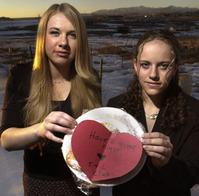
It got a lot of press, but maybe you didn't hear about it. Two teenage girls living in rural Durango, Colorado decided one evening to bake cookies and deliver plates of them to their neighbors, decorated with hearts and friendly messages. They baked chocolate-chip and sugar cookies, and cut out big hearts from pink construction paper, and wrote "Have a Great Night!" on them. Just to be nice. Random act of kindness. Pay it forward. But one of those neighbors, who apparently is living in her own little strange world of terror, where everybody would be expected to attack her at any time, had a fit, thought somebody was going to break in and burglarize her, called the police, and generally got so upset that she checked herself into the hospital, thinking she was getting a heart attack from anxiety. Sounds like she's somebody who really could have used a plate of cookies and a friendly unthreatening message of kindness. But no, she then sued the two girls for her medical expenses and some judge agreed with her and ordered them to pay her $900. For delivering free cookies to her. So, if you ever had planned to do anything unexpectedly nice for Wanita Renea Young in Durango, you've better take her off your list!
Now, this little event in itself might seem terribly unimportant for the world situation. And yet it was mentioned in most of the news outlets I normally look at. And I'm sure lots of people quote it and talk about it and pass it around. And that is what is fabulous. Almost anybody who hears the story will be outraged. It is unjust, unfair and mean what happened there. Sends a message that kindness isn't worth the trouble. But the uproar about it sends the opposite message. There's plenty of people in the world who think that kindness is a great thing, to be encouraged, rewarded, cultivated. The majority of people, really. So imagine for a moment a world where you can't get away with even the smallest injustice. You might get away with it at first, but your public reputation will forever keep a record of what you did. That's a great benefit of easily shared communication. More >
|
|
|
|
26 Jan 2005 @ 14:41, by swanny. Communities
"Community"
01-26-05, 07:39 am (PDT)
In response to message #54
I think the idea of "community" is somewhat timely
and perhaps "relates" to that fellows
"inclusionism"..theory... The problem is that some people
don't want to be in community not that thats particularily
realistic or doable but they want a sort of minimal degree
of community kind of like a self imposed leper or hermit
yet we are all connected at some level though some
refuse to admit it..... and yes again we are connected to to the pigs
and chickens and mad cows and the Universe
It is a growth of personhood that needs to happen though as
one "globalizes" from self and selfishness to "couple", to family
then neighbourhood then territiory and nation and globe
yet we tend to be "selective" and exclusive in such
which I suppose is normal...and basic human nature. but not necessarily like I say realistic..or sustainable...
Sometimes the very diversity of a community is its
essential strength.... some things are degrees true
but at the base level there is a intangible perhaps
connection.... how it plays out is often quite dramatic
and deadly true to..... but in a global sphere and global
understanding there is no difference at that base level
We often can not appreciate the constructive qualities
of the lepers and hermits..and criminally insane or lawyers
hee hee.. maybe we don't try hard enough
or maybe we try to hard...or maybe its to heavy and dangerous an undertaking to empathize with such..
but some realize the union though sparse as it may be at times.
We at times then have to find the beauty in ugly and the ugly
in beauty and realize the greater esstential transcendent
"grace" that exists in the diverse whole with all of it benefits and pitfalls. A hard pill and task to achieve..... but well old age
ain't for chickens....or ???? More >
|
|
|
|
4 Jan 2005 @ 00:59, by newdawn. Communities
What can I do to help?
If you need a statesman/politician to elicit the dollar out of your pocket then keep it there.
This world is made of human beings, not dollar beings.
If you have a heart that is open and can feel with you will have the strength to put into physical manifestation an action that is just and helpful.
While searching on the net I came across this article which demonstrates what an ordinary person can do if they have love and compassion.
Actions speak louder than words.
link:[link] More >
|
|
|
|
25 Dec 2004 @ 14:29, by earthsky. Communities
Seasons Greetings Group,
We're gifting this Christmas morning an article below "Hunger in America" in which describes the attitudes and eating habits of the average American. We believe there is many important changes people can implement, even by those who reside in the cities. First, that which will have the greatest impact on the planet's ecology would be for everyone to convert to a vegetarian diet. Second, all urban lawns can be put into vegetable gardens. Third, people can strike up a relationship of cooperation with one's local farmer and offer one assistance during the growing season in exchange for produce. Every weekend devoted to helping out on these farms will net a family all the produce they will need for the following week. Fourth, each neighborhood can organize processing kitchens for putting up foods for the winter. Local kitchens in community centers for food processing would make it possible for anyone anywhere to continue year around without starvation.
Regarding vegetarianism, we realize that people will not make this change willingly, but one day everyone will. There are billions of acres of prime agricultural lands throughout the world being used for the production of meats and the grasses and grains which these animals consume. Freely these acres up for vegetable production and organizing their use will meet the needs of the world and solve many problems.
We realize these suggestion will be initially rejected by most people as they present many hardship to make these adjustments in their lives, but it is within everyone's abilities to do so if they wanted to no matter where they live. These suggestions are mere adjustments of one's lifestyle. We have done these adjustments successfully before. Anyone remember the Victory Gardens program that was very popular during World War 2? Of course, these were successful because people basically had few other choices if they wanted fresh vegetables. However, it is a testimony of what is possible if given the incentive to do so.
The solutions we look for/hope for are already known. It is just a matter of will to do what needs to be done. The incentives to do what needs to be done is not too far in the distance future. For those who can and will make the adjustments in their lifestyles they will come to realize that it is a good lifestyle with many benefits they could have never known until they practiced it. We speak from experience because we live all of the above and know these benefits, and we know our suggestions are feasible.
Anyway, this a type of "Seasons Greetings" which is meaningful to us.
Best Wishes, Earth & Sky
HUNGER IN AMERICA
By Kurt Saxon
Last week PBS aired a weird program entitled "Hunger In America". It
was weird because not one of the families shown as examples of hungry
Americans were destitute. They all had living quarters, some had jobs
and even land and each had the money or food stamps which should have
provided them with a more than adequate diet.
The commentator was in full sympathy with those hungry people and
lamented the fact that nothing more was done. I watched this bizarre
exhibition of the helplessness of the otherwise able and heard the
pity of the "there but for the grace of God go I crowd". I harked back
to tales of other starvelings.
In 1845 the Irish potato blight raged and hundreds of thousands
starved in the resulting famine. Yet, it was found that on farms where
whole families had starved, the barns held corn, oats, rye and barley
in the cattle feed bins.
In France and Belgium, millions were starving after WW I. America sent
boatload after boatload of corn and the people were insulted at being
sent food for horses and cattle.
Stalin deliberately starved millions of kulaks in the '30's. When his
henchmen moved in to cart off the bodies of the rebellious farmers,
there too, was found plenty of grain in the feed bins. Of course, the
livestock had been eaten but the livestock's food was not considered
fit for humans to eat.
That people would starve to death before eating corn is a misleading
concept. Had the corn been ground and made into cornmeal mush those
people would have survived. But they simply didn't relate to corn as food.
Of course, you've heard of the African Bushmen and the Australian
Aborigines. They can thrive where Europeans wouldn't see any food at
all. But that is an extreme. The point is that people tend to see as
food, only that which they are accustomed to eating.
The people on the program were accustomed only to prepared foods
bought at the supermarket. One couple with four kids got $390.00 a
month in food stamps. The man was an auto mechanic who had quit work
since he couldn't afford his wife's medical expenses and his loafing
would entitle her to Medicare.
They had four children and lamented the fact that the $390.00 in food
stamps were all used up before the next month's dole. Oh, you know
food prices today and how $390.00 for a family of six doesn't go far.
I don't suppose they spent every bit of it on TV dinners and in the
deli section. Nonetheless, to a Survivalist family, $390.00 would buy
about four months' food for six; maybe more.
That reminds me of 1967 when I was a bum in San Francisco. I was
living in a $10.00 a week sleeping room and worked off and on as a fry
cook and a freelance house-painter. For a no-sweat $5.00 a week I was
selling my blood and so contracted infectious hepatitis.
That's a very debilitating illness and its effects last about a month
when not fatal. Anyway, I was barely able to get around and I couldn't
work. I wasn't hospitalized since the illness wasn't communicable
except through dirty needles, as in my case. But the hospital gave me
some pills and arranged for me to get welfare.
To a single person with what I had, short term, the welfare people
paid my rent and gave me a $6.00 food voucher each week. With that
food voucher I bought sugar, yeast, cheap fruit, margarine, pinto
beans, bacon ends, corn meal, raisins, rice, canned milk and odds and
ends. Quite a box of food for only $6.00, even then.
I had a hot-plate I'd bought earlier in a Salvation Army store for a
dollar and odd pots and pans. One of my favorite dishes was rice and
raisins and canned milk. Delicious, nutritious and cheap. Of course,
$6.00 wouldn't go that far now, but I'd do just as well on its
equivalent today.
Notice, I didn't buy any prepared food, nothing in cans or ready to
eat. The sugar, yeast and fruit was for booze I started in several one
gallon wine bottles. Five days later and from then on I had all the
booze I wanted and just as good as store-bought.
Another group interviewed on the program was a farm worker who had
fathered fifteen children. He had a wife and eight children living
with him. His wife was preparing boiled baloney and rice. They were
hungry.
Yet, he was shown plowing around onions and some kind of greens. The
children, strapping, albeit ill-favored, were shown in the yard.
Behind them was a great stand of weeds. Now, why didn't the man use
from the field he was cultivating, as was his right? Why weren't his
children cultivating a garden?
These people didn't want to be hungry. Obviously, he spent his food
budget on food which was cheap enough but too expensive to supply ten
people. But again, why didn't the man have a garden for all those
children to work?
Naturally, the narrator never mentioned the fact that too many
children born to incompetents was a major contributing factor to
hunger; and most other social and economic ills.
The farm worker and his brood were in Alabama but I've seen the same
thing in Appalachian coal country on other programs. Run-down shacks
with whole families of unemployed adults and their many children
loafing on the porch. No gardens! They were hungry too, as the
narrator of that program gloated in an attempt to make the viewers
feel guilty.
Another family in "Hunger In America" was Mexican migrant farm labor.
The father was heavy and the others were sturdy-looking. Of course,
they wouldn't have much choice in food from the fields, since stuffing
oneself with cucumbers for a week would hardly make a balanced diet.
I suppose they also had inadequate living quarters and kitchen
facilities. Maybe they didn't even have a super- market close by. Even
so, they could have bought masa in bulk for making tortillas, and
pinto beans by the 25 pound sack, and with gleanings could have eaten
as well as if they were earning the equivalent in Mexico. But as it
was, they didn't speak English, migrant labor was their lifestyle and
they had chosen, directly or indirectly, to live on a day-to-day
basis. They simply lacked the adaptability to make that lifestyle as
efficient as it could have been.
Another family on the program owned a dairy farm. They weren't doing
very well at it so they were hungry. But with even a small dairy they
had milk, and from it, butter, buttermilk, cheese and yogurt. There
were no chickens in evidence, although several dozen could have lived
off spilled feed and undigested grain in the cow lot. Why weren't they
supplied with chickens and eggs? Where was their garden?
In all these cases there was no reason for hunger. But each family was
too ignorant of food, as such, to prepare nourishing meals from
cheaper, more basic ingredients. Instead, they unrealistically paid
others to process their foods. Consequently, they could afford only
about a third of the food they would have had, had they processed it
themselves.
A while back I read a Reader's Digest article on hunger in America.
Their argument was that there was no reason for hunger here, as I've
pointed out. But their idea was that those who weren't eating as much
as they needed was because they didn't know where to apply for more aid!
What amazed me was that neither the narrator of the program nor the
writer of the article considered educating such people in simple home
economics. Knowing how to cook and knowing what foods give energy
would have enabled them to shop for foods which would have been
cheaper but more filling and more nutritious.
Several years ago this idea was brought home to me while watching a
local San Francisco news story on malnutrition among the aged there.
Featured was an old man on a fixed income who ran out of food about a
week before his next Social Security check was due.
He was shown cooking his supper. His main course was Canadian bacon.
In case you aren't familiar with it, it was in a roll rather than
slices. It cost three times as much as regular bacon. He was buying
gourmet food on his income from Social Security!
That's the problem with the families on the program. They were buying,
in effect, gourmet food on welfare budgets. No wonder they were
underfed and malnourished.
Most of us have seen people paying with food stamps for TV dinners,
steaks and other highly processed foods. They just don't know how to
buy food. All they know about food is what they see on TV. If they
can't afford it; if they spend all they have on what intelligent
wage-earners can't afford, no wonder they're hungry!
But the bleeding hearts would only have us give them more money. For
them to eat like they must if they can't economize like the rest of
us, we might as well give them all food vouchers to take all their
meals at fancy French restaurants. It won't work. As things get worse,
they'll starve.
More rational sympathizers might suggest TV programs (hosted by
rock-n-roll stars, Jim and Tammy Bakker and sports heroes, to keep
their attention) demonstrating the buying and preparation of
inexpensive and nutritious foods. Of course this would have to be on
PBS, which they never watch. Otherwise, the makers of Captain Stupid's
Sugared Breakfast Crunchies would protest, along with all the other
advertisers of the equally debilitating carcinogens and brain-rotting
delectables morons have been sold as staples for years.
The point is, millions of Americans are so ignorant about food that
without the media they wouldn't know what to eat at all. And with the
inevitable rise in food prices and cuts in welfare, those millions are
going to starve.
But that's not the half of it. Next time you go to the supermarket
look at the foolish people with their carts piled to overflowing with
expensively packaged foods hardly fit for human consumption. One
doesn't have to be a health nut to shudder at what most of that does
to the body and brain. Most people who make good livings don't know
any more about staple foods and their preparation than do the welfare
morons.
This is because, in our prosperous culture, food is usually taken for
granted. Urbanites really had no time, and seldom the facilities for
preparing foods from basic staples. Also not too long ago, food's
cheapness, even processed and packaged, make it impractical for the
homemaker to process staples.
But now, with the rising costs of food, energy, packaging, etc., food
has become a major budget outlay. Therefore, it is becoming more
practical to buy in bulk and process one's own food. But since Granny
baked bread weekly, made sausages in the fall, had a kitchen garden
even in the city, and distrusted canned foods, people have suffered a
kind of cultural amnesia concerning food.
So people are hungry in the midst of plenty. And fewer people are left
to pass on the basic techniques to fewer people who care to learn them.
I was fortunate in having nothing but peasant ancestors who were too
poor to hire commercial food processors to prepare their food. In my
misspent youth I never hungered because I knew food and how to prepare it.
This ability really came in handy when I had the accident which
damaged my hand and left me nearly blind for months. In 1970 I was
getting $87.00 per month County Welfare. My little apartment cost
$50.00, leaving me only $37.00 a month for food and incidentals. I
spent less than $5.00 a week on food and ate better and tastier foods
than I had when I could afford anything I wanted.
Many of the processes are shown in my tape, "The Poor Man's James Bond
Strikes Again". The information was given there to illustrate the fact
that the embattled Survivalist can hold out almost forever with the
right kind of food supplies. Without such foods, any survival program
may fail.
Unfortunately, less than half my subscribers have bought Survivor Vol
I. Some take pride in having stocked up on "survival foods", a snare
and a delusion which will doom many. This is because such foods are
simply stored. They don't increase in food value as do grains used for
sprouting. They need no processing except for adding water.
They also cost up to ten times what I recommend and are not nearly so
good tasting or nutritious. The worst thing about them is that the
Survivalist doesn't learn the skills insuring survival on a long-term
basis. Without such knowledge and skills the "Survivalist" will be
useless to his neighbors and so may be driven from the community when
his supplies run out or are looted.
On the other hand, unprocessed foods are the last items a looter would
want or would even recognize as food. Not nearly so portable and
lootable as the neatly packaged and labeled meals like Mountain House
Freeze-Dried Foods, for instance.
Another class of Survivalists are those fixated on weaponry and
personal defense; and maybe offense. That type saddens me as they are
incomplete and also contributes to the negative side of Survivalism.
The media image of the Survivalist is a camouflage-clothed dingbat
living in a hole in the ground and waving guns at everybody. I made up
the term and that's not my definition. But all too many of my readers
seem to try to live up to it.
But the arms-crazy type won't make it. Banditry is self-defeating. Say
you take food by force from one, two, maybe three families. Logic and
the law of averages should show you that you're only working your way
to a real Survivalist who will destroy you.
Bandits are just as dependent as any other losers. You must be
self-sufficient in many areas in order to survive the coming collapse.
And self-sufficiency in food is the most basic and most important
survival skill.
Surprisingly, self-sufficiency in food is the simplest and also the
most profitable survival skill. As shown, it will take care of you now
and save over half your food bill. When it becomes an absolute
necessity, you will be among the most valued members of your community.
So sure, there's hunger in America. There will be more and only those
who have become independent of the food conglomerates will be prepared
for a future which will doom millions
“The purpose of all the major religious traditions is not to construct big temples on the outside, but to create temples of goodness and compassion inside, in our hearts”
Dalai Lama, "The Good Heart"
|
|
|
|
21 Dec 2004 @ 14:25, by lugon. Communities
If we want to make "sustainability efforts" sustainable, then maybe we need to look at people in three situations:
- full-time sustainability warriors (who work on sustainability as a pay job, or who are rich and can work full time for free)
- part-time sustainability champions (who can give, say, an afternoon each week)
- marginal-time sustainability ants (who can give 1% of their time)
Cultural Creatives say there are some 80+50 million CCs in Europe and USA. Most would be "marginal-time sustainability ants", I'd guess.
So the trick is how to provide an infrastructure for us/them to self-organise effectively. That infrastructure has to work locally, and can of course be designed globally. It may need internet elements, but also non-internet elements, and "conceptual" elements (how-tos).
Most of the conversations will be local, so there could be a way to signal that one is an "ant". Maybe a badge with an ant on it? Something even simpler?
If that works, then the infrastructure could be used for ideas and conversation. "Cake of the week" issues could be suggested for "ants" to pursue on their marginal time.
With infrastructure, content and ants, quite a few things might become possible. Add up some champions to take care of the infrastructure, and a few warriors too, and there you have it.
Connected ant colonies? Yes, sure, but each colony actually lives on its territory. It's not all about the internet!
The trick is to go LOCAL. That's what the badges would be for.
So what do ants do? They could:
- collect information and opinions
- privide ideas
- make questions
- do small physical tasks
- give information to others
- many other ant-like tasks
This may have something to do with "parallelizable tasks" in grid computing - I don't know.
Ideas? More >
|
|
|
|
 12 Dec 2004 @ 11:26, by jazzolog. Communities 12 Dec 2004 @ 11:26, by jazzolog. Communities
Each dewdrop and raindrop has a whole heaven in it.
---Henry Wadsworth Longfellow
Life is an unanswered question, but let's still believe in the dignity and importance of the question.
---Tennessee Williams
Every day is a god, each day is a god, and holiness holds forth in time. I worship each god, I praise each day splintered down, splintered down and wrapped in time like a husk, a husk of many colors spreading, at dawn fast over the mountains split.
---Annie Dillard
Gauguin, Paul
Grape Harvest in Arles, 1888
Along with any notions of nonBiblical sex, America is packing away its dreams and memories of a liberal nation. Also into hiding and whispers go any thought of rebellion against stolen elections and a corrupt republic. It's housecleaning time and the jazzoLOG sites have become as messy as those storefront Democratic headquarters in every town, now returned to haunted vacancy. Democrats certainly need practice in organization and calm judgment. More >
|
|
|
|
12 Nov 2004 @ 19:56, by lugon. Communities
A couple of messages in the OSLIST (Open Space Technology, Harrison Owen) make me think that we really have the required "elements for change" in the World.
We have people. Lots of us. Each one almost insignificant. A bit like ants, aren't we?
We have this increasing ability to communicate. Sometimes it's deep interpersonal communication. More often it's just an "I need food", "I have food" sort of thing.
We have the internet, and open source/free software. And a growing "array" (a disorderly one) of cooperation methods and resources.
We have brains that can change from within. Ants can't do that as far as I know, but we can. My grandmother learns new gossip and phone numbers every day, so her brain does change.
Some of us even have a vision. One that we can share, or rather, that begs sharing. Mine has a mixture of fear and curiosity.
We're asking for a huge change, of course, so it's not easy. It will take time, and we don't have lots of time. We have rigid structures and also rigid ideas.
Not long ago, in Ming's blog, there was a bit of talk about "low tech revolution": things that don't need high, yet underdeveloped technology to work. I think Open Space is such a thing. Conversations, good old conversations, may also be such a thing.
What else do we need?
|
|
|
|
6 Nov 2004 @ 08:22, by vaxen. Communities
It is suspected that sections of the US military and security agencies have been using synthetic telepathy against 'internal subversives' for at least a decade. If these networks continue to operate unchecked, soon our thoughts may no longer be our own!
So in contemplating the Admin Why (reason for) of the recent BUSH 'Win' I would suggest that you very seriously contemplate some of the 'seeming outlandish' profiles mentioned herein. A little 'serious' research should be enough to let you know beyond the shadow of a doubt that you are living in perilous times and that your very existence is very much 'at stake.'
Ignorance, you may feel, is bliss but it is NO EXCUSE! Wisdom, Understanding and Knowledge form an Ancient tri-angle that helps to keep the denizens of the 'Absu' (Abyss) at bey.
Enjoy... More >
|
|
|
|
4 Nov 2004 @ 14:15, by redstar. Communities
I am writing this to express my appreciation to all the members and participants
of the New Civilization Network.
To anyone who visits this log, thank you for coming. Sharing experiences, thoughts,
feelings through this medium has become a form of healing, focus and direction to me in this
volatile time and being able to put some of my innersense into writing and having people
who share, identify with, disagree with or even criticise what I have posted is turning out
to be a valuable, educational and sometimes enlightening process.
More >
|
|
<< Newer entries Page: 1 2 3 4 5 6 7 8 Older entries >> |
|
